


Pulmonary Arterial Hypertension Medications: Revatio, Opsumit, and More
Flolan, Veletri, and Tracleer are a few of the many pulmonary arterial hypertension medications. Learn about their differences and which is best for you with this guide.
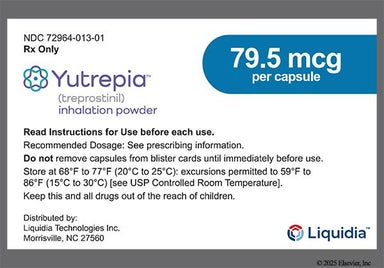
Yutrepia (treprostinil) is a medication that's inhaled to treat pulmonary arterial hypertension in adults. It also treats pulmonary hypertension related to interstitial lung disease. It works as a prostacyclin analog to help improve your ability to exercise. Yutrepia (treprostinil) comes as a dry-powder capsule that's used with a special inhaler. You inhale it through your mouth using the inhaler, usually 3 to 5 times a day. Common side effects are cough, headache, and throat irritation.

Yutrepia (treprostinil) is a prostacyclin analog. This means it acts like a natural hormone in your body called prostacyclin.
The medication helps relax and widen the blood vessels in your lungs. This lowers blood pressure in the lungs and helps blood flow more easily. That can help improve your capacity to exercise.
| Common Brands | Yutrepia |
|---|---|
| Drug Class | Prostacyclin analog |
| Controlled Substance Classification | Not a controlled medication |
| Generic Status | No lower-cost generic available |
| Availability | Prescription only |

The following side effects may get better over time as your body gets used to the medication. Let your healthcare provider know immediately if you continue to experience these symptoms or if they worsen over time.
Note: Side effects were from adults who started Yutrepia (treprostinil) as add-on therapy.
Contact your healthcare provider immediately if you experience any of the following.
Side effects that you should report to your care team as soon as possible:
Side effects that usually do not require medical attention (report these to your care team if they continue or are bothersome):



How to use Yutrepia (treprostinil):

Yutrepia (treprostinil) can cause some serious health issues. This risk may be even higher for certain groups. If this worries you, talk to your doctor or pharmacist about other options.
Yutrepia (treprostinil) relaxes and widens the blood vessels in your lungs, but it can also relax blood vessels in the rest of your body. That can make your blood pressure drop too much. When this happens, you might feel dizzy, weak, lightheaded, or like you might faint. You might be more likely to have these symptoms if you already have low blood pressure.
If you feel dizzy or lightheaded, sit or lie down until you feel better. Tell your prescriber if these symptoms happen often or don't go away. Get medical help right away if you faint or get hurt after a fall.
Yutrepia (treprostinil) can raise your risk of bleeding. It makes it harder for platelets, the blood cells that help stop bleeding, to clump together. Your risk of bleeding is higher if you also take a blood thinner or have a condition that makes you bleed or bruise more easily.
Watch for signs of bleeding, such as nosebleeds, bleeding gums, easy bruising, or bleeding that lasts longer than usual. Tell your prescriber if you notice any of these problems.
Get medical help right away if you have severe bleeding, cough up blood, vomit blood, or notice blood in your stool. These can be signs of serious bleeding that needs medical attention.
Some medications can change how much Yutrepia (treprostinil) stays in your body. Certain medications, like gemfibrozil (Lopid), can raise Yutrepia levels and increase side effects. Other medications, such as rifampin, can lower Yutrepia levels and make it work less well.
Tell your prescriber and pharmacist about all the medications, vitamins, and supplements you take. Also tell them before you start, stop, or change any medications. Your prescriber might need to adjust your medications to keep you safe. They might also ask you to watch for more side effects or worsening PAH symptoms.
Yutrepia (treprostinil) can suddenly tighten your airways after you inhale it. This is called bronchospasm. It can make you wheeze, cough more, feel chest tightness, or feel short of breath. Get medical help right away if your breathing gets worse or if you have severe trouble breathing.
Tell your prescriber if you have asthma, chronic obstructive pulmonary disease (COPD), or other condition that makes your airways sensitive. They'll help make sure these conditions are well controlled before you start Yutrepia (treprostinil) and while you're taking it.

Yutrepia (treprostinil) is inhaled through your mouth using its provided inhaler. Depending on your prescribed dose, you might use 1 or more capsules for each treatment. Each capsule inhaled as 2 breaths.
Your prescriber will slowly raise your dose each week until you reach the dose that's right for you. If you have liver problems, your dose might be raised more slowly.
Many people take a maintenance dose of 79.5 mcg to 106 mcg inhaled 4 times a day. But your dose might be different depending on how well you tolerate Yutrepia (treprostinil).


Prescription savings
Stop paying too much for your prescriptions. Compare prices, get pharmacy coupons, and save up to 80%.Resources
About GoodRx
 Find expert answers to your health questions so you can make the best decisions for yourself and your family.
Health conditions
Medications & treatment
Access & affordability
Well-being
Medication discounts

Yutrepia was FDA approved in May 2025.
Yes, diarrhea is a possible side effect of Yutrepia. If this happens, be sure to drink plenty of fluids to help prevent dehydration. If your diarrhea is severe, hard to manage, or doesn't go away, tell your prescriber. They might decide to raise your dose more slowly.
Yutrepia and Tyvaso both contain treprostinil. They're both used to treat pulmonary arterial hypertension and pulmonary hypertension related to interstitial lung disease. They're both inhaled through the mouth several times a day, but the main difference is how you use them. Yutrepia comes as a dry-powder capsule that's used with a special inhaler. Tyvaso is an inhalation solution that's used with a nebulizer. There's also Tyvaso DPI, which is another dry-powder version that has its own inhaler. Talk to your prescriber to compare and find out which option is right for you.
Yes. You can switch from Tyvaso to Yutrepia, but only with your prescriber's guidance. Both medications contain treprostinil, but they use different devices and have different doses. That's why your prescriber will choose the right Yutrepia dose based on your current Tyvaso dose. Don't switch on your own. Ask your prescriber if switching to Yutrepia is right for you.
