Key takeaways:
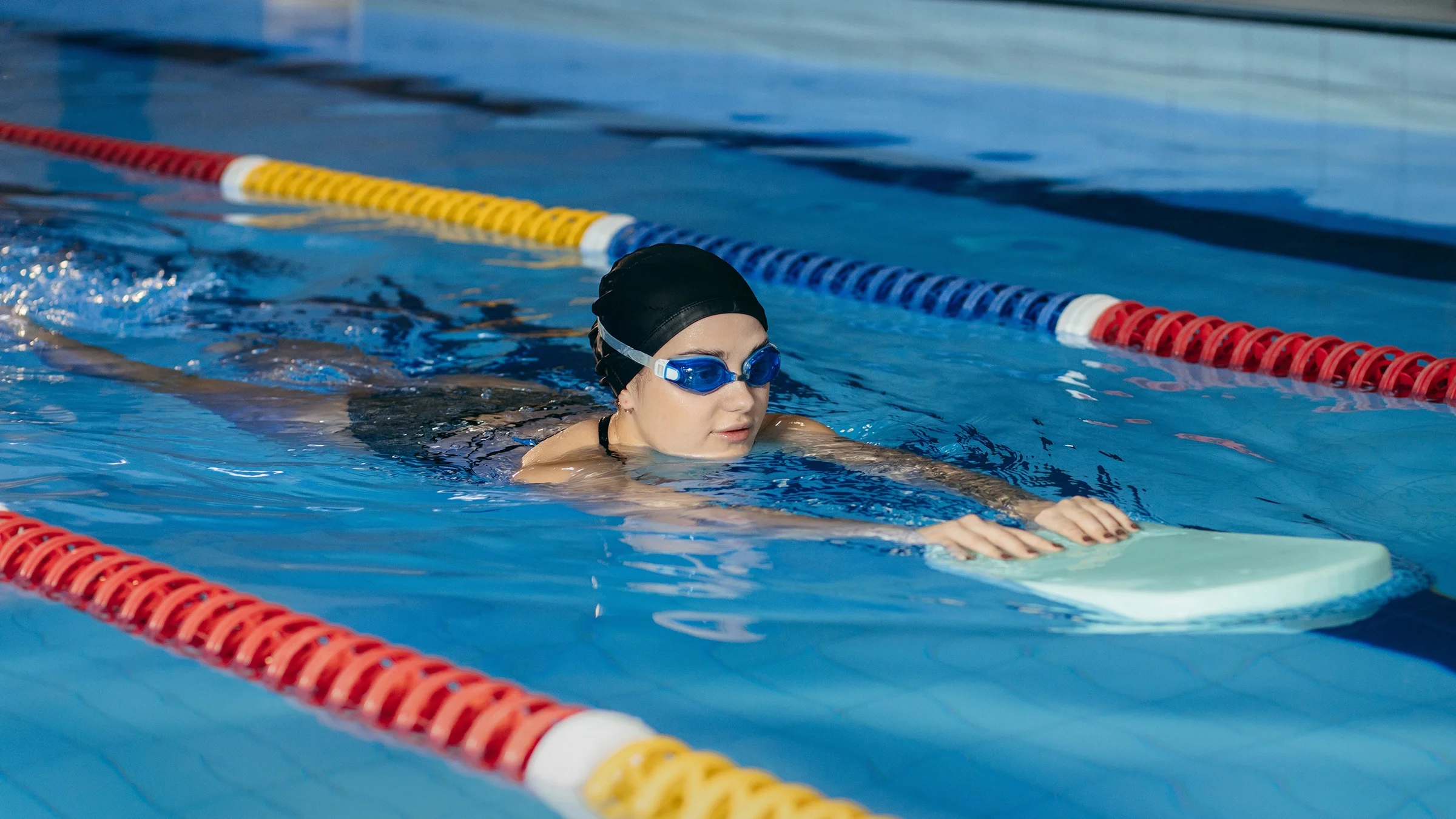
Swimming is a low-impact cardio exercise that works core, upper, and lower body muscles.
A beginner swim workout may include technical drills followed by cardio sets with freestyle strokes.
A complete swim set should include a warmup, drills, a main set, and a cooldown.
Swimming is an excellent low-impact cardio workout with many benefits, from supporting mental health to strengthening the lungs. Swimming works the core, upper body, and lower body muscles, so it’s a great full-body exercise on its own. And since it’s low impact and easy on the joints, it’s also great for people with musculoskeletal conditions like arthritis and fibromyalgia.
And if you’re used to land-based exercise, swimming can be a fun way to mix it up and keep your workouts interesting. Whether you’re planning an aquatic adventure or want to start swimming for exercise, these tips for beginner swim workouts will steer you in the right direction.
1. Basic interval swimming workout
A simple interval workout is great for swimmers who want to get their heart rate up and focus on sprint work, said Emily Thomas, USA Swimming coach and director of SwimCincinnati. The times may differ from person to person. Use the pace clock to find your split, and build sets that include 15 to 20 seconds of rest, Thomas suggested.
Warmup: 100 yards easy swimming with your choice of stroke
Drills: 4x50 flutter kick 1:30-2:00
Main set:
4x25 free 0:45-1:00
4x50 free 1:30-2:00
4x75 free 2:30
4x100 free 3:00
Cooldown: 200 yards of cooldown laps
Search and compare options
Good to know: If you need a primer on the formatting of these numbers and basic definitions of key swimming terms, jump down to our overview of swim workout basics.
2. Interval swimming with equipment
New swimmers may want to use flotation devices like kickboards or pull buoys to isolate upper or lower body movements with this workout. A pull buoy fits between your legs, adding buoyancy to your hips so you can better work on your stroke. To focus on your leg technique, you can hold a kickboard in front of you.
Warmup: 200 yards easy swimming with your choice of stroke
Main set:
4x25 with kickboard 0:45-1:00
4x25 with pull buoy 0:45-1:00
4x50 with kickboard 1:30-2:00
4x50 with pull buoy 1:30-2:00
4x50 free 3:30
Cooldown: 100 yards of cooldown laps
3. Interval swimming with drills
A drill-focused workout will give you plenty of options to work on technique. And sets of fast intervals add in some great cardio.
This workout includes zipper drills. A zipper drill is all about the recovery stroke when your arm exits the water. As you reach your recovering hand forward, you slide your thumb across your torso up to your armpit. Imagine that there’s a zipper on the side of your body, and you have to zip it up.
Warmup: 100 yards easy swimming with your choice of stroke
Main set:
4x25 zipper drill
4x25 fast flutter kick with kickboard
4x50 fast swimming 1:30
4x25 zipper drill
4x50 fast swimming 1:30
4x25 flutter kick
4x50 fast swimming 1:30
Cooldown: 100 yards of cooldown laps
4. Distance swimming
This workout focuses on distance instead of time. It offers steady-state exercise that’s great for endurance and heart health. And it can help you feel more comfortable in the water. “It gets you in that groove of feeling your stroke,” Thomas said.
Warmup: 200 yards easy swimming with your choice of stroke
Main set: 5x100 freestyle at a comfortable pace, with 30-second rests between sets
Cooldown: 200 yards of cooldown laps
What does a good swim workout set consist of?
Structured swim workouts are made up of sets, which outline the type of exercise you should work on and for what distance. Beginner swim workouts are written in sets, too, so it’s important to get familiar with this formatting. Once you understand sets, you can use them to create workouts that will target your specific fitness goals.

Read more like this
Explore these related articles, suggested for readers like you.
Swim sets will include:
Stroke category or exercise: This could be one of the four competitive strokes or a drill, like flutter kicks.
Interval distance: This is the distance you’re meant to swim before resting. Since the length of a pool is 25 meters, intervals are always multiples of 25. The most common intervals are 25, 50, 100, 200, and 500.
The number of repetitions: This is how many intervals you should do for each exercise.
Interval time: This is the time it should take you to complete each set of intervals, including both swimming and rest time.
An example of a beginner swim set is “4x25 free 1:00.” This set includes four intervals of 25 done in freestyle. You have 1 minute to complete each interval and rest. In total, this set should take 4 minutes.
Using swim pace clocks
You can use a swim pace clock to track your swim time, rest time, and progress. Analog pace clocks look like a typical clock, but they measure seconds instead of hours, with 60 at the top and 30 at the bottom. Some pools have digital pace clocks.
Pace clocks make it easy to see your split, which is how much time an interval takes you before rest. Knowing your workout splits will help you plan swim sets that work well with your current fitness level.
Swim workout tips for beginners
Swim sets for beginners should focus on building a technical foundation with drills, according to Thomas. Learning the competitive strokes comes later. In the beginning, new swimmers can push themselves with a few challenging freestyle laps.
The best swim sets for beginners should include:
A warmup: “I always liked doing 200 yards of super easy swimming,” Thomas said of her preferred warmup. Get your body moving with some gentle laps in any style. Warming up helps prepare your muscles and heart for the cardio that’s to come.
Drills: New swimmers can use drills to strengthen their swim technique. Thomas recommends including sets focused on flutter kicking (kicking with the arms held forward) and rotary breathing (rotating your head and body to the side to breathe).
The main set: For the main set, new swimmers might try intervals of 100 at the fastest comfortable pace. “You want your heart rate to go up,” Thomas said.
A cooldown: Wrap up your swim with a few cooldown laps. And consider some cooldown stretches after your workout.
What are the best exercises to improve your swimming stroke?
As you get more comfortable in the water, you might want to improve your freestyle swimming technique. There are lots of exercises that can help you with that, both on land and in the water.
Planks and push-ups
Exercises like planks and push-ups are great for supporting strong body alignment. You want to work toward a streamlined body position, meaning your legs are together and everything is in a straight line. The zipper drill is great for this, too, since the focus is on keeping the arms and elbows tucked in.
Side planks
The side plank is also a great on-land exercise to get you used to the body roll motion in swimming. A key to doing a proper swim stroke is strong breathing technique, which involves turning to the side rather than lifting your head up. With each stroke and breath, your body should tilt from side to side while remaining parallel with the surface of the water. Avoid the temptation to look forward, as this will cause your hips and legs to drop down.
Pool safety tips
For new swimmers, getting comfortable and staying safe in the water can take some time. But if you know what to expect and what to work on, the transition from on-land exercise to swimming is a little easier. Here are a few helpful safety tips and best practices:
Avoid plugging your nose: Getting water up your nose is uncomfortable. But Thomas recommends that new swimmers get used to exhaling though their nose underwater. You can practice before your sets in the shallow end. “Start from the surface and move your way down,” she said. If you’re still uncomfortable, you can use a nose plug during your laps.
Pick the right lane: Many pools have slow and fast lanes, so choose the lane that fits your pace. When pools are busy, swimmers might share lanes. But be sure to ask a swimmer before you share a lane with them. Then, keep to the right side of the lane, swimming in a counter-clockwise circle, letting faster swimmers pass you on the left.
Avoid collisions: Crowded pools make collisions more likely. Take extra caution if you’re swimming near others. When sharing a lane, be mindful to stay on your side and never enter a lane directly in front of another swimmer. If you need a rest, don’t stop in the middle of the lane. Instead, move to the corner or exit the pool.
Swim equipment
All you really need to start swimming is a bathing suit. But you may want to grab a few other items to make your beginner swim workout more comfortable, such as:
Nose plug
Earplugs to protect from swimmer’s ear
Goggles
Swim cap
Kickboard
Pull buoy
Swim paddles
Frequently asked questions
How many times a week should a beginner swim?
There’s no set rule on how many times a week you should swim. How much you swim depends on your health and fitness goals as well as what other exercises you’re doing. Adults should aim to get 150 minutes of moderate-intensity cardio every week. Swimming at a comfortable pace can check that box.
If you’re totally new to swimming, consider taking swim lessons, which may meet once to a few times a week. Many organizations, such as the American Red Cross and YMCA, offer swim lessons for adults.
Is 30 minutes of swimming per day enough?
Swimming for 30 minutes per day can be a great way to get your heart rate up and increase your strength and endurance. What’s considered “enough” will depend on your health and fitness goals as well as the intensity of your workout. Even a little bit of physical activity can go a long way.
Can you get in shape by swimming alone?
Yes, swimming by itself can help you get into shape. Swimming is a full-body workout, and there’s a wide range of workouts and drills that can hit different muscle groups and get your heart rate up. Swimming can also support weight loss. But keep in mind that swimming is a low-impact activity. High-impact activities can help promote strong bones.
The bottom line
Swimming provides a low-impact, full-body workout with lots of health benefits. Swim workouts are made up of sets, which lay out the number of laps, the type of drill or stroke, and the time it should take to complete. You can find swim sets online or create your own based on your fitness goals. Just make sure you follow pool etiquette and check with a healthcare professional before diving in if you have any underlying conditions.

Why trust our experts?



References
American Red Cross. (n.d.). Swimming safety.
Goodman, E. (2024). Swimming 101: The four strokes. NBC Universal.
McCall, P. (2015). HIIT vs. steady state cardio: Which one is best for your clients? American Council on Exercise.
MySwimPro. (2021). Beginner swim drill: Zipper drill [video]. YouTube.