


2018 in Review: The Good(Rx) and the Bad in Prescription Drug Prices
2018 has been the year of drug prices. From the new ban on pharmacist gag clauses, to new proposed rules surrounding drug commercials, drug prices have
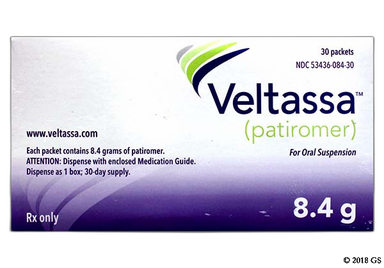
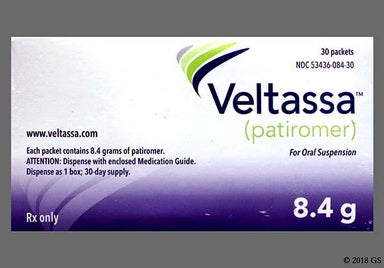
Veltassa (patiromer) is a medication that's used to treat high potassium levels in adults. But it isn't used for life-threatening situations when potassium levels are extremely high because it works slowly. Veltassa (patiromer) comes as a packet of powder that you mix with water and then drink; generally, you only need to take one dose per day. Common side effects include bowel changes, like constipation or diarrhea. Veltassa (patiromer) is only available as a brand-name medication; there's no lower-cost generic option currently.

Veltassa (patiromer) is a potassium binder. It works by binding (attaching) to potassium in your stomach and intestines (gut) so that your body can't absorb it. It's then passed through your stool. This lowers the levels of potassium in your blood.
| Common Brands | Veltassa |
|---|---|
| Drug Class | Potassium binder |
| Controlled Substance Classification | Not a controlled medication |
| Generic Status | No lower-cost generic available |
| Availability | Prescription only |

The following side effects may get better over time as your body gets used to the medication. Let your healthcare provider know immediately if you continue to experience these symptoms or if they worsen over time.
Side effects that you should report to your care team as soon as possible:
Side effects that usually do not require medical attention (report to your care team if they continue or are bothersome):



How to prepare and take your Veltassa (patiromer) dose:

Veltassa (patiromer) can cause some serious health issues. This risk may be even higher for certain groups. If this worries you, talk to your doctor or pharmacist about other options.
Don't use Veltassa (patiromer) if you have stomach problems, like bowel obstruction (blockage in your gut) or severe constipation, without talking to your provider first. It's not known whether Veltassa (patiromer) works well for people with these conditions. It's also possible for Veltassa (patiromer) to worsen these conditions.
Taking Veltassa (patiromer) puts you at risk for low potassium levels (hypokalemia) and low magnesium levels (hypomagnesemia). Don't start any new medications while taking Veltassa (patiromer) without talking to your provider first. Some medications can further lower your potassium levels (e.g., loop diuretics), and other medications can lower magnesium levels even more (e.g., reflux medications like omeprazole (Prilosec), thiazide diuretics).
If you have any of the risk factors listed above before and during treatment with Veltassa (patiromer), contact your provider. You might need to have your Veltassa (patiromer) dose lowered or get your blood drawn to check your potassium or magnesium levels. If your magnesium levels are too low, your provider might recommend you to start taking magnesium supplements to get your levels back closer to normal.
Symptoms of hypokalemia or hypomagnesemia include muscle weakness, muscle spasms, tiredness, or tingling or numbness of your body. If you experience any of these symptoms, contact your provider.

 Carton
| Dosage | Quantity | Price as low as | Price per unit |
|---|---|---|---|
| 30 packets of 8.4g | 1 carton | $996.26 | $996.26 |
| 30 packets of 16.8g | 3 cartons | $2,969.82 | $989.94 |
| 30 packets of 25.2g | 1 carton | $989.98 | $989.98 |
| 4 packets of 8.4g | 1 carton | $183.90 | $183.90 |
| 60 packets of 1g | 1 carton | $517.50 | $517.50 |
The typical starting dose is 8.4 grams by mouth once per day. Your provider will change your dose based on how your potassium levels change with treatment and whether you're having side effects. The maximum dose is 25.2 grams in a 24-hour period.


Prescription savings
Stop paying too much for your prescriptions. Compare prices, get pharmacy coupons, and save up to 80%. Find expert answers to your health questions so you can make the best decisions for yourself and your family.
Health conditions
Medications & treatment
Access & affordability
 Our monthly healthcare membership can help you save thousands on your prescription costs.
Resources

If you have high potassium levels, such as due to certain medical conditions (like kidney problems) or certain medications, it's important to take Veltassa if it's prescribed to you. This medication helps get your potassium levels down to a safer range. Although many people don't get symptoms when there's too much potassium in the body, it can potentially be life-threatening. Some symptoms include weakness, nausea, muscle cramps or pain, and chest pain. But more seriously, it can also cause your heart to beat irregularly, which can be dangerous.
Yes, it's possible for Veltassa to cause diarrhea. In clinical studies, about 5% of people who took Veltassa reported having diarrhea. If you experience bothersome diarrhea while you're taking this medication, contact your provider. They can recommend ways to help manage this side effect, such as adding soluble fiber to your diet to help add bulk to your stool or over-the-counter medications. But if you have diarrhea that doesn't go away or have concerning symptoms along with diarrhea, talk with your provider right away so they can check to see what's going on.
During the course of a year-long clinical study, up to 95% of people with chronic kidney disease and Type 2 diabetes who took Veltassa were able to keep their potassium levels within normal range (between 3.5 mEq/L and 5 mEq/L). About 6% of participants' potassium levels dropped too low (below 3.5 mEq/L). For this reason, be sure to keep up with lab appointments so your provider can make sure your potassium doesn't drop too low while taking this medication.
Yes, you need to store the Veltassa powder packets in the refrigerator. If you happen to leave the packets at room temperature, that's okay too — you just need to use them within 3 months. No matter how you store it, don't use Veltassa after the expiration date that's printed on the packet.
It can take several hours for Veltassa to start to work, but its effects linger. A small study showed that it took at least about 7 hours after a Veltassa dose for people's potassium levels to get to a desirable level. This potassium-lowering effect, however, might last for up to 2 days (48 hours). Keep in mind that everyone might respond to the medication differently.
The manufacturer recommends mixing Veltassa with water, apple juice, or cranberry juice only. The Veltassa powder will make the mixture look cloudy; this is okay. But if the mixture is too thick, you can add more liquid to make it more drinkable. Don't mix Veltassa with a blender. Also, never add the powder to hot foods or liquids, or heat up the mixture (e.g., microwaved).
No. While Lokelma (sodium zirconium cyclosilicate) and Veltassa are both potassium binders that work well to treat high levels of potassium in adults, they aren't the same medication. Veltassa is always taken once per day. But for people who aren't on dialysis, Lokelma is taken three times per day for the first 2 days of treatment, then generally either once every day or every other day. In addition, the Veltassa powder can also be mixed with apple or cranberry juice or soft foods, while the Lokelma powder can only be mixed with water. Lastly, Veltassa might be a better option for people with heart failure or kidney problems, since it doesn't contain a high amount of sodium and raise the risk of fluid overload like Lokelma does. Discuss the best option with your provider.
Veltassa can be used in people who are pregnant or breastfeeding. It's not absorbed into your body, so it's not expected to cause any harm to your unborn baby or breastfed infant. Speak to your provider if you have any concerns.
