Uplizna
Uplizna (inebilizumab or inebilizumab-cdon) is FDA-approved to treat certain adults with a nerve condition that affects the eye and spinal cord called neuromyelitis optica spectrum disorder (NMOSD). This medication is a CD19-directed monoclonal antibody that's given as an infusion through the vein by a healthcare provider. It's given only twice a year after the first couple doses, but has side effects like joint pain, headache, and infusion reactions.


What is Uplizna (inebilizumab)?
What is Uplizna (inebilizumab) used for?
How Uplizna (inebilizumab) works
Uplizna (inebilizumab) is an anti-CD19 monoclonal antibody. It's unclear how the medication works, but it's thought to attach to CD19 proteins that are found on your B cells (a type of immune cell that plays a role in inflammation).
Once attached, the medication destroys these B cells and lowers the amount of B cells in the body. This might help treat NMOSD, a condition that happens when the immune system attacks the nerves of the eye and spinal cord and causes swelling.
Drug facts
| Common Brands | Uplizna |
|---|---|
| Drug Class | Anti-CD19 monoclonal antibody |
| Controlled Substance Classification | Not a controlled medication |
| Generic Status | No lower-cost generic available |
| Availability | Prescription only |

Side effects of Uplizna (inebilizumab)
The following side effects may get better over time as your body gets used to the medication. Let your healthcare provider know immediately if you continue to experience these symptoms or if they worsen over time.
Common Side Effects
- Urinary tract infection (UTI; 20%)
- Common cold-like symptoms (13%)
- Infusion reaction (e.g., fever, muscle pain, nausea; 12%)
- Joint pain (11%)
- Headache (10%)
Less Common Side Effects
- Back pain
Uplizna (inebilizumab) serious side effects
Contact your healthcare provider immediately if you experience any of the following.
- Serious infection: fever, chills, muscle aches, constant cough, sore throat, skin redness or swelling, diarrhea, burning feeling during urination
- Brain infection: weakness on one side of the body, loss of coordination in your arms or legs, vision changes, changes in thinking or memory, confusion, changes in personality
- Serious infusion reaction: headache, nausea, sleepiness, trouble breathing, fever, muscle aches, rash
The following Uplizna (inebilizumab) side effects have also been reported
Side effects that you should report to your care team as soon as possible:
- Allergic reactions—skin rash, itching, hives, swelling of the face, lips, tongue, or throat
- Dizziness, loss of balance or coordination, confusion or trouble speaking
- Infection—fever, chills, cough, sore throat, wounds that don't heal, pain or trouble when passing urine, general feeling of discomfort or being unwell
- Infusion reactions—chest pain, shortness of breath or trouble breathing, feeling faint or lightheaded
Side effects that usually do not require medical attention (report these to your care team if they continue or are bothersome):
- Cough
- Headache
- Joint pain
- Runny or stuffy nose
- Sore throat

Pros and cons of Uplizna (inebilizumab)
Pros
- Only given twice a year after the first two doses
- Can help lower the number of NMOSD relapses and hospitalizations per year
- Medications given before each infusion to lower the risk and seriousness of infusion reactions
Cons
- Given as an infusion through the vein, so not ideal for people who don't like needles
- Can raise the risk of infections
- Not recommended to get live vaccines during treatment

Pharmacist tips for Uplizna (inebilizumab)

- Before every Uplizna (inebilizumab) infusion, let your provider know if you feel sick or have symptoms such as fever, sore throat, cough, or body aches. You should wait until you've recovered before you get your infusion, so you might need to reschedule your appointment.
- Before you get any vaccines, make sure to let your provider or pharmacist know that you're getting Uplizna (inebilizumab) infusions. Certain vaccines aren't recommended for you during treatment because this medication can affect the way your body responds to some vaccines. Your provider and pharmacist can check that you can get the vaccine you're looking for.
- Remember to take the appropriate medications that your provider prescribed before your infusion to lower your risk of infusion reactions.
- Each appointment for your Uplizna (inebilizumab) infusion can last a few hours. The infusion itself takes about 1.5 hours, and then you'll stay at the clinic or infusion center for at least another hour so your providers can watch for any infusion reactions. Be sure to bring something to do to pass the time, some snacks, and water.
- If you're able to become pregnant, make sure to use birth control during Uplizna (inebilizumab) treatment and for at least 6 months after your last dose of Uplizna (inebilizumab). This medication might cause harm to your baby.
- Tell your provider right away if you become pregnant during treatment with Uplizna (inebilizumab). There's a chance that this medication can affect your baby's health. Your provider will need to check your baby's immune health after they're born. Your baby might not be able to get certain vaccines until their immune system is strong enough.

Risks and warnings for Uplizna (inebilizumab)
Uplizna (inebilizumab) can cause some serious health issues. This risk may be even higher for certain groups. If this worries you, talk to your doctor or pharmacist about other options.
Infusion reactions
Uplizna (inebilizumab) can cause infusion reactions, such as headache, nausea, sleepiness, trouble breathing, fever, muscle pain, and rash. These reactions can happen during any of your Uplizna (inebilizumab) infusions, but are more common with the first infusion.
Your provider will prescribe medications, such as corticosteroids, antihistamines, and fever-reducers, for you to take before your infusion to lower the risk or seriousness of these infusion reactions. Your care team will also watch for reactions during the infusion and for at least an hour after the infusion. Let your nurse know if you have any reactions during your infusion. Your provider can temporarily stop the infusion, slow it down, or give you appropriate treatment.
Risk of infection
Uplizna (inebilizumab) can lower your immune system and put you at risk for infections. The most common types of infections reported in clinical studies include urinary tract infections (UTIs), the common cold, and flu. In addition, this medication can potentially make hepatitis B infection or tuberculosis (TB) worse or come back. Although rare, Uplizna (inebilizumab) might also raise the risk of a serious brain infection called progressive multifocal leukoencephalopathy (PML).
Before you start Uplizna (inebilizumab), tell your provider about your medical history. Your provider will examine you for hepatitis B because you might not be able to take this medication if you're currently infected. Your provider will also check for TB to see whether you need additional antibiotics to prevent it from getting worse or coming back. Tell your provider if you currently have an infection because it should be treated before you get your infusions.
Let your provider know right away if you have signs and symptoms of an infection, such as fever, chills, muscle aches, constant cough, sore throat, skin redness or swelling, diarrhea, or burning feeling during urination. Also tell your provider right away if you have any signs of PML, including weakness on one side of the body, loss of coordination in your arms or legs, vision changes, changes in thinking or memory, confusion, or changes in personality.
Lower antibody levels
Long-term treatment with Uplizna (inebilizumab) can lower the amount of antibodies called immunoglobulins in your body. These antibodies are made by your white blood cells to help your body fight off infections. Your provider will check your immunoglobulin levels during treatment. Your provider might stop your Uplizna (inebilizumab) treatment if your levels get too low.
Potential harm to unborn baby
Uplizna (inebilizumab) might cause harm to your unborn baby if you take it during pregnancy. If you can become pregnant, you should use birth control during Uplizna (inebilizumab) treatment and for at least 6 months after your last dose.

Uplizna (inebilizumab) dosage
Typical dosage for Uplizna (inebilizumab)
The typical dose is 300 mg given as an infusion into the vein (intravenously or IV). The first two doses are given 2 weeks apart. After that, you'll get the 300 mg IV infusion every 6 months.

Uplizna (inebilizumab) contraindications
Contraindications are specific health conditions or situations in which a person should not take a medication due to safety concerns. If you have any of the following conditions or if any of the following apply to you, let your healthcare provider know because Uplizna (inebilizumab) will not be safe for you to take.
- Had a life-threatening infusion reaction to Uplizna (inebilizumab)
- Current hepatitis B infection
- Current or untreated latent (inactive) tuberculosis (TB)

What are alternatives to Uplizna (inebilizumab)?

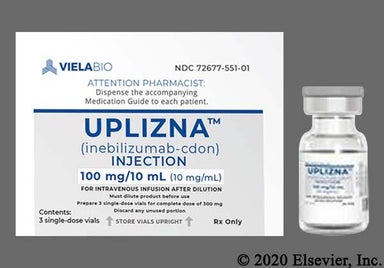
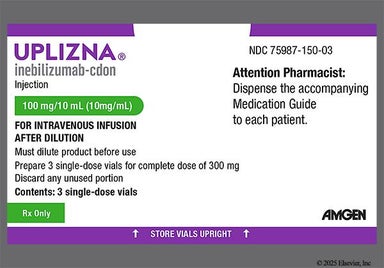
Uplizna (inebilizumab) images