


Medications to Treat Endometriosis: What Are the Current Options?
While there's no cure for endometriosis, NSAIDs and laparoscopic surgery are options for pain relief and fertility. Explore current treatments for endometriosis, with GoodRx.
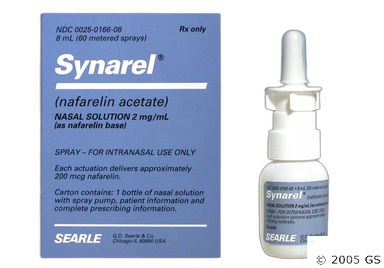
Synarel (nafarelin) is used to treat endometriosis and relieve related pain, including back pain, pelvic pain, and pain during sex. It's also used to stop early puberty in young children. It's easy to use since the medication comes as a nasal spray. Synarel (nafarelin) can cause bothersome side effects, like mood swings and acne.

Synarel (nafarelin) is a gonadotropin-releasing hormone (GnRH) agonist, meaning that it acts like GnRH, a hormone that controls the release of sex hormones into your body.
For people with endometriosis, estrogen plays a role in endometrial tissue growth. By acting like GnRH, Synarel (nafarelin) prevents the release of estrogen, helping to shrink endometrial tissue and reduce pain.
For young children with early puberty, sex hormones trigger puberty. By acting like GnRH, Synarel (nafarelin) stops the releasing of these hormones, slowing down puberty progression, growth in height, bone maturation, and genital development.
| Common Brands | Synarel |
|---|---|
| Drug Class | Gonadotropin-releasing hormone (GnRH) agonist |
| Controlled Substance Classification | Not a controlled medication |
| Generic Status | No lower-cost generic available |
| Availability | Prescription only |

The following side effects may get better over time as your body gets used to the medication. Let your healthcare provider know immediately if you continue to experience these symptoms or if they worsen over time.
Endometriosis:
Early puberty:
Endometriosis:
Early puberty:
Along with its needed effects, a medicine may cause some unwanted effects. Although not all of these side effects may occur, if they do occur they may need medical attention.
Check with your doctor immediately if any of the following side effects occur:
More common
For adults (female)
Breast enlargement
light vaginal bleeding between regular menstrual periods, called spotting
longer or heavier menstrual periods
vaginal bleeding between regular menstrual periods, called breakthrough bleeding
For children (male)
Body odor
growth of pubic hair
Less common or rare
Incidence not known
For adults (female)
difficulty with speaking
dizziness or lightheadedness
double vision
fainting
fast heartbeat
inability to move the arms, legs, or facial muscles
inability to speak
pain or discomfort in the arms, jaw, back, or neck
pain, redness, or swelling in the arm or leg
slow speech
sweating
troubled breathing
vomiting
yellow eyes or skin
Incidence not known
Anxiety or mental depression
changes in vision
cold, clammy, or pale skin
confusion
convulsions
headache
irregular heartbeats
nightmares or unusually vivid dreams
slow heart rate
vomiting
weakness
Some side effects may occur that usually do not need medical attention. These side effects may go away during treatment as your body adjusts to the medicine. Also, your health care professional may be able to tell you about ways to prevent or reduce some of these side effects. Check with your health care professional if any of the following side effects continue or are bothersome or if you have any questions about them:
More common
For adults (female)
dandruff
increase or decrease in sexual desire
increased hair growth, often abnormally distributed
mood swings
oily skin
pain during sexual intercourse
rapid weight gain
reduced breast size
stopping of menstrual periods
swelling of the feet or lower legs
vaginal dryness
Less common or rare
For adults (female)
Breast pain
headache (mild and transient)
irritated or runny nose
mental depression (mild and transient)
For children (male)
Irritated or runny nose
Other side effects not listed may also occur in some patients. If you notice any other effects, check with your healthcare professional.
Call your doctor for medical advice about side effects. You may report side effects to the FDA at 1-800-FDA-1088.



How to use Synarel (nafarelin):
More tips for using Synarel (nafarelin) for endometriosis:
More tips for using Synarel (nafarelin) for early puberty:

Synarel (nafarelin) can cause some serious health issues. This risk may be even higher for certain groups. If this worries you, talk to your doctor or pharmacist about other options.
Accidental or unplanned pregnancies can happen if you have unprotected sex while you're taking Synarel (nafarelin), even though the medication typically blocks ovulation from happening. Your body might accidentally release an egg (ovulate) during treatment, especially if you miss doses of Synarel (nafarelin) one right after another. And because you might not get your menstrual period every month, you might not know if you do get pregnant.
Because the medication can cause birth defects if used during pregnancy, it's important to use birth control while you're taking Synarel (nafarelin). Use non-hormonal birth control, such as diaphragms, condoms, or Paragard (copper IUD), to prevent unplanned pregnancy. Hormonal birth control methods (e.g., pill, patch, vaginal ring) might not work well, since Synarel (nafarelin) affects your hormone levels. Let your prescriber know right away if you think there's a possibility you might be pregnant while you're taking this medication.
Some people have developed ovarian cysts during the first 2 months of using Synarel (nafarelin). Your risk of getting ovarian cysts is higher if you also have polycystic ovarian syndrome (PCOS). Symptoms of an ovarian cyst can include pelvic pain, pain during sex, and bloating. The cysts generally go away on their own after about 4 to 6 weeks. But tell your healthcare provider if these symptoms become bothersome or if they don't go away. Get medical help right away if you feel any severe cramps or pelvic pain.
Synarel (nafarelin) lowers your estrogen levels. This can cause a very small amount of bone loss during treatment. Let your prescriber know about your medical history and the medications you take so they can check your risk for bone loss. In addition, the risk of bone loss isn't known beyond 6 months of regular use. It's recommended that Synarel (nafarelin) should only be used for at most 6 months during your entire lifetime to be safe and to lower your risk of bone loss.
It's possible that GnRH agonists like Synarel (nafarelin) can cause new or worsening depression. Tell your healthcare provider if you have a history of depression so they know to follow up with you about your mental health. Let your prescriber know if you or a loved one notices any signs or symptoms of depression, such as feeling sad or hopeless, having trouble concentrating, or having trouble sleeping.
Some children have had seizures while taking GnRH agonists like Synarel (nafarelin). People who've had seizures in the past or people who are taking medications that can cause seizures, such as bupropion (Wellbutrin) and sertraline (Zoloft), are at a higher risk for seizures with this medication. Let your child's pediatrician know if they've had a seizure in the past before they start Synarel (nafarelin).
GnRH agonists like Synarel (nafarelin) can cause mood changes in children. These behaviors can include crying, irritability, impatience, anger, and aggression. Children taking GnRH agonists for early puberty can also develop depression, rarely with suicidal thoughts and behavior. Children with a history of mental health conditions or other conditions that raise the risk of depression are more likely to experience depression while taking Synarel (nafarelin). Let your child's pediatrician know if you notice new or worsening changes in mood in your child.
Children who have taken GnRH agonists like Synarel (nafarelin) have experienced high blood pressure in the skull, or pseudotumor cerebri (idiopathic intracranial hypertension). Contact your child's pediatrician if they start to have headache, vision changes, eye pain, ringing in the ears, dizziness, and nausea.

 Nasal spray
| Dosage | Quantity | Price as low as | Price per unit |
|---|---|---|---|
| 8ml of 2mg/ml | 1 nasal spray | $3,085.26 | $3,085.26 |

Although certain medicines should not be used together at all, in other cases two different medicines may be used together even if an interaction might occur. In these cases, your doctor may want to change the dose, or other precautions may be necessary. When you are taking this medicine, it is especially important that your healthcare professional know if you are taking any of the medicines listed below. The following interactions have been selected on the basis of their potential significance and are not necessarily all-inclusive.
Using this medicine with any of the following medicines is not recommended. Your doctor may decide not to treat you with this medication or change some of the other medicines you take.
Using this medicine with any of the following medicines is usually not recommended, but may be required in some cases. If both medicines are prescribed together, your doctor may change the dose or how often you use one or both of the medicines.


Contraindications are specific health conditions or situations in which a person should not take a medication due to safety concerns. If you have any of the following conditions or if any of the following apply to you, let your healthcare provider know because Synarel (nafarelin) will not be safe for you to take.




Prescription savings
Stop paying too much for your prescriptions. Compare prices, get pharmacy coupons, and save up to 80%. Find expert answers to your health questions so you can make the best decisions for yourself and your family.
Health conditions
Medications & treatment
Access & affordability
Medication discounts

It's not completely clear how long it takes Synarel to start working for endometriosis. A small study showed that people who took Synarel had some improvements in menstrual pain, pelvic pain, pelvic tenderness, and pain during sex by month 3 of treatment. Another study showed that 60% of women who took Synarel were symptom-free, 32% had mild symptoms, and 8% had moderate-to-severe symptoms by the end of 6-month treatment. Since it might take some time to feel improvement, be sure to continue taking the medication as directed by your prescriber.
Typically, your monthly menstrual periods eventually stop while you're taking Synarel. You might stop having periods after 2 months of regular use, but it takes time to work. During the first 2 months, you might still have your normal period, breakthrough bleeding, or spotting. Missing doses can also cause breakthrough bleeding. Let your prescriber know if you're still having periods after 2 months of taking Synarel regularly. They might adjust your dose. Menstrual periods typically come back within 2 to 3 months of stopping the medication.
It's best to limit how much alcohol you drink while you're taking Synarel. Alcohol might worsen hot flashes, which is a common side effect of the medication. In addition, drinking too much alcohol while you're taking Synarel can put you at higher risk for bone loss. Speak with your prescriber if you have additional questions.
Depending on the situation, some reproductive endocrinologists follow protocols that use GnRH agonists like Synarel off-label to help with in vitro fertilization (IVF). GnRH agonists can sometimes be used to help trigger final egg maturation before egg retrieval. GnRH agonists cause a rapid rise in sex hormone levels at first, which causes eggs to mature. It's thought that using GnRH agonists also helps to lowers the risk for ovarian hyperstimulation syndrome (OHSS), a rare but serious complication of IVF. Talk to your reproductive endocrinologist to see if Synarel is the right option for you for IVF.
Some studies suggest that Synarel can help lessen bleeding, improve menstrual pain and pelvic discomfort, and shrink the size of fibroids. Keep in mind that this is considered an "off-label" use of Synarel because it's not FDA approved for this particular purpose. Ask your prescriber about whether Synarel is right for you if you have fibroids.
You might still notice some signs of puberty in your child during the first month of treatment with Synarel, such as vaginal bleeding or breast enlargement. This is normal and should go away within 2 months. Missing doses might also cause breakthrough bleeding. If these signs don't improve after 2 months, contact your child's pediatrician. They might recommend blood tests to check hormone levels during the first 6 to 8 weeks and regular visits to monitor growth.
Puberty should restart in your child after they stop taking Synarel. Your child will start to experience monthly menstrual periods, breast and other genital development, and pubic hair growth again within 1 year after stopping Synarel.
Your child can take Synarel until you or your child wishes for puberty to continue.
