Key takeaways:
Restasis (cyclosporine) is an FDA-approved eye drop that’s used to treat chronic dry eye. It's available as a brand-name and generic medication.
Without insurance, a 1-month supply can cost around $769.23 for 60 single-use vials. The retail price of the generic version is about $586.38 for the same quantity.
You can buy the generic version of Restasis to save money. You can save on both the brand-name and generic versions using GoodRx.
Save on related medications
Dry eye can be a debilitating chronic condition, especially in older adults. Restasis (cyclosporine) is a prescription eye drop that’s FDA approved to treat chronic dry eye. It works by stimulating the eyes to produce more tears, but it may take as long as 6 months to feel its full effects. The wait can be worth it because Restasis can lead to the long-lasting resolution of dry eye symptoms.
A 1-month supply of Restasis can cost more than $700 without insurance. But in many cases, you won't pay this much. Here’s what you need to know about the price of Restasis and how to keep your costs down.
How much is Restasis without insurance?
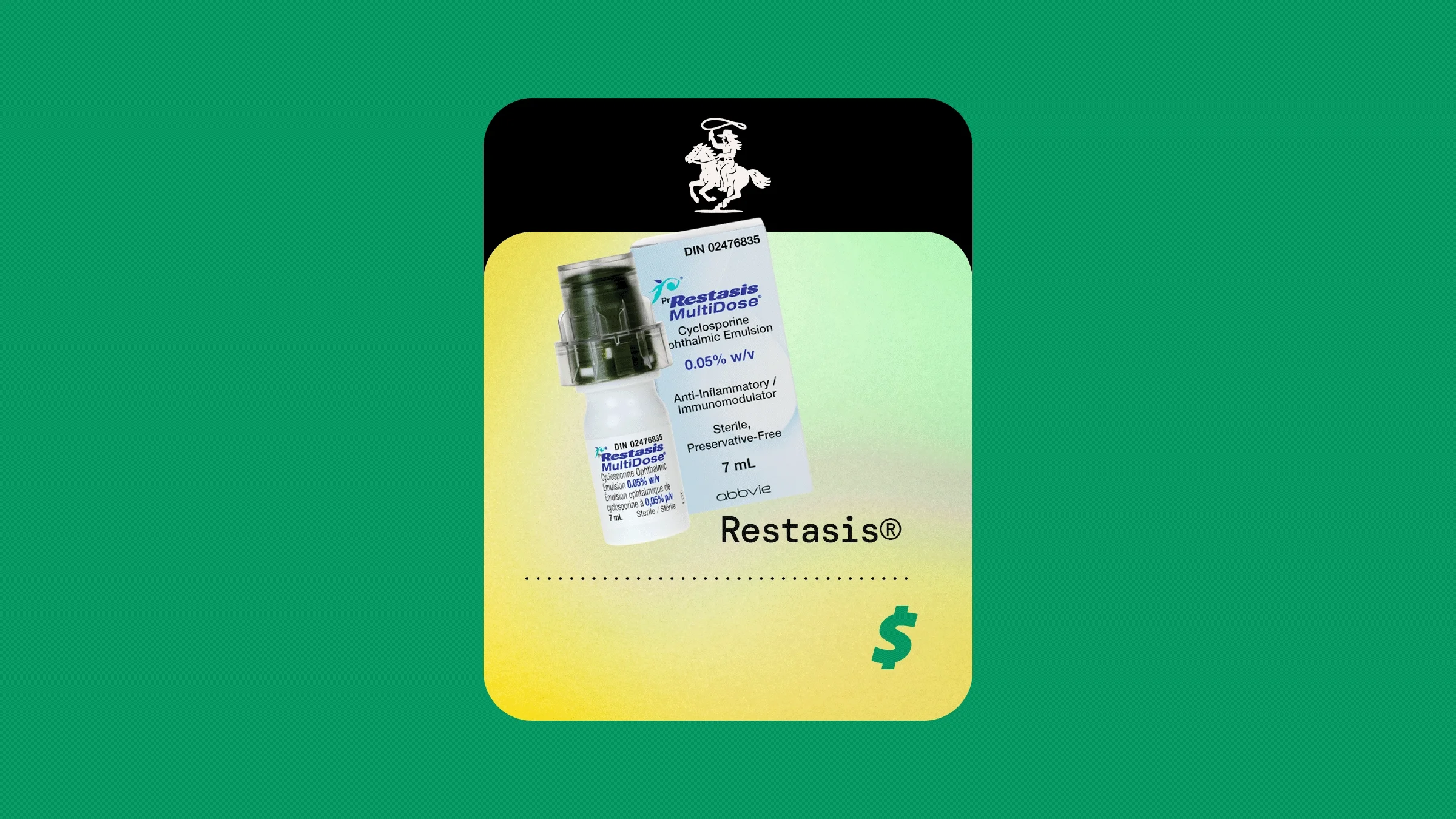
The retail price of Restasis depends on the dosage and form (bottle of solution or package). Without insurance, brand-name Restasis vials can cost around $769.23 for a 1-month supply of 60 single-use vials at some pharmacies. The same quantity of the generic version may cost around $586.38.
A 5.5 mL bottle of 0.05% Restasis MultiDose can cost around $766.97.
Is there a generic version of Restasis?
In February 2022, the FDA approved the first generic version of Restasis vials (cyclosporine eye drops). Generic medications work just as well as brand-name medications, but they cost less.
To ensure safety, the FDA developed special requirements for pharmaceutical companies developing generic cyclosporine eye drops. These were put in place even before the patents covering Restasis expired. As a result, the FDA considers generic cyclosporine eye drops to be just as safe and effective as the brand-name medication.
Good to know: Only Restasis single-use vials have a generic version available. Restasis MultiDose bottles are available only as a brand-name medication.
What factors affect the cost of Restasis?
Several factors can affect the cost of Restasis, including:
Pharmacy: The price of Restasis can vary among pharmacies, even within the same city. GoodRx lets you compare prices so you can find the best deal in your area.
Location: Where you live can affect the price of Restasis because of demand, cost of living, and other factors. For example, GoodRx research shows that prescriptions cost more in New York than in Denver.
Insurance: If Restasis is listed on your insurance plan’s formulary (list of covered medications), your insurance plan will most likely pay for your medication if it’s considered a preferred medication. But you may still have to pay coinsurance or copayments.
Dosage form: The dosage form of Restasis affects how much you pay. For example, the average retail price for one package of 60 vials of 0.4 mL (a 30-day supply) can cost around $769.23. For one bottle of solution (a 30-day supply), the price is around $766.97.
Generic versus brand name: The generic version of Restasis costs less than the brand-name version. Having competition from generic manufacturers brings down the price of the medication.
Does insurance cover Restasis?
Insurance coverage of Restasis varies, depending on if you're getting the single-use vials or a multidose bottle. But in general, many plans cover both forms.
About 6 in 10 people enrolled in Affordable Care Act (ACA) marketplace plans have coverage for Restasis. But nearly half of covered ACA enrollees will need a prior authorization. About 1 in 3 enrollees may need to try other medications first (step therapy) before accessing Restasis.
Commercial insurance plans cover Restasis for about 8 in 10 enrollees, but prior authorization is required for about 2 in 5 covered plan members. Roughly 1 in 6 enrollees must complete step therapy.
Medicare provides coverage for more than half of enrollees. Prior authorization and step therapy are rarely required for enrollees.
Medicaid plans cover Restasis for nearly all enrollees. About 8 in 10 will need prior authorization, and some will need step therapy.
To understand how your insurance covers Restasis, check your health plan’s formulary or contact your insurer.
How different insurance plans cover Restasis
The tables below outline how likely Restasis is to be covered by different types of insurance, along with whether prior authorization or step therapy might be required.
Insurance type | Enrollees covered for Restasis single-use vials | Enrollees required to get prior authorization | Enrollees required to do step therapy |
60.2% | 49.2% | 31.3% | |
Commercial plans (not including ACA plans) | 79.4% | 44% | 18.2% |
Medicare, including original Medicare and Medicare Advantage plans | 57.3% | 1.2% | 1% |
Medicaid, including state-run and managed care plans | 99.4% | 77.6% | 39.9% |
Insurance type | Enrollees covered for Restasis MultiDose bottles | Enrollees required to get prior authorization | Enrollees required to do step therapy |
ACA plans | 70.7% | 59.8% | 36.1% |
Commercial plans (not including ACA plans) | 89.4% | 53.6% | 17.6% |
Medicare, including original Medicare and Medicare Advantage plans | 56.9% | 1.0% | 1% |
Medicaid, including state-run and managed care plans | 99.4% | 37.5% | 17.2% |
Source: Managed Markets Insight & Technology, LLC™, as of April 14, 2025. (See methodology below.)
How can you save on Restasis?
Here are a five ways to save on Restasis whether or not you have insurance coverage:
1. Use a GoodRx coupon
With a free GoodRx coupon, the price of one package of 60 vials of 0.4 mL may be as low as $633.46 in your area. And the price for the same quantity of the generic version may be as low as $62.46.
To get your free coupon for Restasis:
Visit www.goodrx.com, or download the GoodRx app on your phone or tablet.
Search for “Restasis (brand-name)” or “Restasis (generic),” and click or tap "Start saving."
Choose your prescribed dosage form and quantity.
Select to receive your coupon by text or email, or print it out.
Present the coupon at your pharmacy before picking up your Restasis prescription. Providing this information earlier in the filling process can help you avoid delays at the register.
You can access discounted prescription medications with a GoodRx Companion subscription. Over 200 medications are available for free, with hundreds more under $10. The program also includes benefits to help you cut your self-pay costs, such as lower prices for online care visits, discounts on dental care, and other health services.
2. See if you qualify for the Restasis manufacturer copay savings card
With the Restasis savings card, you could get the medication for as little as $0 for a 90-day supply. This manufacturer copay savings card can be used for single-use vials or Restasis MultiDose bottles. But out-of-pocket expenses vary depending on your plan, and there are maximum savings limits.
You must have commercial insurance and a Restasis prescription to qualify for savings. If you are enrolled in Medicaid, Medicare, or any other government-funded healthcare program, you do not qualify.
3. Check if you’re eligible for a patient assistance program
If you cannot afford your medication, you may be able to get up to 12 months of Restasis for free through the AbbVie Patient Assistance Foundation. Restasis is one of many medications available through this program.
To qualify for the Restasis patient assistance program, you must:
Have limited or no health insurance (including people enrolled in Medicare Part D)
Live in the U.S.
Are being prescribed Restasis by a U.S.-licensed healthcare professional for an FDA-approved use
Meet certain income requirements and are able to show proof of income
4. Fill a 90-day supply
Ask your healthcare professional about prescribing you a 90-day supply of Restasis instead of a 30-day supply. Some insurance plans offer lower copays for 90-day prescriptions, and pharmacies may provide discounts on larger quantities. While the savings can vary, this may reduce both your costs and your number of trips to the pharmacy.
5. Tap into your HSA, FSA, or HRA
Consider using funds from a health savings account (HSA), flexible spending account (FSA), or health reimbursement arrangement (HRA) to purchase Restasis. These accounts let you use pretax dollars to pay for copays, coinsurance, and other qualified medical expenses. This can help you reduce your costs through tax savings.
Just be sure to check if the money in your account has to be used before a certain time. FSA dollars have an expiration date. But HSA funds roll over and can be saved for later. HRA funds may or may not expire, depending on your account.
Are there alternatives to Restasis for dry eye?
There are a few alternative medications for dry eye that you can try. These include:
Artificial tears: This is usually the first-choice treatment for dry eye. You can buy these eye drops without a prescription. But unlike Restasis, artificial tears don’t stimulate tear production and aren’t a long-lasting solution.
Xiidra (lifitegrast): This is a brand-name-only prescription eye drop that treats chronic dry eye. It works differently from Restasis. It has a manufacturer savings program and a patient assistance program. If you don’t have coverage for Restasis, ask your insurer if your plan will cover Xiidra.
Miebo (perfluorohexyloctane): This is another brand-name prescription eye drop. But it works best when dry eye is caused by a condition called meibomian gland dysfunction. So it may not be right for everyone. It has a copay savings card available, as well as a patient assistance program.
If you’re taking Restasis, ask your prescriber before switching to another treatment. Also, it’s important to understand the risks and side effects of any medication, whether it’s prescription or over the counter.
Frequently asked questions
Many people say that Restasis is worth the cost. Unlike over-the-counter eye drops, Restasis can lead to the long-lasting resolution of dry eye symptoms. It’s one of the most popular prescription dry eye treatments.
Restasis can be highly effective for treating dry eye. But you’ll also want to consider the potential side effects, as you would with any medication. The most common side effect is a temporary burning sensation in the eye. Other side effects can include red eye and eye pain.
There is no direct Restasis alternative available over the counter. Over-the-counter eye drops, such as artificial tears, may provide short-term relief for your dry eye symptoms, but they don’t treat the underlying cause of the condition. A prescription medication like Restasis may be better suited for long-term management. If your condition is mild, you might want to consider over-the-counter options.
Many people say that Restasis is worth the cost. Unlike over-the-counter eye drops, Restasis can lead to the long-lasting resolution of dry eye symptoms. It’s one of the most popular prescription dry eye treatments.
Restasis can be highly effective for treating dry eye. But you’ll also want to consider the potential side effects, as you would with any medication. The most common side effect is a temporary burning sensation in the eye. Other side effects can include red eye and eye pain.
There is no direct Restasis alternative available over the counter. Over-the-counter eye drops, such as artificial tears, may provide short-term relief for your dry eye symptoms, but they don’t treat the underlying cause of the condition. A prescription medication like Restasis may be better suited for long-term management. If your condition is mild, you might want to consider over-the-counter options.
The bottom line
Without insurance, the average cost of Restasis (cyclosporine) can cost around $769.23 for a 1-month supply of single-use vials at some pharmacies. The cost for a 1-month supply of Restasis MultiDose bottles can cost around $766.97. The price you pay will depend on the dosage form you’re using, your insurance, and other factors. You can save money using a GoodRx coupon or by buying the generic version of the eye drops.

Why trust our experts?



References
AbbVie. (n.d.). Check your eligibility.
U.S. Food and Drug Administration. (2016). Draft guidance on cyclosporine.
Viatris. (2022). Viatris is first to receive FDA approval of generic Restasis (cyclosporine ophthalmic emulsion 0.05%) to treat dry eye disease.