



Quviviq vs. Belsomra: 5 Things to Know When Comparing These Insomnia Medications
Quviviq and Belsomra are insomnia medications that work in similar ways. Learn about Quviviq versus Belsomra in this guide.

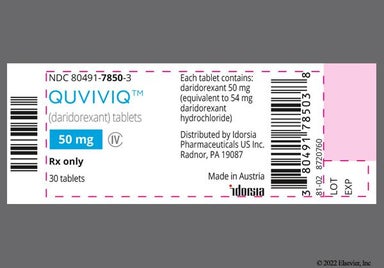
Quviviq (daridorexant) is an orexin antagonist that's used as a sleeping pill to help adults fall and stay asleep. It's available as a tablet that you take once every night, about 30 minutes before bedtime. You should take Quviviq (daridorexant) only if you can get at least 7 hours of sleep before waking up the next day. This medication might cause side effects like headache, daytime sleepiness, and dizziness. It's a schedule IV controlled substance because it has a risk for misuse.

Quviviq (daridorexant) is an orexin antagonist. Unlike some other insomnia medications that sedate the brain, Quviviq (daridorexant) is thought to work by turning down overactive wake signals, one of the biological causes of insomnia, helping you fall asleep and stay asleep.
| Common Brands | Quviviq |
|---|---|
| Drug Class | Orexin receptor antagonist |
| Controlled Substance Classification | Schedule IV |
| Generic Status | No lower-cost generic available |
| Availability | Prescription only |

Quviviq (daridorexant) can cause some serious health issues. This risk may be even higher for certain groups. If this worries you, talk to your doctor or pharmacist about other options.
Quviviq (daridorexant) can make you very sleepy and affect your ability to focus, think, or react during the daytime. These side effects are more likely to happen or be more intense if you're 65 years or older. In addition, your risk for these side effects is higher if you drink alcohol while you're taking Quviviq (daridorexant) or if you take other medications that cause sleepiness (like benzodiazepines or other sleep medications). Daytime sleepiness and trouble with concentrate is also possible if you sleep for fewer than 7 hours after you've taken Quviviq (daridorexant).
Don't drive or operate machinery until you know how Quviviq (daridorexant) affects you. Keep in mind that these side effects can sometimes last for up to several days after the last dose of the medication for some people.
Some people with mental health problems, including insomnia or depression, who take medications like Quviviq (daridorexant) can have worsened depression. They're also at higher risk for having thoughts of suicide, thoughts of harming themselves, or suicidal actions.
Your prescriber will check for your risk for self-harm and worsening depression before you start Quviviq (daridorexant) and also at follow-up visits. Call your prescriber right away if you or your loved ones notice that you have suicidal thoughts or worsening depression (e.g., anxiety, difficulty sleeping, feeling angry or irritated) while you take Quviviq (daridorexant).
Some people who take Quviviq (daridorexant) might experience sleep paralysis. This happens when you're not able to move or speak for up to several minutes after you start to wake up. Some people have also had hallucinations (seeing things that aren't real) and cataplexy-like symptoms (sudden muscle weakness and paralysis that's triggered by sudden, strong emotions like laughter, surprise, or stress). Contact your prescriber if you or your loved ones notice any of these effects.
Some people who take sleep medications like Quviviq (daridorexant) have experienced abnormal sleep behaviors. These unusual behaviors can include sleepwalking, sleep-driving, and sleeping during activities (e.g., cooking and eating food, having a conversation, having sex).
These abnormal sleep behaviors can happen in anyone who takes Quviviq (daridorexant) and at any time during treatment. You might not remember doing these things. Stop taking this medication and contact your prescriber right away if your loved ones say they've noticed these behaviors.
Let the prescriber know if you have breathing problems before you start taking Quviviq (daridorexant). It's not completely clear whether this medication can worsen breathing problems such as sleep apnea or chronic obstructive pulmonary disease (COPD). Talk with your prescriber to see whether Quviviq (daridorexant) is safe for you to take.

The following side effects may get better over time as your body gets used to the medication. Let your healthcare provider know immediately if you continue to experience these symptoms or if they worsen over time.
Contact your healthcare provider immediately if you experience any of the following.
Side effects that you should report to your care team as soon as possible:
Side effects that usually do not require medical attention (report these to your care team if they continue or are bothersome):




The typical dose is 25 mg to 50 mg by mouth once per night within 30 minutes of going to bed.
Your dose will be no more than 25 mg per night if you have certain liver problems or if you're also taking certain medications that can interact with Quviviq (daridorexant).


Contraindications are specific health conditions or situations in which a person should not take a medication due to safety concerns. If you have any of the following conditions or if any of the following apply to you, let your healthcare provider know because Quviviq (daridorexant) will not be safe for you to take.




Prescription savings
Stop paying too much for your prescriptions. Compare prices, get pharmacy coupons, and save up to 80%. Find expert answers to your health questions so you can make the best decisions for yourself and your family.
Health conditions
Medications & treatment
Access & affordability
 Our monthly healthcare membership can help you save thousands on your prescription costs.
Resources

It takes about 35 to 40 minutes for the 25 mg dose of Quviviq to start to work. And it takes about 30 minutes for the 50 mg dose to work. This is why you should take Quviviq 30 minutes before bedtime. Taking it too far away from your bedtime can make you very sleepy at a time when you're not ready for bed. This can raise your risk for falls if you're not in bed by the time the effects of the medication kicks in.
Yes, Quviviq is a schedule IV controlled substance because it has a risk of misuse. Misuse is when a medication is used for non-medical reasons for its desirable physical or emotional effects. Speak with your prescriber if you have concerns about taking Quviviq because of this risk.
No, Quviviq isn't a benzodiazepine. Quviviq belongs to a drug class called orexin antagonists. Both Quviviq and certain benzodiazepines are prescribed for treating insomnia (difficulty sleeping), but they work differently in the brain. They can also both raise your risk for daytime sleepiness and the risk for falls. Discuss with your prescriber about your treatment options for insomnia.
Quviviq and zolpidem (Ambien) are both medications that are used to help treat insomnia (or difficulty sleeping). They're both schedule IV controlled medications with risks of misuse. But they differ in a few aspects. Quviviq and zolpidem work on different chemicals in the brain to help you sleep. In addition, Quviviq is taken consistently every night, whereas zolpidem (Ambien) can be used as needed. Talk to your primary care provider or prescriber if you have more questions about the differences between both medications.
People who took Quviviq during clinical studies didn't report weight gain. Talk with a healthcare professional if you notice concerning weight gain while you're taking this medication. They can examine you and discuss with you about possible other causes of your weight changes.
In clinical studies, people reported that they were able to fall asleep about 30 minutes faster after taking Quviviq for a month. They also stayed asleep about 20 to 30 minutes longer after falling asleep and gained about 35 to 45 minutes of total sleep time compared to their baseline (before they started taking the medication). The effect on sleep is based on the dose; in studies, the 50 mg dose generally had a greater effect on sleep than the 25 mg dose. With this being said, only take Quviviq as instructed by your prescriber to lower your risk of side effects.
No, don't cut Quviviq in half. The tablets have a film coating. And this film coat can become damaged if you cut the tablets in half. A damaged film coat can affect how well the medications works for you and raise your risk for side effects. Swallow Quviviq tablets whole. Let your prescriber know if you're having trouble swallowing the tablets. They might consider a different medication for you.
