Key takeaways:
Positive reinforcement may help change your cat’s scratching locations.
Scratching posts that vary in height and texture, and over-the-arm scratch pads give some cats a preferred alternative.
Deterrence works for some, such as covering furniture corners with clear plastic.
Cat owners know that the unconditional love of your felines can mean sacrifices where your favorite furniture is concerned.
But some cat lovers have found strategies for winning the war of cat versus couch. Three people share what has worked in their homes.
Cat lover invested in an array of scratching posts
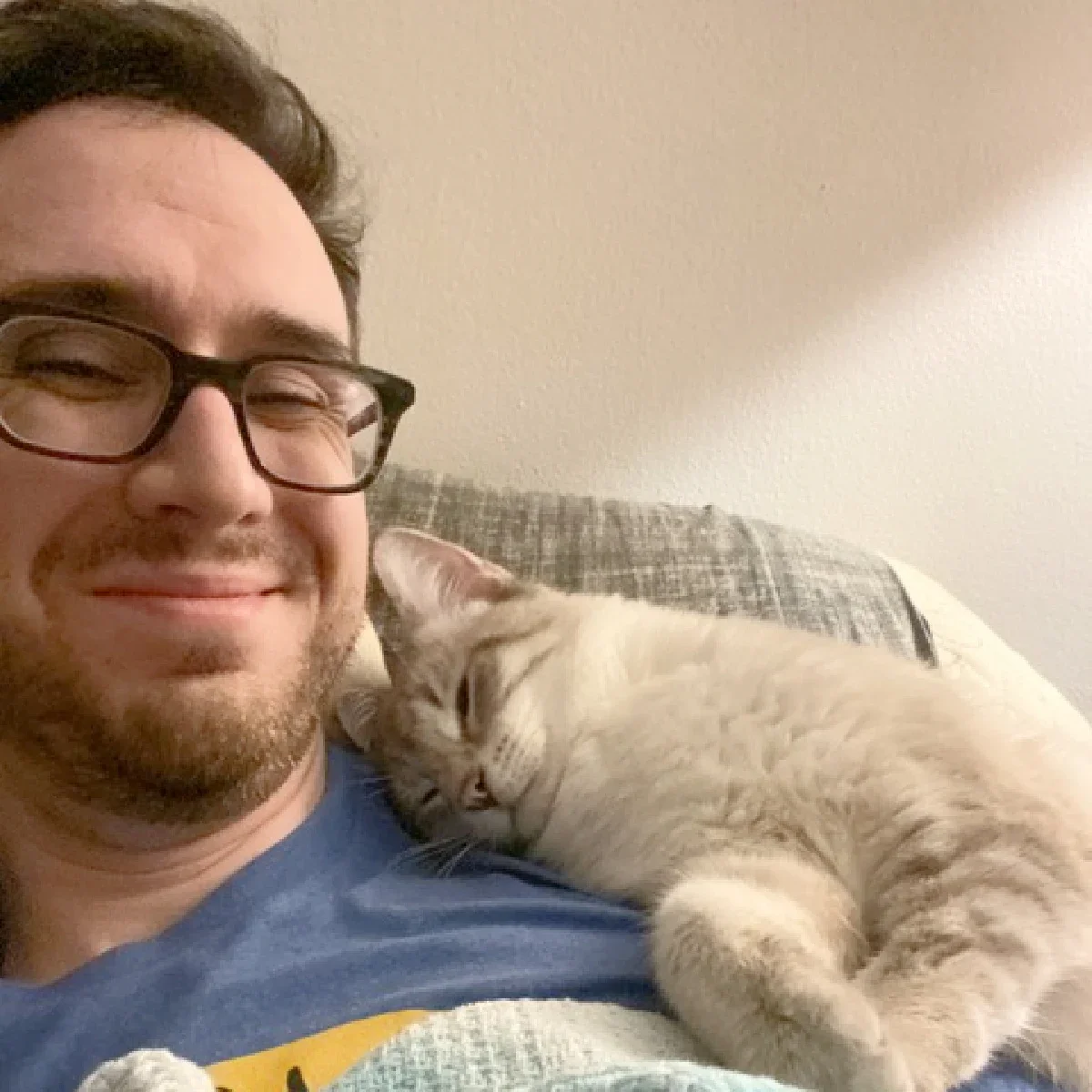
Joey Lusvardi of Minneapolis has had his cats, Prozac and Poutine, for less than a year. They took to him immediately. But they also took to his couch, office chair, and bed, digging in to satisfy scratching urges.
![“I’ve got at least 10 [scratching posts].” — Joey Lusvardi](https://www.grxstatic.com/4f3rgqwzdznj/17VazVaGzBBSUexViVKngC/fd1b042e9463dcaf4132403acf98c6d3/pet_care_scratching_quote_1a.png?fm=webp&q=80&w=961)

Scratching posts — of different heights, shapes, and textures — helped Joey solve the problem.
“I’ve got at least 10 [scratching posts]” — 15 if you count the ones built into cat towers, says Joey, 33, a certified cat behavior consultant and founder of Class Act Cats.
Search and compare options
While Poutine knew just what to do with the scratching posts, Prozac needed more incentive. So Joey rubbed silver vine, which attracts cats like catnip, onto the posts. He finds some of his cats who haven’t responded to catnip respond to silver vine, which is part of the kiwi family.
The different types of posts accommodate the cats’ need to scratch at different angles.
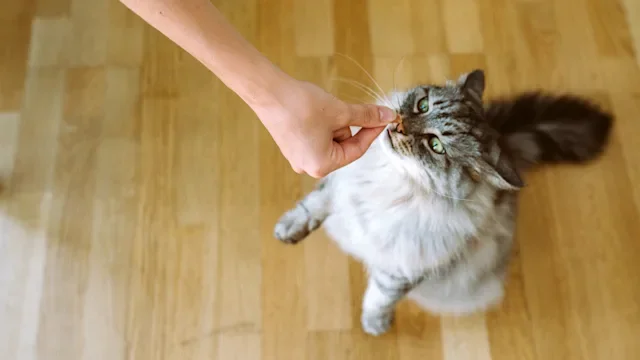
“I start giving them a lot of attention and praise as soon as they start actually scratching the thing that I want,” he says.
He’s also had luck with over-the-arm scratching pads. He demonstrated scratching with his fingernails. When his cats heard the sound, they welcomed the chance to scratch in a favorite spot but with a satisfying sound and texture — and a reward instead of correction.
Cat behavior expert uses positive reinforcement
Mikel Delgado, 52, of Sacramento, California, has three cats: Ruby, Coriander, and Professor Scribbles.
Mikel also has a multitude of scratching posts: four inside, two in the “catio” (an outdoor enclosed patio for cats), and four built into cat trees. Location is important, she says, and she has three of them set up against the back of her couch, a place her cats love to play.


Height is also important, she says, so cats can get a good, vertical stretch. All of her scratching posts are at least 3 feet tall, she says.

Read more like this
Explore these related articles, suggested for readers like you.
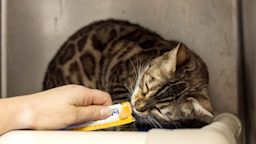


Mikel, who is a cat behavior expert at Rover, says she uses positive reinforcement instead of punishment to keep her cats from scratching the couch.
“I prefer to let my cats know what I like them to do by rewarding them with treats and praise when they do scratch the post or do something that I like,” she says. “I don't want to be seen by my cats as scary.”
“Scratching is a natural behavior,” she points out. “Yelling at them is not going to address the fact that they still feel like they need to scratch. Now you’ve just stressed them out because they know you’re mad at them.”
Sheets of heavy-gauge plastic saved the new leather furniture
Walt Leuzinger, 73, a retired pharmacist who lives near Bushnell, Florida, says he and his wife got new leather furniture recently. Protecting it from their three cats’ claws became a mission.
They tried spritzing the cats with water when they scratched the furniture. That was fairly effective, but it required being on “sentry duty” waiting for an infraction, he says.
He finally found a solution in heavy-gauge, clear plastic sheets with an adhesive back that can be cut to fit the furniture areas cats love. He was skeptical, but then pleasantly surprised.
“The shields have been completely successful in ending our cats clawing the furniture,” he says. “The cats don’t go anywhere near the furniture.”
![“The [plastic] shields have been completely successful in ending our cats clawing the furniture.” — Walt Leuzinger](https://www.grxstatic.com/4f3rgqwzdznj/5NY45I8wud5Ri4bX43dWKt/eddfad29adb197afda319133bf87cd04/pet_care_scratching_quote_3b.png?fm=webp&q=80&w=961)
“It really doesn’t look too bad,” he adds. “It’s actually not so obvious, and it sure beats that usual tattered, cat-clawed furniture look.”
Declawing is illegal in many cities and states
One solution all cat owners should rule out is declawing. The Humane Society of the United States and the Humane Society Veterinary Medical Association oppose declawing and tendonectomies (severing the tendon that controls the claw) except in rare medically necessary cases, such as removing cancer cells in the nail bed.
Many countries have banned declawing or consider it unethical. “In the U.S., New York, Maryland, the District of Columbia, and more than a dozen cities have banned declawing,” the groups state.
The Humane Society explains the trauma: “Declawing is the amputation of the last bone of each toe on a cat’s paw. It would be like cutting off your finger at the last knuckle.”
What does the veterinarian say?

Ghanasyam Bey, DVM
Veterinary Reviewer
Scratching objects is part of cats’ natural behavior. So it is important to give your cat approved places to scratch throughout your home to discourage unwanted furniture scratching. Each cat has its own preferences, so you may have to learn what works best for yours. Use a variety of heights and textures.
Positive reinforcement works better than negative reinforcement. But sometimes you may have to wrap furniture to discourage scratching.

Why trust our experts?