

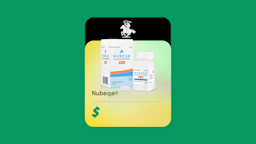
How Much Is Nubeqa Without Insurance?
Nubeqa can cost thousands per month without insurance or discounts. Learn more about how much Nubeqa is without insurance and the best ways to save with GoodRx.
Nubeqa (darolutamide) is a prescription medication used to treat certain types of prostate cancer in adults. You usually take it along with other hormone treatments, with chemotherapy, or after surgery to remove the testicles. As an androgen receptor inhibitor, it blocks testosterone from helping prostate cancer grow. You take the tablet by mouth twice a day with food. Common side effects include low white blood cell count, tiredness, and rash.

Nubeqa (darolutamide) is an androgen receptor inhibitor. It works by blocking testosterone in prostate cancer cells. Since testosterone helps prostate cancer grow, this medication reduces its effects to slow or stop the cancer from growing or spreading.
| Common Brands | Nubeqa |
|---|---|
| Drug Class | Androgen receptor inhibitor |
| Controlled Substance Classification | Not a controlled medication |
| Generic Status | No lower-cost generic available |
| Availability | Prescription only |

The following side effects may get better over time as your body gets used to the medication. Let your healthcare provider know immediately if you continue to experience these symptoms or if they worsen over time.
Non-metastatic prostate cancer:
Metastatic prostate cancer (when taken alone):
Metastatic prostate cancer (when taken with docetaxel):
Non-metastatic prostate cancer:
Metastatic prostate cancer (when taken alone):
Metastatic prostate cancer (when taken with docetaxel):
Contact your healthcare provider immediately if you experience any of the following.
Side effects that you should report to your care team as soon as possible:
Side effects that usually do not require medical attention (report these to your care team if they continue or are bothersome):




Nubeqa (darolutamide) can cause some serious health issues. This risk may be even higher for certain groups. If this worries you, talk to your doctor or pharmacist about other options.
Rarely, Nubeqa (darolutamide) can cause blocked arteries in the heart called ischemic heart disease. If this happens and your symptoms are severe, you’ll need to stop taking this medication. Call your oncologist right away if you have chest pain, chest discomfort during rest or activity, or shortness of breath, since these might be signs of heart problems.
Though rare, Nubeqa (darolutamide) can raise your risk of seizures. In studies, seizures were reported as early as 1 month after starting treatment and as late as several years later. Tell your oncologist right away if you think you've had a seizure. Early warning signs can include unusual smells or tastes, nausea, anxiety, or a fluttering feeling. Because losing consciousness can be dangerous, avoid activities where a sudden seizure could put you or others at risk. If you do have a seizure, you might need to stop taking this medication altogether and switch to something else.
It’s possible for Nubeqa (darolutamide) to harm an unborn baby. If your partner can get pregnant, use birth control such as condoms while taking this medication and for 1 week after your last dose. Let your oncologist know right away if your partner becomes pregnant during this time.

The typical dose is 600 mg taken by mouth twice a day with food.
Your dose might be different if you experience serious side effects or have kidney or liver problems.




Prescription savings
Stop paying too much for your prescriptions. Compare prices, get pharmacy coupons, and save up to 80%. Find expert answers to your health questions so you can make the best decisions for yourself and your family.
Health conditions
Medications & treatment
Access & affordability
Medication discounts

Nubeqa isn’t chemotherapy. Chemotherapy kills all fast-growing cells in the body, including healthy ones, which often leads to more side effects. Nubeqa works differently since it’s a targeted hormone therapy that specifically blocks testosterone from working to feed prostate cancer cells.
Yes. Nubeqa is a hormonal therapy used for certain types of prostate cancer. It belongs to a group of medications called androgen receptor inhibitors, which work by blocking signals from testosterone. Since most prostate cancer cells need testosterone to grow, blocking it helps slow down the cancer.
Yes, weight gain is a common side effect of Nubeqa when it’s taken with docetaxel, a type of chemotherapy. If you notice your weight going up while on this treatment, let your oncology team know so they can check for causes and help you manage it.
How long you take Nubeqa depends on how well it works and how well you tolerate side effects. Your oncologist will monitor your progress with scans and prostate-specific antigen (PSA) blood tests. They’ll also check in with you regularly to see if symptoms of prostate cancer, such as trouble urinating or blood in the urine, are improving. Don’t stop taking this medication without talking to your oncologist first.
Nubeqa and Xtandi (enzalutamide) are both oral medications used to treat certain types of prostate cancer. One difference is that Nubeqa is often better tolerated and might cause fewer problems with the brain and nervous system, such as confusion, falls, or seizures, because it doesn’t enter the brain as much as Xtandi (enzalutamide). Another difference is how you take them: Nubeqa is usually taken twice a day with food, while Xtandi (enzalutamide) is taken once a day and can be taken with or without food. Talk to your oncologist if you have questions comparing the two.
Nubeqa can interact with other medications. Some medications, such as carbamazepine, phenytoin, and rifampin, can make Nubeqa work less well. It can also raise the levels of certain medications, such as ketoconazole and clarithromycin, which might raise side effects. Always tell your oncologist about all the medications, supplements, and over-the-counter products you take so they can check for interactions and adjust your treatment if needed.
