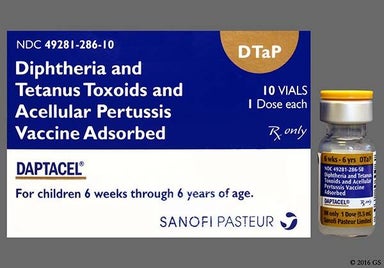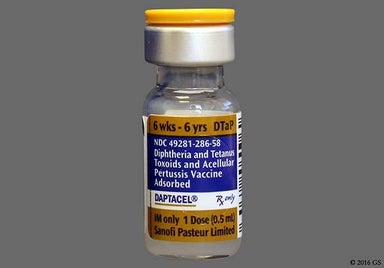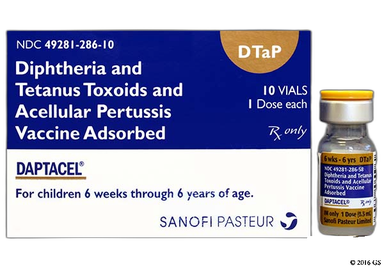
Daptacel
The DTaP vaccine protects your child from diphtheria, tetanus, and pertussis (also known as whooping cough). DTaP is shorthand for this vaccine. It's a routine vaccine for all children starting at 2 months of age and given as a 5-dose series (1 injection at age 2 months, 4 months, 6 months, 15 to 20 months, and 4 to 6 years). Children older than 7 years of age and adults who didn't receive or complete the DTaP vaccine series receive the Tdap vaccine instead of the DTaP vaccine. Common side effects include injection-site reactions, sleepiness, and irritability.


What is The DTaP vaccine?
What is The DTaP vaccine used for?
Prevention of:
- Diphtheria
- Tetanus
- Pertussis (whooping cough)
How The DTaP vaccine works
The DTaP vaccine is an inactivated vaccine that protects you from three bacteria that cause different conditions: Corynebacterium diphtheriae (diphtheria), Clostridium tetani (tetanus), and Bordetella pertussis (pertussis or whooping cough). The vaccine helps your body's immune system make antibodies that will attack these bacteria if they ever infect you.
Drug facts
| Common Brands | Daptacel, Infanrix |
|---|---|
| Drug Class | Vaccine |
| Controlled Substance Classification | Not a controlled medication |
| Generic Status | No lower-cost generic available |
| Availability | Prescription only |

Side effects of The DTaP vaccine
The following side effects may get better over time as your body gets used to the medication. Let your healthcare provider know immediately if you continue to experience these symptoms or if they worsen over time.
Common Side Effects
Daptacel
- Irritability (32-40%)
- Sleepiness (19-33%)
- Fever (8-24%)
- Tenderness at injection site (8-11%)
- Low appetite (8-11%)
- Vomiting (4-7%)
- Swelling at injection site (1-6%)
- Redness at injection site (1-4%)
Infanrix
- Irritability (52%)
- Redness at injection site (48%)
- Pain at injection site (45%)
- Sleepiness (36%)
- Swelling at injection site (33%)
- Loss of appetite (25%)
- Fever (9%)
Less Common Side Effects
- Nausea
- Diarrhea
- Itching
- Rash
- Headache
- Cough
The DTaP vaccine serious side effects
Contact your healthcare provider immediately if you experience any of the following.
- Serious allergic reaction: hives, rash, nausea, flushing, dizziness, shortness of breath, chest pain, swelling of lips, tongue, or throat
The following The DTaP vaccine side effects have also been reported
Side effects that you should report to your care team as soon as possible:
- Allergic reactions—skin rash, itching, hives, swelling of the face, lips, tongue, or throat
- Feeling faint or lightheaded
Side effects that usually do not require medical attention (report these to your care team if they continue or are bothersome):
- Chills
- Fever
- General discomfort and fatigue
- Headache
- Joint pain
- Muscle pain
- Pain, redness, or irritation at injection site

Get your GoodRx coupon

Pros and cons of The DTaP vaccine
Pros
- Works well to prevent diphtheria, tetanus, and whooping cough
- Can be given with other vaccines
- Readily available and easy to find
- Can be given to children as young as 6 weeks old
Cons
- Needs to be injected into the muscle
- Must be given by a healthcare provider at an office, clinic, or pharmacy
- Need to receive 5 injections to complete the series
- Not used in people age 7 years and older

Pharmacist tips for The DTaP vaccine

- Read the vaccine information statement for more information on the DTaP vaccine.
- If your child has a brain condition, talk to your child's provider before they receive the DTaP vaccine to make sure it's right for them. Your child's provider might hold off on giving your child the vaccine because there can be confusion between the rare side effects of the DTaP vaccine and the signs or symptoms of your child's brain condition.
- Wait until your child is healthy to get the DTaP vaccine. This will help make sure their immune system protects them as best as it can. If your child has a mild sickness, such as a cold or low-grade fever, they can still get the DTaP vaccine. But if your child feels moderately to severely sick, wait until they recover. Ask your child's provider if you're not sure whether they can get this vaccine.
- Most children who receive the DTaP vaccine don't have any serious side effects. Side effects are generally mild and should go away on their own in a few days.
- If your child has a history of seizures, ask your child's provider about medication to prevent a high fever from occuring after getting the DTaP vaccine.
- Make sure to keep a record of all your child's immunizations and show it to your child's provider or pharmacist before they receive any vaccines, including the DTaP vaccine, to make sure they're receiving all their vaccines on schedule.
- If your child experiences a severe reaction to the DTaP vaccine, you or your child's provider can report it to the vaccine adverse event reporting system (VAERS) website or call this reporting system at 1-800-822-7967.

Risks and warnings for The DTaP vaccine
The DTaP vaccine can cause some serious health issues. This risk may be even higher for certain groups. If this worries you, talk to your doctor or pharmacist about other options.
Severe allergic reactions
- Risk factors: Latex allergy (for Infanrix only) | Allergic reaction to other vaccines
As with any vaccine, there's a rare chance that your child might have a severe allergic reaction to the DTaP vaccine. The risk is higher if your child is allergic to latex and receives Infanrix, since tip caps of the prefilled syringes contain natural rubber latex. Your provider might ask you and your child to stay at the pharmacy or clinic for a short period of time after your child has received the vaccine to make sure your child can get proper care in case of a serious allergic reaction. Sometimes, these reactions can happen after you've already left the clinic. Get medical help right away if you notice symptoms of a severe allergic reaction, such as feeling faint, swelling of the face, closing of the throat, difficulty breathing, hives or rash, dizziness, shaking, nausea, or chest pain.
Fainting
- Risk factors: Fainting after vaccines in the past
Fainting can happen while or after receiving injectable vaccines, such as the DTaP vaccine. Signs of fainting include changes in vision, burning sensation, and stiffening or twitching of your arms and legs. Let your child's provider know if your child has fainted after vaccines in the past so they can be monitored.
Lower response to the DTaP vaccine in children with weakened immune systems
- Risk factors: Medical conditions or medications that weaken the immune system
The DTaP vaccine might not work as well in children with a weakened immune system. This can put your child at higher risk of diphtheria, tetanus, and whooping cough, even after they've received the vaccine. If your child has any medical conditions (e.g., HIV (human immunodeficiency virus), cancer) or takes medications that weaken their immune system (e.g., high-dose corticosteroids,transplant medications), talk to your child's provider before they receive the DTaP vaccine.
Discuss benefits and risks of the DTaP vaccine with provider if your child has previously experienced reactions to a pertussis vaccine
- Risk factors: Previous side effects from another pertussis vaccine
Before your child receives the DTaP vaccine, tell your child's provider or pharmacist if your child has ever had side effects within 2 to 3 days after receiving a pertussis vaccine. These side effects include a high fever (105 degrees Fahrenheit or more), collapsing or passing out, continuous crying lasting at least 3 hours, or seizures with or without a fever. Your child's provider or pharmacist will weigh the risks and benefits of your child receiving another pertussis-containing vaccine like the DTaP vaccine.
Breathing issues (apnea) in premature babies
- Risk factors: Premature birth
Babies who were born prematurely have experienced apnea after receiving vaccines that are injected into the muscle, like the DTaP vaccine. Apnea is a condition where there's a temporary pause in their breathing, sometimes occurring with a slowed heart rate or low oxygen level. If your baby was born prematurely, be sure to discuss the benefits and risks of receiving the DTaP vaccine with your child's provider.
Guillain-Barre syndrome (GBS) and nerve problems
- Risk factors: GBS within 6 weeks of receiving any tetanus vaccine
Although very rare, some people have reported getting GBS or nerve problems after they've received tetanus toxoid-containing vaccines like the DTaP vaccine. GBS is a rare condition that causes muscle weakness and paralysis. Let your child's provider know right away if your child has experienced these symptoms, especially if it occurred within 6 weeks of receiving a tetanus toxoid-containing vaccine.

The DTaP vaccine dosage
 Vial
Vial| Dosage | Quantity | Price as low as | Price per unit |
|---|---|---|---|
| 0.5ml | 1 vial | $75.01 | $75.01 |

How much does The DTaP vaccine cost?
$75.01

The DTaP vaccine contraindications
Contraindications are specific health conditions or situations in which a person should not take a medication due to safety concerns. If you have any of the following conditions or if any of the following apply to you, let your healthcare provider know because The DTaP vaccine will not be safe for you to take.
- Severe allergy to any diphtheria, tetanus, or pertussis-containing vaccine (including DT, Td, and DTaP)
- Coma, have seizures for a long time, or lowered level of consciousness within 7 days of a previous dose of a pertussis-containing vaccine
- Certain brain disorders (e.g., uncontrolled seizures)

The DTaP vaccine images