



How Much Is Stelara Without Insurance?
Stelara can be costly without insurance coverage. Find out how much Stelara costs and ways to save on this biologic medication.
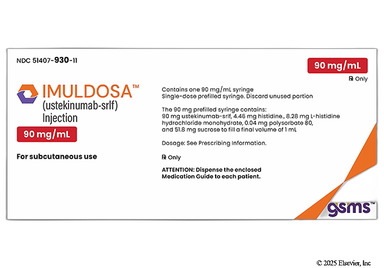
Imuldosa (ustekinumab or ustekinumab-srlf) is a biosimilar to Stelara (ustekinumab) that's FDA approved to treat several long-term autoimmune conditions like plaque psoriasis, psoriatic arthritis, Crohn's disease, and ulcerative colitis. It works by blocking certain proteins in the body called interleukins, which help reduce inflammation. The medication is usually given as a shot under the skin, with maintenance doses every 8 to 12 weeks. Common side effects include tiredness, headache, and cold-like symptoms.

Imuldosa (ustekinumab) is an interleukin antagonist. It works by blocking two proteins in your immune system — interleukin-12 (IL-12) and interleukin-23 (IL-23) — that play a major role in inflammation. By targeting these proteins, the medication helps to lower inflammation and relieve symptoms from autoimmune conditions.
| Common Brands | Imuldosa |
|---|---|
| Drug Class | IL-12 and IL-23 antagonist |
| Controlled Substance Classification | Not a controlled medication |
| Generic Status | No lower-cost generic available |
| Availability | Prescription only |

The following side effects may get better over time as your body gets used to the medication. Let your healthcare provider know immediately if you continue to experience these symptoms or if they worsen over time.
Plaque psoriasis
Psoriatic arthritis
Crohn's disease
Ulcerative colitis:
Contact your healthcare provider immediately if you experience any of the following.
Side effects that you should report to your care team as soon as possible:
Side effects that usually do not require medical attention (report these to your care team if they continue or are bothersome):



How to inject Imuldosa (ustekinumab) from a prefilled syringe:

Imuldosa (ustekinumab) can cause some serious health issues. This risk may be even higher for certain groups. If this worries you, talk to your doctor or pharmacist about other options.
Imuldosa (ustekinumab) can raise your risk of infections, including serious ones that might need hospital care. These can be caused by bacteria, viruses, or fungi. Tell your prescriber about your medical history before starting Imuldosa (ustekinumab), especially if you've ever had tuberculosis (TB). Let your care team know right away if you have signs of infection, such as fever, chills, cough, or tiredness — your treatment might need to be paused until you recover.
Imuldosa (ustekinumab) weakens your immune system and can raise your risk of certain cancers. Some people developed skin cancer while taking this medication, especially those with a higher risk. Your care team will check your skin regularly during treatment, particularly if you have a history of cancer or other risk factors. Let your prescriber know if you’ve had cancer before or if you notice any new or changing spots on your skin.
Serious allergic reactions, including anaphylaxis and angioedema, have been reported with Imuldosa (ustekinumab). If you have a severe reaction, your care team will stop the medication and treat you right away. Get medical help immediately if you have symptoms like trouble breathing, swelling of your face or throat, or a serious rash.
Rare cases of a brain condition called posterior reversible encephalopathy syndrome (PRES) have been reported in people taking Imuldosa (ustekinumab). Symptoms can include headache, seizures, confusion, or vision changes. These symptoms can appear anywhere from a few days to months after starting the medication, sometimes even after a year or more. If you have PRES, your care team will stop the medication and provide treatment. Let your prescriber know right away if you notice any of these signs.
Before starting Imuldosa (ustekinumab), you or your child should be up to date on all recommended vaccines. While you're being treated, avoid getting live vaccines. You should also avoid the BCG vaccine during treatment, as well as for one year before starting and one year after stopping the medication. Be careful if someone in your household gets a live vaccine since it can spread and pose a risk to you. Non-live vaccines are generally safe, but they might not work as well while you're taking Imuldosa (ustekinumab). Check with your care team before getting any vaccines during treatment.
Different types of pneumonia have been reported in people taking Imuldosa (ustekinumab), and in some cases, these conditions were serious. Symptoms can include cough and trouble breathing. Let your care team know right away if you have new or worsening breathing problems. You might have to stop taking the medication and receive the appropriate treatment.



Prescription savings
Stop paying too much for your prescriptions. Compare prices, get pharmacy coupons, and save up to 80%.Resources
About GoodRx
 Find expert answers to your health questions so you can make the best decisions for yourself and your family.
Health conditions
Medications & treatment
Access & affordability
Well-being
Medication discounts

Yes. Imuldosa is available in the United States as of August 2025. It was approved by the FDA in October 2024.
No. Imuldosa and Stelara (ustekinumab) aren't exactly the same, but they're very similar. Imuldosa is a biosimilar to Stelara (ustekinumab), meaning it has the same active ingredient, works the same way, and treats the same conditions. Even if the medications look a little different, they're expected to be just as safe and effective. If you have questions comparing the two, talk to your prescriber.
No. Imuldosa isn't considered interchangeable with Stelara (ustekinumab). This means your pharmacy can’t automatically switch Stelara (ustekinumab) for Imuldosa without your prescriber’s approval, so you would need a new prescription. If you’re interested in switching, talk to your prescriber to see if Imuldosa is a good option for you.
You can keep taking Imuldosa as long as it continues to help and you don’t have serious side effects. Your prescriber will check in with you regularly to be sure the medication is still working well and is safe for you to keep taking.
Yes, you should store Imuldosa in the refrigerator in its original box to protect it from light. If you take a prefilled syringe out of the fridge, you can keep it at room temperature (up to 86°F or 30°C) for up to 30 days, but you can't put it back in the refrigerator once it has warmed. Throw it away after 30 days at room temperature or if you notice any changes in color or particles in the syringe.
