Key takeaways:
Maintaining balance requires multiple parts of your body to work together.
As you get older, your balance can get worse, which raises your risk of falls and other injuries.
Balance exercises can help prevent falls, improve mobility, and help you stay independent.
You might take your sense of balance for granted. But staying steady on your feet is very important. Balance affects how you move in your daily life, from standing and walking to sitting and bending down to tie your shoes.
As you age, balance and coordination often get worse. In fact, researchers estimate that balance begins to decline at age 50. At least 1 in 4 adults ages 65 and older experience falls every year. And when you fall, your risk of falling again goes up.
That’s why experts recommend balance exercises for older adults. You don’t have to wait to reach a certain age before you get started. You can benefit from balance training at any age.
Search and compare options
The best balance exercises for older adults should activate and strengthen core and lower body muscles.
Try these exercises at least twice a week as part of your weekly fitness routine. If you’re new to exercise and feeling unsure, check with a healthcare professional first.
1. Single-leg stance
Standing on one leg is a great way to test your stability and measure your progress after you start balance training. Being able to do this has been linked to better cognitive health and living longer.
Here’s how to do this exercise:
Step 1: Stand behind a counter or sturdy chair. Keep your back straight and feet together.
Step 2: Slowly lift your right foot off the floor. If needed, hold the back of the chair or counter for support.
Step 3: Bend your right knee to a 90-degree angle.
Step 4: Hold this position for 10 seconds.
Step 5: Lower your right foot back to the floor.
Step 6: Repeat the exercise 10 to 15 times on each foot. Try to slowly increase your single-leg balance time, aiming for 30 to 60 seconds.
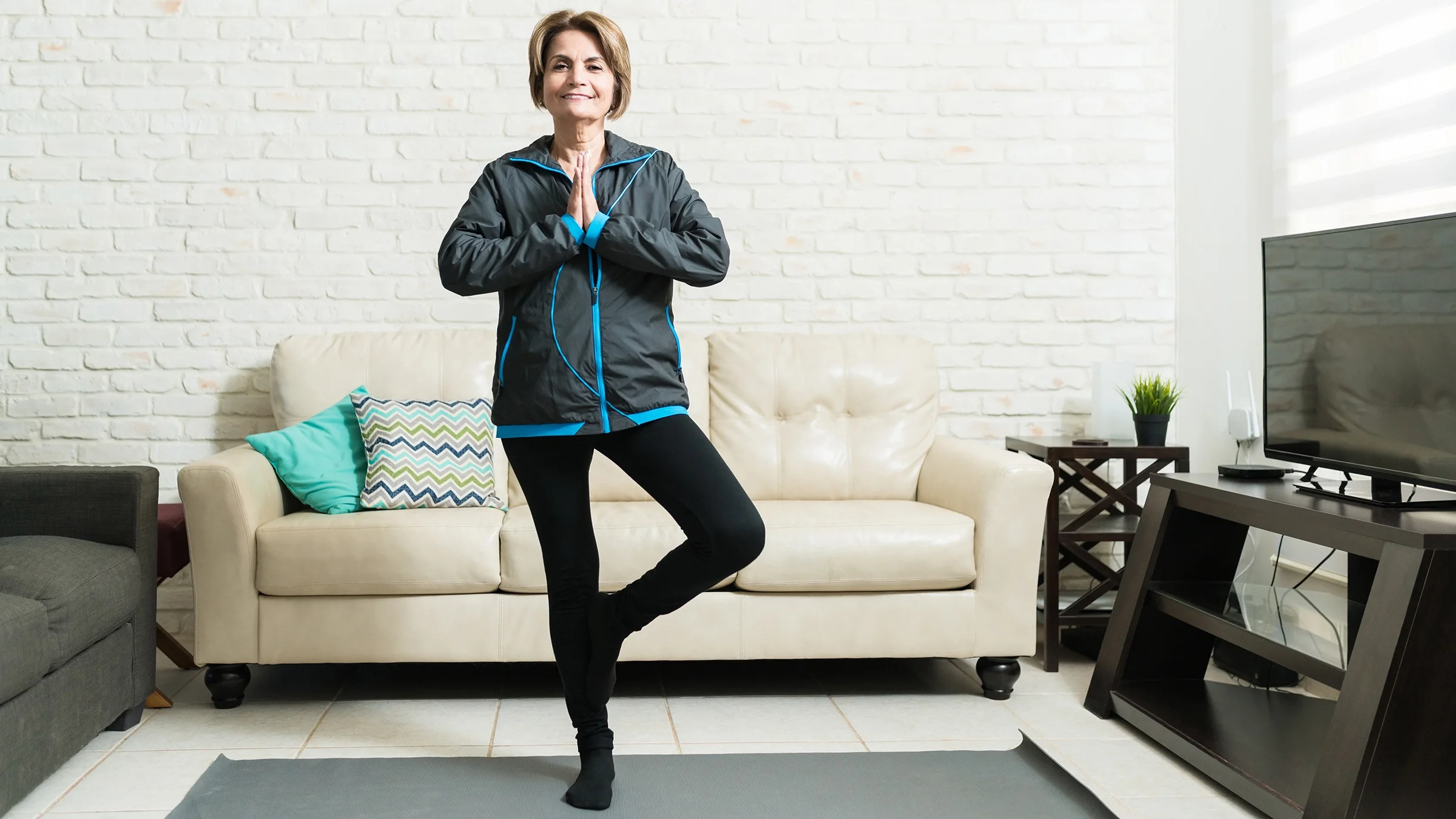
2. Tree pose
Tree pose is a common yoga pose that you can work toward after mastering the single-leg stance. Yoga is one of many ways to improve your balance and flexibility.
Here’s how to do tree pose:
Step 1: Stand with your shoulders down, back straight, and feet together. Rest your hands on your hips.
Step 2: Shift your weight to your right foot. Bend your left knee and place your left foot flat against the side of your right calf.
Step 3: For an advanced version, place your left foot against your right inner thigh. But make sure not to put your foot against your knee. This can cause discomfort or pain.
Step 4: Clasp your hands in front of your chest, or lift your arms above your head (like the branches of a tree) if you can.
Step 5: Hold the pose for 10 to 15 seconds, and then switch legs.
3. Heel-toe raises
Shuffling your feet when you walk instead of lifting each foot off the ground can cause falls. Heel-toe raises can strengthen the muscles in your shins and ankles, helping you walk more efficiently.

Read more like this
Explore these related articles, suggested for readers like you.
You can do these sitting or standing, depending on your ability level. If standing, it helps to have a sturdy surface or chair in front of you. Here’s how to do heel-toe raises:
Step 1: Sit or stand with your back straight and your hands in your lap or on the chair. Keep your feet flat on the floor.
Step 2: Press into the balls of your feet to lift your heels. Stand on your tiptoes. Hold for 5 to 10 seconds, then lower your heels back to the floor.
Step 3: Press into your heels and lift your toes as high as you can, hinging at your ankles. Hold for 5 to 10 seconds before placing your feet flat on the floor. Try to do each raise slowly and with control.
4. Heel-to-toe walking
Heel-to-toe walking helps you practice your balance and coordination skills. If you feel unsteady on your feet, try this move near a wall for support. Follow these steps:
Step 1: Stand tall with your shoulders down and arms out at your sides, palms facing the floor.
Step 2: Take one step forward with your right foot, placing your heel directly in front of your left toes.
Step 3: Keep walking in a straight line, placing one foot directly in front of the other.
Step 4: Continue this walking pattern for 20 to 30 steps.
5. Sideways walking
The sideways-walking exercise challenges your balance by moving in a different direction. If you’re uneasy on your feet, stand next to a waist-high surface for support.
Here’s how to try it out:
Step 1: Stand tall and put your hands on your hips (if comfortable).
Step 2: Take one step to the side with your right foot.
Step 3: Bring your left foot to meet your right, then pause. Keep going for 10 more steps (if you have space). Then, go back the other way, stepping out with your left foot first.
Step 4: Continue this walking pattern for 20 to 30 steps.
6. Sit-to-stand
The sit-to-stand exercise mimics one of many functional movements that’s important for activities of daily living. It can boost core and leg strength and help build balance as you move.
You’ll need a sturdy chair or other fixed surface you can sit on, then:
Step 1: Sit toward the front of your chair with your back straight and feet hip-width apart. Rest your hands on your lap or the armrests.
Step 2: Engage your core (belly muscles) and press your feet into the floor to stand up.
Step 3: Pause for a breath while standing.
Step 4: Hinge at your hips and bend your knees to sit down, returning to the starting position.
Step 5: Repeat this move 10 to 15 times.
7. Side leg raises
Standing side leg raises can improve stability by working your hips, glutes, and abdominals. This will help you feel more stable as you walk and change positions.
To do a side leg raise, follow these steps:
Step 1: Stand upright behind a sturdy chair with feet shoulder-width apart. Put your hands on your hips or hold the back of the chair for support.
Step 2: Engage your core and shift your weight to your left foot.
Step 3: Slowly lift your right leg out to the side. Keep your right foot flexed and toes pointing forward.
Step 4: Hold for 10 to 15 seconds, then lower it to the starting position.
Step 5: Complete 10 to 15 repetitions on each side.
8. Back leg raises
Similar to side leg raises, back leg raises can improve stability by working your hips, glutes, and abdominals.
Here’s how to do a simple back leg raise:
Step 1: Stand beside a counter or sturdy chair with feet shoulder-width apart. Put one hand on your hip and the other on the surface for support.
Step 2: Engage your core and shift your weight to your right foot.
Step 3: Squeeze your glute muscles on the left to slowly lift your leg behind you. Be sure not to arch your back.
Step 4: Hold for 10 to 15 seconds before lowering your leg to the starting position.
Step 5: Complete 10 to 15 reps on each side.
9. Lunges
Lunges are a go-to move for many, and for good reason. They can boost lower body strength and improve your balance and functional fitness.
Follow these steps to do a simple forward lunge:
Step 1: Stand tall with your core engaged, feet hip-width apart, and hands on your hips.
Step 2: Look straight ahead and take a big step forward with your right foot, about 2 to 3 feet.
Step 3: Bend both knees to lower into a forward lunge. Your right knee should be at a 90-degree angle, and your left knee should be above the floor.
Step 4: Press your feet onto the floor to stand up from the lunge.
Step 5: Repeat steps 2 to 4 with your left leg.
Step 6: Alternate legs for several repetitions.
10. Dead bug
Despite its funny name, the dead bug exercise offers serious health benefits. It works core muscles in your stomach, low back, and hips. It also challenges your balance and coordination skills. But this move is a bit more advanced. Skip this exercise if you don’t feel comfortable or safe lying on the floor.
Here’s how to do the dead bug exercise:
Step 1: Lie on your back with your knees bent, feet flat on the floor, and arms extended toward the ceiling.
Step 2: Engage your core by drawing your belly button toward your spine.
Step 3: Lower your left arm back toward the floor as you extend your right leg. Keep your lower back on the floor as you hold your left arm and right leg just above the floor.
Step 4: Hold briefly before lifting your left arm and right leg back to the starting position.
Step 5: Repeat steps 2 to 4 with your right arm and left leg.
Step 6: Complete 5 to 10 reps on each side.
What are the benefits of balance exercises for seniors?
Good balance is essential for your health and safety as you get older. Balance exercises can help older adults:
Lower the risk of falls and other injuries
Move around more easily and safely (functional mobility)
Boost cognitive function
Enjoy a better quality of life
Tips to improve balance
If you want to work on your balance, it helps to be consistent. You can also try to make the exercises a bit harder as you get better at them. For example, if you feel comfortable and safe doing so, try:
Moving your head side to side while doing your balance walking
Holding onto a chair or other surface with only one hand instead of two
Adding small ankle weights or doing more repetitions to your leg exercises
You can also consider other types of balance exercises, not just the ones listed above. Yoga and tai chi are great ways to build balance and have other health benefits, too. And don’t forget the other important parts of a good workout routine, like regular aerobic, strength-training, and flexibility exercises.
Safety considerations
Of course, staying safe and avoiding falls is the most important part of these exercises. These tips can help:
Modify the exercises to match your ability level.
Use assistive devices if needed, like a cane, walker, or balance tools.
Wear sturdy, supportive footwear.
Remove trip hazards before getting started.
Get regular vision and hearing checks, as this can affect your balance, too.
What causes poor balance in older adults?
Maintaining your balance requires several parts of your body to work together, including your:
Central nervous system
Eyes
Inner ear
Muscles, bones, and joints
Age-related changes in one or more of these systems can lead to balance problems. For example, musculoskeletal changes like less muscle mass and bone density may affect your posture and the way you walk. Slower or limited mobility can make you unstable on your feet, resulting in falls.
Various health conditions — like arthritis, inner ear disorders, and vision issues — can also cause balance problems. Certain medications, like sleep aids and high blood pressure medications, can also make balance issues worse.
When to get help for severe balance issues
If you feel off balance, it’s a good idea to see your primary care provider. It’s better to avoid falls than to treat an injury afterward.
If you’ve already fallen, you should get medical attention.
Frequently asked questions
This is difficult to answer in a general sense, because it depends on the individual. Factors like medications, medical conditions, and fitness level can all determine what is safe or not.
For example, people with osteoporosis should avoid certain yoga moves and high-impact exercises. That’s why it’s always a good idea to discuss your goals and health status with a qualified health professional first.
Isometric exercises are moves where you hold a position while your muscles contract (stay tight). They’re a type of muscle-strengthening exercise that’s safe for older adults. Examples include holding a squat or push-up against a wall.
How long you can balance on one leg depends on many different factors, and your age is just one of them. If at age 70 you can balance on one leg, that’s fantastic! Once you can safely balance on one leg for 60 seconds, consider incorporating the other balance exercises into your routine.
Yes, having strong legs is an important part of maintaining your balance — especially as you get older. Strength training is also great for your bone health. If you’re new to strength training, start slowly with light weights — using your body weight is a great place to begin. Doing too much too soon can lead to injury. And it’s always a good idea to check in with a healthcare professional before starting a new exercise routine.
This is difficult to answer in a general sense, because it depends on the individual. Factors like medications, medical conditions, and fitness level can all determine what is safe or not.
For example, people with osteoporosis should avoid certain yoga moves and high-impact exercises. That’s why it’s always a good idea to discuss your goals and health status with a qualified health professional first.
Isometric exercises are moves where you hold a position while your muscles contract (stay tight). They’re a type of muscle-strengthening exercise that’s safe for older adults. Examples include holding a squat or push-up against a wall.
How long you can balance on one leg depends on many different factors, and your age is just one of them. If at age 70 you can balance on one leg, that’s fantastic! Once you can safely balance on one leg for 60 seconds, consider incorporating the other balance exercises into your routine.
Yes, having strong legs is an important part of maintaining your balance — especially as you get older. Strength training is also great for your bone health. If you’re new to strength training, start slowly with light weights — using your body weight is a great place to begin. Doing too much too soon can lead to injury. And it’s always a good idea to check in with a healthcare professional before starting a new exercise routine.
The bottom line
Proper balance is an important part of staying healthy, especially as you get older. But sometimes it’s overlooked. Balance exercises for older adults should stretch and strengthen your core and lower body muscles. They’re simple and require little to no equipment. And best of all, balance exercises can lower the risk of falls, improve mobility, and help you feel better overall.

Why trust our experts?



References
American Council on Exercise. (n.d.). Forward lunge.
ASU College of Health Solutions. (2025). Pelvic floor/core: Deadbug [video]. YouTube.
Balance Builders by Doug Weiss. (2024). Seniors: 21 best exercises to improve your balance: Complete 35 minute program [video]. YouTube.
Baptist Health. (2020). Sit to stand [video]. YouTube.
Caregiver Stress. (2015). Part 5: heel toe raises - prevent senior falls: Assessment & balance exercises. YouTube.
Centers for Disease Control and Prevention. (2026). Facts about falls.
Cooper, R., et al. (2014). Physical capability in mid-life and survival over 13 years of follow-up: British birth cohort study. The BMJ.
Dorner, T., et al. (2013). The effect of structured strength and balance training on cognitive function in frail, cognitive impaired elderly long-term care residents. Aging Clinical and Experimental Research.
Dunsky, A. (2019). The effect of balance and coordination exercises on quality of life in older adults: A mini-review. Frontiers in Aging Neuroscience.
Edemekong, P. F., et al. (2025). Activities of daily living. StatPearls.
Hall, K. S., et al. (2016). Physical performance across the adult life span: Correlates with age and physical activity. The Journals of Gerontology: Series A.
Halvarsson, A., et al. (2015). Taking balance training for older adults one step further: the rationale for and a description of a proven balance training programme. Clinical Rehabilitation.
Jeter, P. E., et al. (2014). A systematic review of yoga for balance in a healthy population. Journal of Alternative and Complementary Medicine.
Matthews, J. (2015). Yoga for active older adults: 6 accessible poses to enhance functional capacity. American Council on Exercise.
MedlinePlus. (2024). Aging changes in the bones –muscles– joints.
National Health Service. (2023). Balance exercises.
National Institute on Aging. (2012). Heel-to-toe walk balance exercise for older adults [video]. YouTube.
National Institute on Aging. (2022). Older adults and balance problems. National Institutes of Health.
National Institute on Aging. (2012). Shoulder and arm stretch for older adults. National Institutes of Health.
National Institute on Aging. (2012). Side leg raise – strength training exercise for older adults [video]. YouTube.
National Institute on Aging. (2012). Stand on one foot balance exercise for older adults [video]. YouTube.
Sherrington, C., et al. (2020). Evidence on physical activity and falls prevention for people aged 65+ years: Systematic review to inform the WHO guidelines on physical activity and sedentary behaviour. International Journal of Behavioral Nutrition and Physical Activity.
Tabara, Y., et al. (2014). Association of postural instability with asymptomatic cerebrovascular damage and cognitive decline: The Japan Shimanami health promoting program study. Journal of Stroke and Cerebrovascular Diseases.
UC Davis Health. (2025). 3 isometric exercises for strengthening tendons and ligaments with Dr. Keith Baar | UC Davis Health [video]. YouTube.
Watson, M. A., et al. (n.d.). The human balance system. Vestibular Disorders Association.
Youkhana, S., et al. (2015). Yoga-based exercise improves balance and mobility in people aged 60 and over: a systematic review and meta-analysis. Age and Ageing.
Zaleski, A. L., et al. (2016). Coming of age: Considerations in the prescription of exercise for older adults. Methodist DeBakey Cardiovascular Journal.