Key takeaways:
Chronic urticaria (chronic hives) is an itchy rash that comes and goes for longer than 6 weeks. It can occur on any part of the body.
There are many different causes for chronic hives, but usually the cause is never found.
Chronic hives can take anywhere from 1 to 5 years to resolve. But there are some medications that can alleviate the symptoms until they go away.
Save on related medications
Most people are familiar with urticaria (hives) — a type of itchy rash that often occurs alongside an allergic reaction. Allergic hives occur quickly and consistently after a known trigger, like a food or medication. But for about 1 in 20 people, hives become a long-term (chronic) condition and can keep coming back over and over again for long periods of time. This can be a distressing experience, especially when symptoms are unpredictable and you don’t know where they’re coming from.
Read on to learn more about chronic urticaria, its possible causes, and treatment options.
What is chronic urticaria?
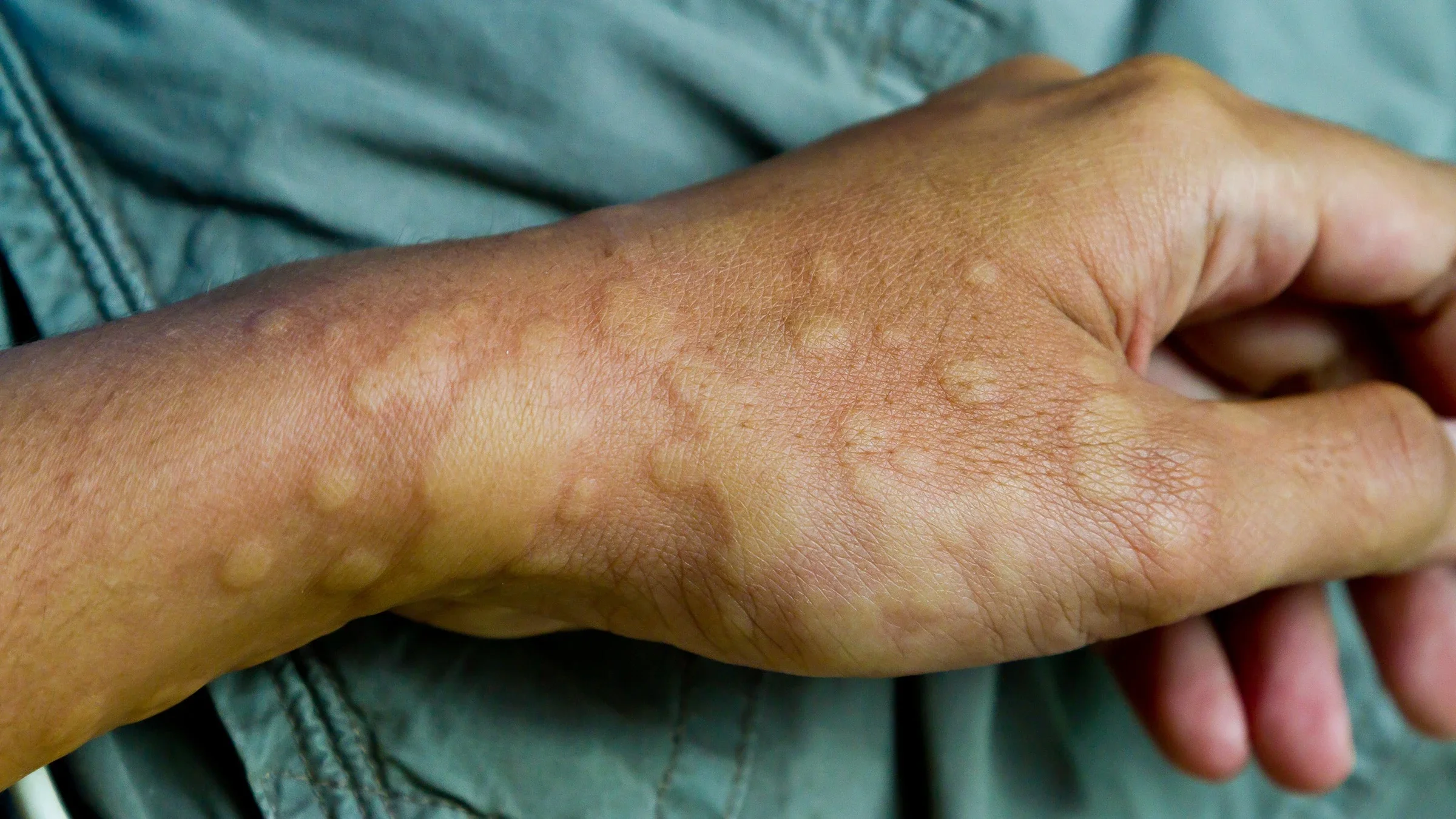
Chronic hives is a type of itchy skin rash that keeps coming and going. There are many different kinds of itchy skin rashes — like eczema and contact dermatitis. But hives tend to come and go quickly. In fact, hives can resolve in as little as 30 minutes. But even as some patches resolve, new hives may continue to appear on other parts of the body.
Search and compare options
“Chronic hives” means the hives continue to come and go for 6 weeks or longer.
There are two main types of chronic hives:
Chronic spontaneous urticaria means the hives have no identifiable trigger.
Chronic inducible urticaria has a known trigger. The trigger can be either physical (like skin scratching) or nonphysical (like food).
Causes of chronic urticaria
Chronic hives often don’t have a clear cause. In one large review of nearly 6,500 people with chronic hives, fewer than 2% were able to find a cause for their symptoms.
We review some specific causes of chronic urticaria in the sections that follow. But it's important to note that even if chronic hives don’t have a clear cause, some exposures can make them worse or cause them to flare more often. Examples include:
Heat or cold
Exercise
Skin scratching
Medications, especially nonsteroidal anti-inflammatory drugs (NSAIDs) like ibuprofen or aspirin
Alcohol (5% to 10% of people find that alcohol worsens their chronic hives)
Can food cause chronic urticaria?
Food allergies are unlikely to cause chronic hives.
Hives from a food allergy are consistent and predictable. With a food allergy, there’ll be a reaction every time you eat the food, even just a small bite. The reaction also happens quickly, often within a few minutes to an hour of eating the food. If you avoid the food, you shouldn’t get any hives.
Unfortunately, chronic hives generally don’t follow this pattern. And testing for food allergies isn’t generally recommended in people with chronic hives.

Read more like this
Explore these related articles, suggested for readers like you.



Can chronic urticaria be a sign of another health condition?
Chronic hives do seem to be associated with certain health conditions, possibly related to increased inflammation. But these conditions will often cause other symptoms besides just chronic hives:
Autoimmune disorders: People with chronic hives are more likely to have autoimmune disorders. The strongest link seems to be with autoimmune thyroid disorders, including both hyperthyroidism and hypothyroidism.
Infections: Chronic hives have also been linked to different infections like hepatitis B, hepatitis C, and herpes — as well as Helicobacter pylori (H. pylori), a common, long-term bacterial infection of the stomach that can cause stomach ulcers.
Can stress cause chronic urticaria?
Very often, people with chronic hives notice their hives are worse with increased stress. There are studies that support this observation, though this might be a “chicken-and-egg” phenomenon. After all, chronic hives can be very uncomfortable, interfere with sleep, and cause significant stress on their own.
Symptoms of chronic urticaria
Chronic hives causes a rash with the following symptoms:
It usually looks like smooth bumps or circular patches. The rash isn't scaly, crusty, or rough.
It’s very itchy. Some people describe a burning or stinging sensation, too.
It can appear lighter, darker, or the same color as the skin.
It can cause swelling underneath the skin.
It shifts in size and/or location in a matter of hours. Typically, a patch of hives disappears within 24 hours.
It resolves without leaving a mark (no skin color changes, scabbing, bruising, or flaking).
How is chronic urticaria diagnosed?
Chronic hives are diagnosed based on the appearance of your rash and the duration and/or frequency of your symptoms. Diagnosing chronic hives is the easy part. Figuring out the cause — if one can be found — is usually harder.
Your healthcare team — either a primary care provider or dermatologist — will go through a careful history of when and where your rash occurs. Figuring out the cause can sometimes be a process of elimination. It can also take some time. Your healthcare team may ask you to keep a journal. Recording the frequency and possible triggers of your symptoms can help them figure out the cause.
Allergy testing isn't recommended, unless there appears to be a clear cause of your symptoms — like a certain food.
When to see a doctor for chronic urticaria
It’s a good idea to see a healthcare professional for any new rash — particularly one that isn't going away or keeps coming back. They can help you figure out if it's hives. And if it's hives, they can help figure out the possible causes.
Call 911 if you’re experiencing symptoms of possible anaphylaxis alongside your hives. These include:
Tightness of the throat
Swelling of the face, lips, tongue, or throat
Difficulty breathing
Fast heartbeat
Nausea or vomiting, abdominal pain, or diarrhea
Dizziness or lightheadedness
Anaphylaxis is life-threatening and needs immediate medical care.
Treatment options for chronic hives
If your hives are mild or infrequent, you might not need treatment. But treatment could be helpful if your hives are severe, frequent, or get in the way of your everyday life.
Over-the-counter (OTC) antihistamines are the medication of choice for chronic hives. Some common options include:
Diphenhydramine (Benadryl) and other older antihistamines can be effective for flares, but they can also make you sleepy.
Zyrtec (cetirizine) or Allegra (fexofenadine) are examples of newer antihistamines that you can use daily to prevent hives. These are much less likely to make you sleepy, and they last around 24 hours.
Famotidine (Pepcid AC) is often used for stomach problems, but it’s also a type of antihistamine that can help control hives.
For hives that don’t get better with antihistamines, there are prescription treatment options.
Some examples are:
Singulair (montelukast) is an oral medication that’s often used for allergies and asthma but can also be helpful for hives.
Prednisone or methylprednisolone (Medrol) are oral steroid medications. These can provide quick relief for several weeks, but they aren’t for long-term treatment.
Xolair (omalizumab) is a monthly injected medication that can help treat very severe or stubborn hives.
How long do chronic hives last?
It’s difficult to predict how long chronic hives will last, but symptoms generally last around 2 to 5 years for most people. About 1 in 3 people don’t have symptoms after the first year, and about 2 in 3 people don’t have symptoms after 5 years.
People who have autoimmune issues or physical triggers for their hives may be more likely to have symptoms for longer than 5 years.
Frequently asked questions
Chronic hives itself isn't an autoimmune disease. But people with autoimmune conditions are more likely to have chronic hives — particularly autoimmune thyroid conditions.
No, hives aren’t contagious. They’re caused by someone's immune system response to a trigger.
The most common food triggers for hives are:
Peanuts and tree nuts
Fish and shellfish
Soy
Dairy
Wheat
Eggs
Chronic hives itself isn't an autoimmune disease. But people with autoimmune conditions are more likely to have chronic hives — particularly autoimmune thyroid conditions.
No, hives aren’t contagious. They’re caused by someone's immune system response to a trigger.
The most common food triggers for hives are:
Peanuts and tree nuts
Fish and shellfish
Soy
Dairy
Wheat
Eggs
The bottom line
Chronic hives are a common condition that can cause both stress and discomfort. But they’re rarely a sign of other health issues. For most people, they’re a very bothersome but otherwise harmless condition. If you think you may be experiencing chronic hives, see a healthcare professional to discuss your symptoms and any triggers you may suspect. Together, you can figure out a plan to ease your symptoms until they eventually resolve on their own.

Why trust our experts?



References
Adams, K. E., et al. (2013). Adverse reactions to alcohol and alcoholic beverages00690-X/fulltext). Annals of Allergy, Asthma & Immunology.
Allergy & Asthma Network. (n.d.). Chronic urticaria: Symptoms, causes and diagnosis.
American Family Physician. (2017). Hives.
Ben-Shoshan, M., et al. (2013). Psychosocial factors and chronic spontaneous urticaria: A systematic review. Allergy.
Bernstein, J. A., et al. (2014). The diagnosis and management of acute and chronic urticaria: 2014 update. Journal of Allergy and Clinical Immunology.
Confino-Cohen, R., et al. (2012). Chronic urticaria and autoimmunity: Associations found in a large population study. Journal of Allergy and Clinical Immunology.
Hiragun, M., et al. (2013). Prognosis of chronic spontaneous urticaria in 117 patients not controlled by a standard dose of antihistamine. Allergy.
Kozel, M. M. A., et al. (2003). Laboratory tests and identified diagnoses in patients with physical and chronic urticaria and angioedema: A systematic review. Journal of the American Academy of Dermatology.
Lee, R., et al. (2025). Chronic spontaneous urticaria and chronic inducible urticaria. Journal of Allergy and Clinical Immunology.
Malhotra, S. K., et al. (2008). Role of stressful life events in induction or exacerbation of psoriasis and chronic urticaria. Indian Journal of Dermatology, Venereology and Leprology.
Toubi, E., et al. (2004). Clinical and laboratory parameters in predicting chronic urticaria duration: A prospective study of 139 patients. Allergy.