foscarnet
Foscarnet (Foscavir) is an antiviral used to treat cytomegalovirus (CMV) retinitis, an eye condition, in people with acquired immunodeficiency syndrome (AIDS). It's also used to treat certain types of herpes simplex virus (HSV) infections in people with weakened immune systems. It's given as an intravenous (IV) infusion by a trained healthcare provider, typically in a hospital setting. Your provider will closely monitor your kidney health and electrolyte levels through blood work while you're receiving foscarnet (Foscavir).


What is Foscarnet (Foscavir)?
What is Foscarnet (Foscavir) used for?
- Cytomegalovirus (CMV) retinitis in people with AIDs
- Herpes simplex virus (HSV) infection that didn't respond well to acyclovir, in people with weakened immune systems
How Foscarnet (Foscavir) works
Foscarnet (Foscavir) is an antiviral that works by blocking a protein the virus needs to make copies of itself and spread in your body.
Drug facts
| Common Brands | Foscavir |
|---|---|
| Drug Class | Antiviral |
| Controlled Substance Classification | Not a controlled medication |
| Generic Status | No lower-cost generic available |
| Availability | Prescription only |

Side effects of Foscarnet (Foscavir)
The following side effects may get better over time as your body gets used to the medication. Let your healthcare provider know immediately if you continue to experience these symptoms or if they worsen over time.
Common Side Effects
- Fever (65%)
- Nausea (47%)
- Lower red blood cell counts (33%)
- Diarrhea (30%)
- Electrolyte or creatinine levels out of balance (27%)
- Vomiting (26%)
- Headache (26%)
Less Common Side Effects
- Seizures
- Feeling tired
- Chills
- Weakness
- Dizziness
- Tinging in arms and legs
- Uncontrolled muscle movements
- Confusion
- Rash
Foscarnet (Foscavir) serious side effects
Contact your healthcare provider immediately if you experience any of the following.
- Seizures
- Abnormal heart rhythm (QT prolongation): chest pounding, trouble breathing, chest pain, feeling faint or lightheaded
- Kidney damage: urinating less often than usual, swelling in your feet, ankles, or hands, unexplained weight gain, itchy skin
- Electrolyte changes: tingling around the mouth, numbness, prickling sensation, muscle weakness or spasms, skipping heartbeats
- Serious allergic reaction: swelling the face or throat, rash, trouble breathing
The following Foscarnet (Foscavir) side effects have also been reported
Along with its needed effects, a medicine may cause some unwanted effects. Although not all of these side effects may occur, if they do occur they may need medical attention.
Check with your doctor or nurse immediately if any of the following side effects occur:
More common
Increased or decreased frequency of urination or amount of urine
increased thirst
Less common
Chills
convulsions
muscle twitching
pain at the injection site
pain or numbness in hands or feet
tingling sensation around the mouth
unusual tiredness and weakness
Rare
Sores or ulcers on the mouth or throat, penis, or vulva
Incidence not known
Difficulty with breathing or swallowing
fainting
hives or welts, itching, or skin rash
irregular heartbeat recurrent
large, hive-like swelling on the face, eyelids, lips, tongue, throat, hands, legs, feet, or sex organs
reddening of the skin, especially around the ears
swelling of the eyes, face, or inside of the nose
Some side effects may occur that usually do not need medical attention. These side effects may go away during treatment as your body adjusts to the medicine. Also, your health care professional may be able to tell you about ways to prevent or reduce some of these side effects. Check with your health care professional if any of the following side effects continue or are bothersome or if you have any questions about them:
More common
Abdominal or stomach pain
anxious feeling
confusion
dizziness
headache
loss of appetite
unusual tiredness or weakness
Other side effects not listed may also occur in some patients. If you notice any other effects, check with your healthcare professional.
Call your doctor for medical advice about side effects. You may report side effects to the FDA at 1-800-FDA-1088.

Pros and cons of Foscarnet (Foscavir)
Pros
Cons
- Each infusion can take 1 to 2 hours
- Only available as an IV infusion
- Raises risk of kidney damage and seizures

Pharmacist tips for Foscarnet (Foscavir)

- It's important for your provider to closely monitor you for side effects while taking foscarnet (Foscavir). This medication can cause changes in your electrolytes, kidney damage, and heart problems. Your provider might need to adjust your dose or stop it altogether if you experience side effects.
- Foscarnet (Foscavir) infusions might irritate your veins, especially if it's infused in the veins of the hand or arm. Your provider will try to minimize this risk by diluting it with IV fluids. Let your care team know if you notice any redness, swelling, or pain where the medication is being infused and they can try to ease your discomfort.
- It's important to stay well-hydrated while receiving foscarnet (Foscavir) to prevent kidney damage and other side effects. Your provider will help make sure you're getting enough fluids during your treatment.
- Since foscarnet (Foscavir) contains sodium (salt), it's important to let your provider know if you're on a low sodium diet.
- Don't drive or operate machinery while you're receiving foscarnet (Foscavir) until you know how it affects you. This medication can cause dizziness, drowsiness, and seizures, which can lead to accidents.

Risks and warnings for Foscarnet (Foscavir)
Foscarnet (Foscavir) can cause some serious health issues. This risk may be even higher for certain groups. If this worries you, talk to your doctor or pharmacist about other options.
Kidney damage
- Risk factors: Lower fluids in the body | Older adults | Taking other medications that harm the kidneys | Receiving foscarnet (Foscavir) infusions too quickly
 Foscarnet (Foscavir) can cause serious harm to the kidneys, especially in older adults. This is typically seen during the second week of treatment, but can happen at any time. The risk is higher for people who are dehydrated (not enough fluids in the body) or take other medications that can harm the kidneys. Your provider will give you IV fluids during treatment to minimize kidney damage. They'll also order blood work to check your kidney health. If your labs show changes in your kidney health, your provider might lower your dose of foscarnet (Foscavir) or stop it altogether.
Electrolyte changes and seizures
- Risk factors: Taking a higher dose of foscarnet (Foscavir) | Receiving foscarnet (Foscavir) infusions too quickly | Kidney problems | History of seizures
Foscarnet (Foscavir) can cause changes to your electrolyte levels, including low calcium, low magnesium, and low potassium levels. In some cases, this can be life-threatening and have also led to seizures. Your provider will regularly monitor your electrolyte levels and provide treatment if needed. Tell your care team if you experience tingling in your arms or legs, muscle spasms, or numbness since these can be signs of electrolyte problems.
Severe allergic reaction
In some rare cases, foscarnet (Foscavir) can cause severe allergic reactions. If you notice a rash, trouble breathing, or swelling in your face or throat, get medical attention right away.
Heart rhythm problems (QT prolongation)
- Risk factors: Older adults | Low blood potassium or magnesium levels | Kidney problems | Heart rate or heart rhythms problems | Taking other medications that can cause QT prolongation
Foscarnet (Foscavir) can affect your heart rhythm, which can be serious and life-threatening. One example includes lengthening the time period from when the heart pumps and then relaxes. This is known as QT prolongation. Your risk for QT prolongation is higher if you currently have heart or electrolyte problems, or are taking other medications that can cause heart rhythm problems. Your provider will check your heart with an electrocardiogram (ECG) before and during treatment. If you feel your chest pounding, have trouble breathing or chest pain, or feel faint or lightheaded while taking foscarnet (Foscavir), get medical help right away.
Low blood cell counts
- Risk factors: Taking other medications that affect blood cell count | Kidney problems
Foscarnet (Foscavir) can lower your blood cell counts, including red blood cells and white blood cells. This can make you feel more tired or make it harder for your body to fight new infections. Your provider will order blood tests regularly and might change your dose of foscarnet (Foscavir). In some cases, your provider might stop the medication altogether if your blood counts become too low.

Foscarnet (Foscavir) dosage
Typical dosage for Foscarnet (Foscavir)
Your provider will calculate the dose of foscarnet (Foscavir) based on your body weight. This medication is typically given as a slow infusion into the veins (IV) by a trained healthcare provider in a hospital or clinic setting.
-
Treatment of CMV eye infection
- Starting dose: The typical dose is 90 mg/kg given IV every 12 hours, or 60 mg/kg given every 8 hours. Treatment with the starting dose usually lasts 2 to 3 weeks, depending on your condition.
- Maintenance dose: The typical dose is 90 mg/kg given IV once daily. If needed, your provider might raise your dose to 120 mg/kg once daily. Your provider will determine when you can stop your infusions.
-
Treatment of herpes simplex virus: The typical dose is 40 mg/kg given IV every 8 to 12 hours for 2 to 3 weeks or until healed.
Your dose might differ if you have kidney problems.

Interactions between Foscarnet (Foscavir) and other drugs
Although certain medicines should not be used together at all, in other cases two different medicines may be used together even if an interaction might occur. In these cases, your doctor may want to change the dose, or other precautions may be necessary. When you are receiving this medicine, it is especially important that your healthcare professional know if you are taking any of the medicines listed below. The following interactions have been selected on the basis of their potential significance and are not necessarily all-inclusive.
Using this medicine with any of the following medicines is not recommended. Your doctor may decide not to treat you with this medication or change some of the other medicines you take.
- Arsenic Trioxide
- Bepridil
- Cisapride
- Dronedarone
- Levomethadyl
- Mesoridazine
- Pimozide
- Piperaquine
- Probucol
- Saquinavir
- Sparfloxacin
- Terfenadine
- Thioridazine
- Ziprasidone
Using this medicine with any of the following medicines is usually not recommended, but may be required in some cases. If both medicines are prescribed together, your doctor may change the dose or how often you use one or both of the medicines.
- Acecainide
- Acyclovir
- Ajmaline
- Alfuzosin
- Amikacin
- Amiodarone
- Amisulpride
- Amitriptyline
- Amoxapine
- Amphotericin B
- Anagrelide
- Apomorphine
- Aprindine
- Aripiprazole
- Aripiprazole Lauroxil
- Asenapine
- Astemizole
- Atazanavir
- Azimilide
- Azithromycin
- Bedaquiline
- Bretylium
- Bumetanide
- Buprenorphine
- Buserelin
- Capreomycin
- Ceritinib
- Chloral Hydrate
- Chloroquine
- Chlorpromazine
- Cidofovir
- Ciprofloxacin
- Citalopram
- Clarithromycin
- Clofazimine
- Clomipramine
- Clozapine
- Crizotinib
- Cyclobenzaprine
- Cyclosporine
- Dabrafenib
- Dasatinib
- Degarelix
- Delamanid
- Desipramine
- Deslorelin
- Deutetrabenazine
- Dibekacin
- Dibenzepin
- Disopyramide
- Dofetilide
- Dolasetron
- Domperidone
- Donepezil
- Doxepin
- Droperidol
- Ebastine
- Efavirenz
- Encainide
- Encorafenib
- Enflurane
- Entrectinib
- Eribulin
- Erythromycin
- Escitalopram
- Ethacrynic Acid
- Famotidine
- Felbamate
- Fingolimod
- Flecainide
- Fluconazole
- Fluoxetine
- Formoterol
- Fosphenytoin
- Fostemsavir
- Framycetin
- Furosemide
- Galantamine
- Gatifloxacin
- Gemifloxacin
- Gentamicin
- Glasdegib
- Gonadorelin
- Goserelin
- Granisetron
- Halofantrine
- Haloperidol
- Halothane
- Histrelin
- Hydroquinidine
- Hydroxychloroquine
- Hydroxyzine
- Ibutilide
- Iloperidone
- Imipramine
- Inotuzumab Ozogamicin
- Isepamicin
- Isoflurane
- Isradipine
- Itraconazole
- Ivabradine
- Ivosidenib
- Kanamycin
- Ketoconazole
- Lapatinib
- Lefamulin
- Lenvatinib
- Levofloxacin
- Lidoflazine
- Lofexidine
- Lorcainide
- Lumefantrine
- Macimorelin
- Mefloquine
- Methadone
- Methotrexate
- Methotrimeprazine
- Metronidazole
- Mifepristone
- Mirtazapine
- Mizolastine
- Moricizine
- Moxifloxacin
- Nafarelin
- Nelfinavir
- Neomycin
- Netilmicin
- Nilotinib
- Norfloxacin
- Nortriptyline
- Octreotide
- Ofloxacin
- Olanzapine
- Ondansetron
- Osilodrostat
- Osimertinib
- Oxaliplatin
- Ozanimod
- Paliperidone
- Panobinostat
- Papaverine
- Paromomycin
- Paroxetine
- Pasireotide
- Pazopanib
- Pentamidine
- Perphenazine
- Pimavanserin
- Pipamperone
- Pirmenol
- Pitolisant
- Ponesimod
- Posaconazole
- Prajmaline
- Procainamide
- Prochlorperazine
- Promethazine
- Propafenone
- Protriptyline
- Quetiapine
- Quinidine
- Quinine
- Ranolazine
- Ribociclib
- Risperidone
- Ritonavir
- Selpercatinib
- Sematilide
- Sertindole
- Sertraline
- Sevoflurane
- Siponimod
- Sisomicin
- Sodium Phosphate
- Sodium Phosphate, Dibasic
- Sodium Phosphate, Monobasic
- Solifenacin
- Sorafenib
- Sotalol
- Spectinomycin
- Spiramycin
- Streptomycin
- Sulfamethoxazole
- Sulpiride
- Sultopride
- Sunitinib
- Tacrolimus
- Tamoxifen
- Tedisamil
- Telaprevir
- Telavancin
- Telithromycin
- Tetrabenazine
- Tobramycin
- Tolterodine
- Toremifene
- Torsemide
- Trazodone
- Triclabendazole
- Trifluoperazine
- Trimethoprim
- Trimipramine
- Triptorelin
- Valacyclovir
- Vandetanib
- Vardenafil
- Vemurafenib
- Venlafaxine
- Vilanterol
- Vinflunine
- Voclosporin
- Voriconazole
- Vorinostat
- Zolmitriptan
- Zotepine
- Zuclopenthixol

What are alternatives to Foscarnet (Foscavir)?

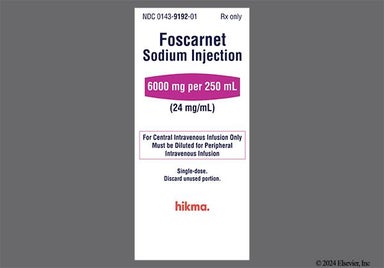
Foscarnet (Foscavir) images