Key takeaways:
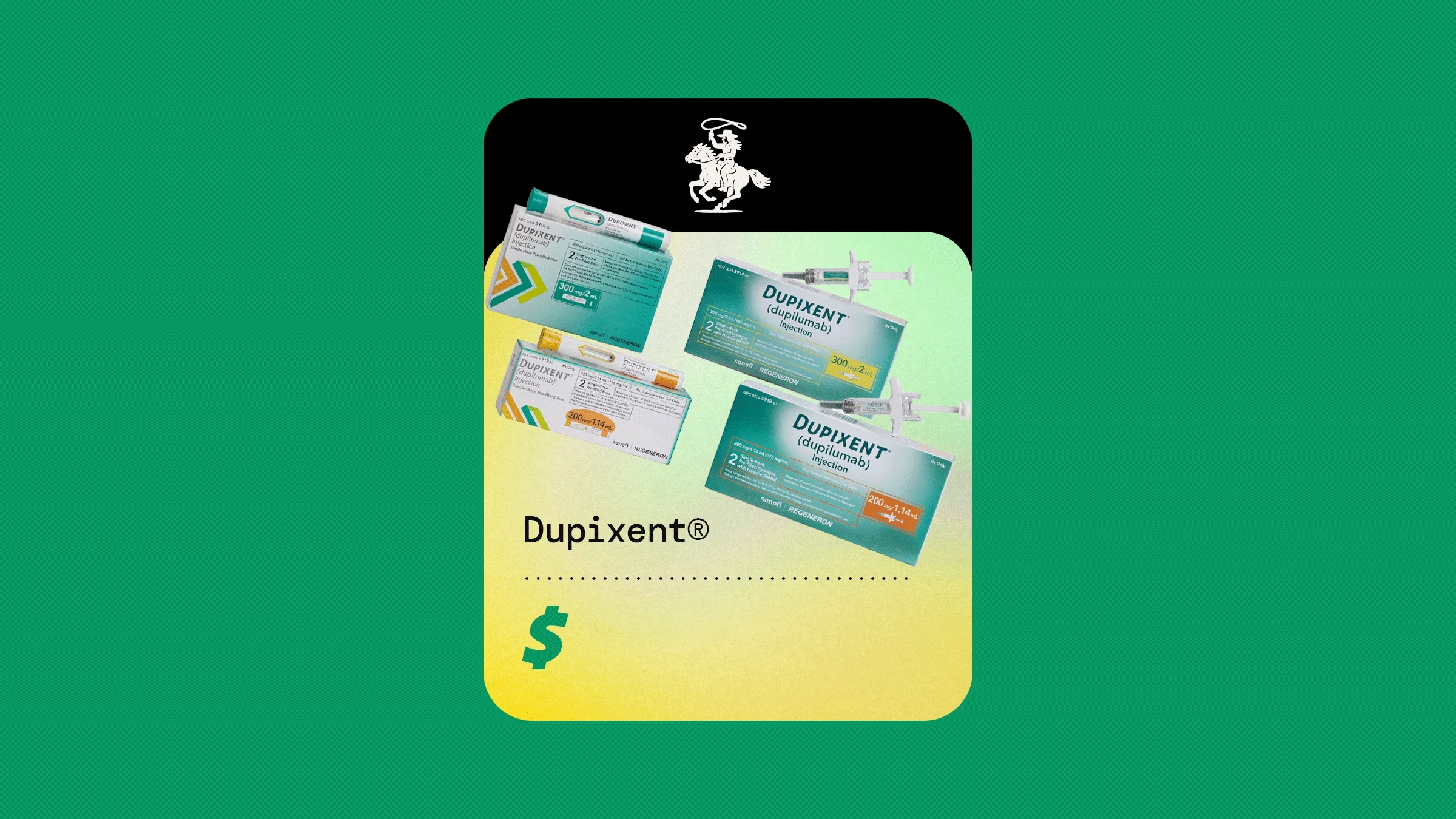
Dupixent (dupilumab) is a prescription medication that’s FDA approved to treat several health conditions. Two prefilled pens of Dupixent 300 mg / 2 mL cost about $2787.08 without insurance or discounts.
Insurance plans generally cover Dupixent, with most requiring prior authorization or step therapy.
You may be able to get Dupixent at no cost if you qualify for the manufacturer’s copay card or patient assistance program.
Save on related medications
Dupixent (dupilumab) is a prescription injectable medication approved to treat several conditions, including asthma and chronic obstructive pulmonary disease (COPD). Without insurance, a month’s supply can cost several thousand dollars, and there’s no biosimilar alternative.
Because Dupixent requires special handling and storage, it’s dispensed through specialty pharmacies rather than traditional retail pharmacies. If you’re concerned about cost, there are several savings strategies that may help lower your out-of-pocket expenses.
How much does Dupixent cost?
As of January 2026, the manufacturer’s list price for Dupixent is $4,193 per carton of 2 injections. Retail prices may be different depending on the pharmacy and other factors.
Below is the average retail price for different doses and forms of Dupixent at some pharmacies:
Dupixent quantity and form | Dose | Average retail price |
|---|---|---|
2 prefilled syringes (1 carton) | 200 mg / 1.14 mL | |
2 prefilled pens (1 carton) | 200 mg / 1.14 mL | |
2 prefilled syringes (1 carton) | 300 mg / 2 mL | |
2 prefilled pens (1 carton) | 300 mg / 2 mL |
How long a carton of pens or syringes lasts depends on your prescribed dosage and whether you need a loading dose. For example, for eczema, the recommended loading dose for adults is 600 mg (two 300 mg injections). After that, the maintenance dose is 300 mg every 2 weeks. This means two 300 mg / 2 mL pens will last about 1 month. But some conditions don’t require a loading dose.
Which factors affect the cost of Dupixent?
What you’ll pay for Dupixent depends on several factors, such as:
Where you live: Medication prices vary by location. For example, GoodRx research shows that people living in Little Rock, Arkansas, often pay higher prescription costs, while those in Denver tend to see lower prices.
Pharmacy: Even in the same neighborhood, prices for Dupixent can vary among pharmacies.
Insurance: If you have insurance, your cost will depend on your plan’s coverage and cost sharing, such as deductibles, copays, and coinsurance.
Dosage: The dose you need depends on the condition being treated. For children and teens, the dosage is often based on age and body weight. All of this can affect your cost.
Discounts: You may be able to lower your cost for Dupixent by using the manufacturer’s savings copay card.
Does insurance cover Dupixent?
Nearly all insurance plans cover Dupixent. Medicare covers Dupixent for all enrollees. And almost everyone enrolled in Medicaid, Affordable Care Act (ACA) marketplace, and commercial insurance plans has coverage.
Prior authorization is required for the vast majority of ACA and commercial plan enrollees, as well as about 4 out of 5 Medicaid enrollees. All covered Medicare beneficiaries must also get prior authorization. Step therapy rules (trying other medications before Dupixent is covered) apply to most covered enrollees across all plan types.
To better understand your insurance coverage and costs, check your health plan’s formulary (list of covered medications), or contact your insurer to verify what requirements you must meet.
How different insurance plans cover Dupixent
The table below shows how various insurance types cover Dupixent, plus whether prior authorization or step therapy is required.
Insurance type | Enrollees covered for Dupixent pen 300 mg | Enrollees required to get prior authorization | Enrollees required to do step therapy |
|---|---|---|---|
97.9% | 91.6% | 87.8% | |
Commercial plans (excluding ACA plans) | 99.2% | 93.7% | 93.9% |
Medicare (original Medicare and Medicare Advantage plans) | 100.0% | 100.0% | 96.2% |
Medicaid, including state-run and managed care plans | 99.6% | 81.4% | 80.9% |
Source: Managed Markets Insight & Technology, LLC™, as of August 8, 2025. (See methodology below.)
What to do if Dupixent isn’t covered by your insurance
If Dupixent isn’t covered by your plan, you can:
Check to see if you qualify for financial assistance through the manufacturer’s copay card (see below for more details).
Ask your prescriber about other medications that may be covered by your plan and could cost less out of pocket.
Request a formulary exception from your insurer. Your prescriber may need to submit paperwork and a letter of medical necessity explaining why Dupixent is needed.
If your insurer denies the formulary exception request, you can file an appeal.
During open enrollment for health insurance, look for a plan that offers better coverage for Dupixent and your other medications.
Ways to save on Dupixent
Dupixent can cost a few thousand dollars each month if you don’t have insurance. But there are ways to lower your out-of-pocket costs or even get the medication for free.
1. Apply for the manufacturer’s copay savings card
You may pay as little as $0 for your prescription with the Dupixent MyWay Copay Card.
To qualify, you must:
Have commercial insurance, including marketplace plans, federal employee plans, and state employee plans
Live in the U.S., including the District of Columbia, Puerto Rico, Guam, or the U.S. Virgin Islands
Have a valid Dupixent prescription for an FDA-approved condition
You and your prescriber must complete an enrollment form based on the condition being treated. You’re not eligible for the copay savings program if you have Medicare, Medicaid, Veterans Affairs, Tricare, or other government-funded insurance. The program also isn’t valid if your insurance already covers the full cost of your prescription.
2. See if you qualify for the manufacturer’s patient assistance program
If you don’t qualify for the Dupixent MyWay Copay Card, you may still be able to get help through the manufacturer’s patient assistance program.
To be eligible, you must:
Meet certain income requirements
If approved, you’ll receive Dupixent at no cost. Enrollment in the patient assistance program uses the same form as the copay savings card. Once it’s submitted, Dupixent MyWay representatives will review your information and let you know which program you qualify for.
3. Check for PAN Foundation assistance
The Patient Access Network (PAN) Foundation may help cover Dupixent costs based on your diagnosis and whether you meet its eligibility requirements.
Funding is available only at certain times of the year, so it’s a good idea to check its website for updates.
4. Use your insurance’s preferred specialty pharmacy
If you have insurance coverage for Dupixent, make sure to fill your prescription with your plan’s preferred specialty pharmacy.
Using your plan’s preferred pharmacy can help you avoid higher out-of-pocket costs associated with going out of network. Specialty pharmacies can also help you find financial assistance. Ask your insurer for a list of preferred specialty pharmacies.
5. Ask for a 90-day supply
Talk to your prescriber about getting a 90-day supply of Dupixent. Many pharmacies offer discounts for larger supplies if you’re paying cash. Plus, some insurance plans reduce copays when you fill a 90-day supply instead of getting monthly refills. Savings aren’t guaranteed, but this option could lower your costs.
If Dupixent is covered by your plan, find out if your insurer’s mail-order pharmacy offers discounts for a 90-day supply.
6. Consider using your tax-free dollars
Do you have a health savings account (HSA), flexible spending account (FSA), or health reimbursement arrangement (HRA)? Consider using these tax-free dollars to cover the cost of Dupixent and other eligible expenses.
You must use your FSA funds by the end of the plan year, or you’ll lose them. But HSA funds roll over annually and are available for use anytime. HRA money may roll over depending on your plan.
The bottom line
Without insurance or discounts, 2 prefilled pens of Dupixent (dupilumab) 300 mg / 2 mL cost around $2787.08. The actual amount you’ll pay depends on your location, pharmacy, insurance coverage, and prescribed dose.
If you have commercial insurance, you may qualify for the manufacturer’s copay card, which can reduce your costs to as little as $0 per prescription. The manufacturer’s patient assistance program may provide Dupixent at no cost if you are uninsured and meet income requirements.
You can also lower your Dupixent costs by choosing your plan’s preferred specialty pharmacy or paying with your tax-free funds.

Why trust our experts?



Methodology
We obtained national prescription coverage data for each medication from Managed Markets Insight & Technology (MMIT). The data reflects health insurance coverage as of August 2025.
We calculated the **percentage of enrollees in plans that cover each medication** by dividing the number of enrollees covered for the medication within a specific insurance channel (e.g., ACA, Medicare, Medicaid) by the total number of enrollees in all plans within that channel.
We determined the **percentage of enrollees in plans with a prior authorization **requirement by calculating the proportion of enrollees in plans that required prior authorization for the medication within each channel.
Finally, we measured the **percentage of enrollees in plans with a step therapy** requirement by calculating the proportion of enrollees in plans that imposed step therapy requirements for the medication in each channel.
These estimates, derived from national MMIT coverage data, provide insight into health insurance coverage for each medication. They take into account restrictions such as prior authorization, step therapy, and quantity limits. The percentages are expressed relative to the total number of enrollees covered by various insurance channels, including ACA plans, commercial (excluding ACA) plans, Medicare, and Medicaid (both state-run and managed care plans).
References
Dupixent MyWay. (n.d.). Copay card. Sanofi.
Dupixent MyWay. (n.d.). Patient assistance program. Sanofi.
HealthCare.gov. (n.d.). Appealing a health plan decision. Centers for Medicare & Medicaid Services.
Medicaid.gov. (n.d.). Managed care. Centers for Medicare & Medicaid Services.
Patient Advocate Foundation. (n.d.). List of all TotalAssist funds.