Key takeaways:
A mammogram involves compressing the breasts between two X-ray machine plates to get an image of breast tissue.
Mammograms can be uncomfortable. But the discomfort is brief, and it’s not typically described as painful.
Here, three medical professionals weigh in on their personal experiences with mammograms.
Multiple studies have shown that regular mammograms save lives. Women with breast cancer don’t usually have symptoms in the early stages of breast cancer. A mammogram can detect signs of breast cancer, giving women a better chance of beating it.
But some women still avoid the procedure. Some think they don’t need the test because they haven’t found any lumps or their families have no history of breast cancer. Others are unsure of what the test involves, or whether it will be painful, or they worry they’ll be exposed to too much radiation. Some fear learning they have cancer and requiring treatment, or they have anxiety about false-positive results.
Most women get breast cancer screenings starting at age 40. Those with higher risk factors for breast cancer may need to start earlier.
GoodRx asked three women to share their experiences with having mammograms.
Breast cancer surgeons get mammograms, too
Anne Peled, MD, knows how important mammograms are: She’s a breast cancer surgeon and researcher. She gets regular mammograms and encourages others to do the same. Still, she knows some people avoid the procedure.

“Fear is very common, especially for people who have never had one before,” says Anne, 43, of Mill Valley, California. “There’s a ton of fear around what’s actually going to happen when you get there. Is it going to hurt? Will you get bad news while you’re there?”
Here’s her professional and personal take: “It can definitely be uncomfortable getting your breasts in the mammogram machine and a little painful when the technicians compress your breast tissue. But it’s over quickly. Each image takes 20 or 30 seconds.”
Anne says she’s never had pain or discomfort after a mammogram. Some of her patients have told her that they have.
To address fears, Anne suggests learning about how the test is performed.
“The waiting room can be more stressful than the actual test. Go in knowing that you’ll be doing one breast at a time. And the time your breast is compressed in the machine will be relatively fast. Talk to the technicians, who do a great job of explaining the choreography of what’s going on.”

How much does a mammogram cost? Without insurance, the national average is $400 for a 2D mammogram and $658 for a more advanced 3D scan.
Does a breast biopsy mean you have cancer? No. Most biopsies turn out not to be cancer.
What does a breast cancer lump feel like? Here’s how three women describe it.
It can be uncomfortable — but lifesaving
Mandy Reece, PharmD, an assistant dean and professor at the Philadelphia College of Osteopathic Medicine’s Georgia location, never enjoyed having mammograms, finding them uncomfortable. But she knows their importance — five women in her friend circle have been diagnosed and treated for cancer after mammograms. She began having yearly exams at age 40.
“I’m big on self-care. And having a mammogram is part of taking care of myself,” says Mandy, 48, who lives in suburban Atlanta. Besides, the test wasn’t really that bad: “You stand in different positions, and your breasts are squished down like a pancake while they take X-rays of your breasts from different angles. It was uncomfortable, but I never had pain afterward.”

Like half of women across the country, Mandy has dense breast tissue. That makes mammograms more difficult to read. After her mammogram in 2023, she wasn’t surprised to be called back for another test. After all, out of the seven mammograms she’d had up to that point, she’d had to have a follow-up mammogram five times.
Still, she was concerned. “It was a little overwhelming,” she says. “It can also be very emotional.”
After the second mammogram and a needle biopsy, doctors determined that Mandy had cancer. Doctors said she could choose a lumpectomy with radiation or a mastectomy, with or without reconstruction.
But a friend had opted for a lumpectomy and then had to do it all over again when her cancer returned. So, Mandy chose bilateral mastectomy.
”I wanted peace of mind that all of the cells were gone,” she says.
During surgery, doctors found that Mandy had aggressive HER2+ cancer cells that hadn’t spread. After surgery, Mandy underwent chemotherapy and immunotherapy.
She’s since had breast reconstruction, meaning her mammogram days are over. Instead, she urges others to have the procedure, allowing her medical center to tell her story on its website.
“I got on the advocacy bus,” she says. “Sometimes my friends send mammogram selfies. I know that my journey is impacting the lives of my friends.”
Doctor says the discomfort is worth it
About a year-and-a-half ago, Laura Purdy, MD, looked at the breasts that had fed her four children and thought they looked like “two empty Ziploc bags." She decided to address the aesthetic issue with breast augmentation surgery. But first, she needed a mammogram.
Beforehand, "I was really nervous," says Laura, 39, of Miami, a family medicine doctor who now leads a concierge health care service. “Everybody talks about how much they hurt. I hear women say, ‘They’re going to squeeze my boobs on this plate,’ and oh, the stories.”
But after? Not bad at all. “Nothing's more painful than a breastfeeding baby who bites.”
Laura’s doctors ordered a 3D mammogram. Both 2D and 3D mammograms involve the same manner of positioning and compressing and the same amount of radiation. The 3D process provides more and clearer images of the breast tissue, making cancer easier to find.
Her first 3D mammogram showed some abnormalities, so she followed up with another one, as well as a traditional mammogram and an ultrasound. The follow-ups showed no problems.
Now with fuller breasts, Laura says it’s easier to have a mammogram, because there’s more tissue to stretch. She now has the test annually.
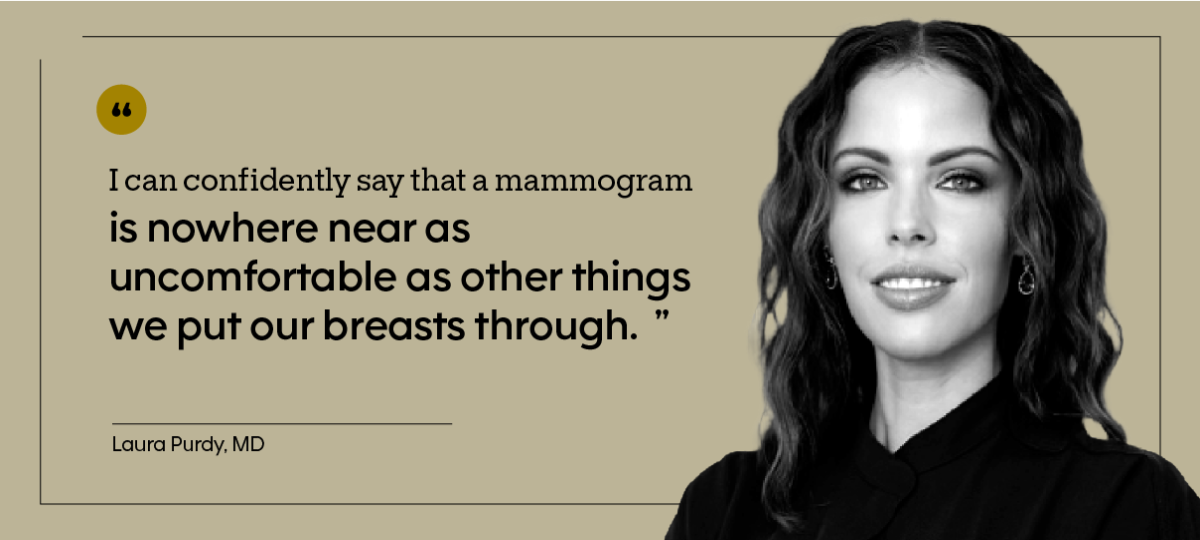
“I can confidently say that a mammogram is nowhere near as uncomfortable as other things we put our breasts through,” she says.
Frequently asked questions
Mammogram discomfort can differ for everyone, regardless of breast size.
Mammogram discomfort can differ for everyone, regardless of breast size.
The bottom line

Why trust our experts?




Mammograms can be uncomfortable because of the firm pressure on the breasts. But, they are essential for finding breast cancer early. They usually last only 20 to 30 seconds per image. The discomfort is often outweighed by the benefits of finding issues early.