Key takeaways:
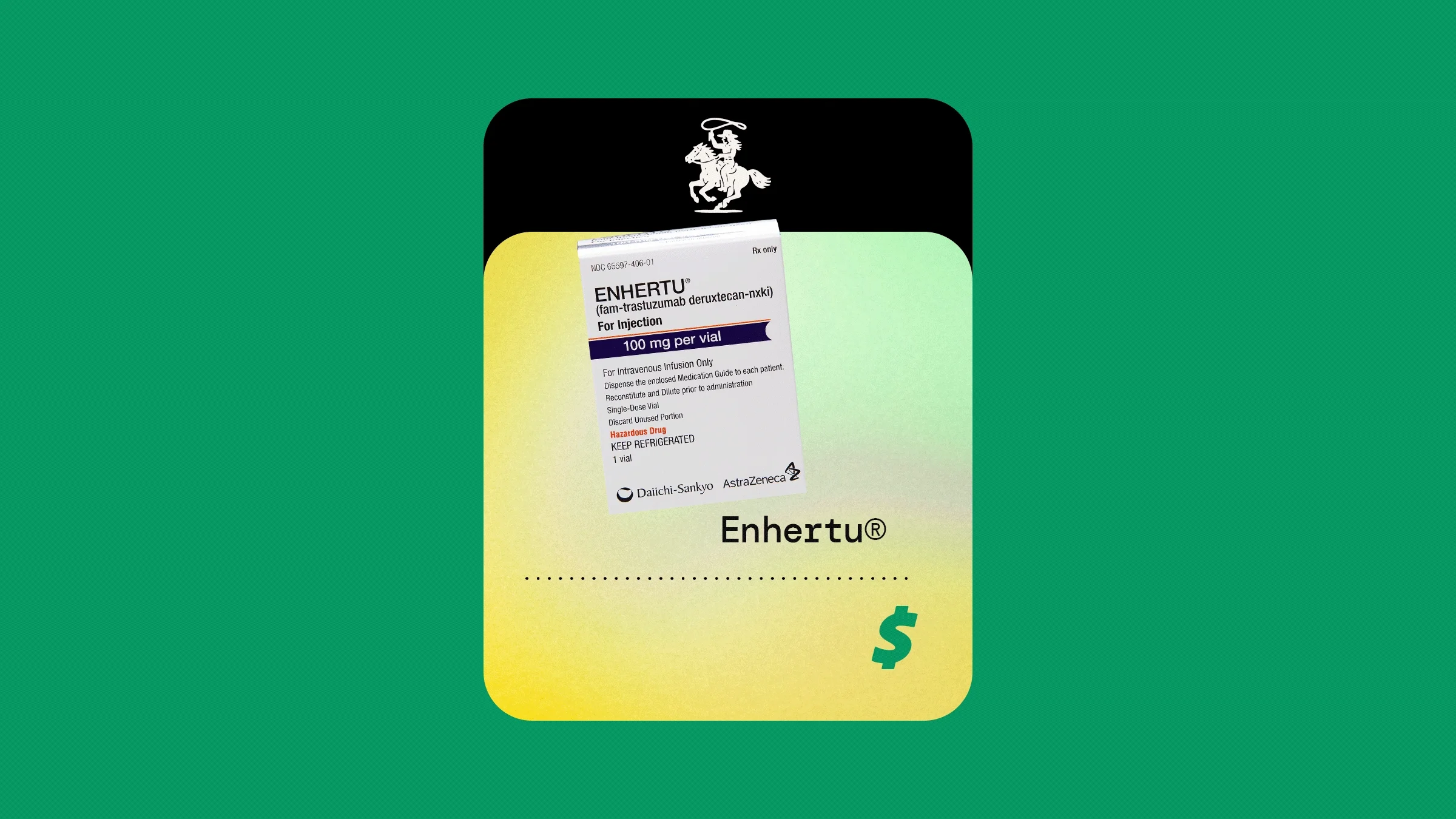
Enhertu (fam-trastuzumab deruxtecan-nxki) is a medication that targets cancer cells in people who have certain HER2-positive breast, lung, and stomach cancers, among other solid tumors.
Enhertu is a brand-name specialty medication. It is administered intravenously by a healthcare professional in a medical setting. Its cost depends on the dosage you need and the length of time you receive the medication. Enhertu, a biologic medication, can cost more than $150,000 per year if you don't have insurance. There is no generic or biosimilar option.
You may be able to reduce your out-of-pocket costs for Enhertu with a copay savings card or a patient assistance program, or through independent foundations that provide financial support.
Save on related medications
One factor that can affect how certain cancerous cells grow is the presence of a gene called human epidermal growth factor receptor 2 (HER2). In some people, changes in the HER2 gene can lead to the overproduction of HER2 proteins on cancer cells. That can cause cancer cells to grow faster or more aggressively. About 15% to 20% of breast tumors are HER2 positive.
Enhertu (fam-trastuzumab deruxtecan-nxki) is a medication that is used to treat certain HER2-positive cancers of the breasts, lungs, and stomach (among other solid tumors). This targeted therapy may be prescribed when someone has metastatic disease, which means the cancer has spread from one part of the body to another. It is also often used when HER2-positive breast cancer recurs during treatment or within 6 months of completing treatment.
Enhertu works differently from traditional chemotherapy. As an antibody-drug conjugate, this medication connects a monoclonal antibody to chemotherapy. The antibody attaches to HER2 proteins on cancer cells. It releases the chemotherapy into the cells in a targeted manner. The chemotherapy then attempts to destroy the cancer cells to slow the progression of cancer. Here’s how much you can expect to pay and how you may be able to save on this medication.
How much does Enhertu cost?
Enhertu is a brand-name medication; there is no generic or biosimilar version. It’s typically administered in a healthcare setting as an IV infusion every 3 weeks.
It’s also costly. Enhertu comes in a 100 mg vial, and multiple vials may be needed for a full dose. Without insurance, one 100 mg vial of Enhertu can cost $2,440 to more than $3,000. Estimated annual treatment costs could range from $9,500 to more than $165,000. The cost will depend on your dosage and how long you need the medication.
Which factors affect the cost of Enhertu?
Insurance coverage can help defray the cost of Enhertu. Your out-of-pocket costs for this treatment depends on several factors, such us:
Whether you use a specialty pharmacy: Unlike retail pharmacies, specialty pharmacies dispense medications that treat complicated or rare conditions. The medications may need to be administered by a healthcare professional. All pharmacies set their own retail prices. A specialty pharmacy may supply this medication to your cancer center or the facility may acquire Enhertu to treat you.
How your medication is dispensed: Depending on how your Enhertu is dispensed at your cancer center, your medication can be covered by the medical benefit of your health insurance or your prescription plan. Health insurance plans and prescription plans typically have different deductibles. And your costs may be higher for infusion- or administration-specific costs charged by the facility.
Where you live: Medication costs vary in different parts of the country — and even in different parts of the same city.
Does insurance cover Enhertu?
Some health insurance plans cover Enhertu. For example, most Medicaid plans and commercial plans not purchased through an Affordable Care Act (ACA) marketplace cover this medication.
If you have insurance, review your plan’s summary of benefits and coverage and formulary (list of covered medications). This can help you determine if Enhertu is covered. If not, contact your plan provider and ask about your coverage options. You can also discuss alternative treatments with your prescriber or a pharmacist.
How different insurance plans cover Enhertu
This chart shows the likelihood of having Enhertu coverage with different types of insurance. It also shows the likelihood of having prior authorization and step therapy requirements.
Insurance type | Enrollees covered for Enhertu 100 mg IV solution | Enrollees required to get prior authorization | Enrollees required to do step therapy |
|---|---|---|---|
51.4% | 45.2% | 0.8% | |
Commercial plans (excluding ACA plans) | 79% | 48.7% | 1.3% |
Medicare (Medicare Advantage and Part D plans) | 26.7% | 23.2% | 7.3% |
Medicaid, including state-run and managed care plans | 86.5% | 44.2% | 0% |
Source: Managed Markets Insight & Technology, LLC™, as of September 11, 2025. (See methodology below.)
Tips if your medication isn’t covered by insurance
If your insurance doesn’t cover Enhertu, you still have options. You can:
Ask your prescriber about less costly medications that meet your needs. This could mean switching to another brand-name medication or to a generic medication. In the case of Enhertu, there is no generic or biosimilar medication. But there may be a less costly cancer treatment that’s effective for your condition.
Request a formulary exception from your insurance company. If your request is denied, you have the right to file an appeal with your plan.
During open enrollment, compare insurance plans to find one that provides the coverage you need.
Ways to save on Enhertu
Whether or not you have insurance, there are ways to reduce your out-of-pocket costs for Enhertu. Here are four options.
1. See if you qualify for a copay savings card
Daiichi Sankyo and AstraZeneca, the global makers of Enhertu, offer financial assistance for this medication. If you have commercial insurance that covers Enhertu, you may qualify for financial support through the Enhertu Patient Savings Program. (You aren’t eligible if you have Medicare, Medicaid, or another government insurance plan.)
A copay savings card issued through the program may cover the medication itself, as well as up to $100 per infusion for administration costs. This could leave you to pay as little as $0 per dose. There are no income requirements needed to participate in this program.
2. Check if you’re eligible for a manufacturer patient assistance program
If you don't have commercial insurance or any type of insurance, you may still qualify for help paying for this medication. Enhertu’s manufacturer-sponsored patient assistance programs can help those who are uninsured, are underinsured, or have government-sponsored insurance that doesn’t cover this treatment. You may also qualify for help if you have Medicare and spend at least 3% of your annual household income on medications in the current year.
Even if you don’t meet patient assistance program income requirements, you are urged to apply if you’ve had a life-changing event in the past year such as a job loss, income decline, loss of insurance coverage, shift in marital status, or change in the number of people in your household.
3. Explore independent foundations
You may be able to receive financial help through other patient assistance programs that help people access healthcare. The manufacturer website includes a list of independent charitable organizations such as the CancerCare Financial and Co-Pay Assistance program and The Assistance Fund may be able to help you afford Enhertu.
4. Tap into your HSA, FSA, or HRA
Consider using a flexible spending account (FSA), health savings account (HSA), or health reimbursement arrangement (HRA) to pay for your medication. These types of accounts have multiple tax benefits when they’re used to pay for qualified healthcare expenses. This can reduce your out-of-pocket costs through tax savings. But be sure to review your account’s contribution limits, rollover limits, and eligible expenses.
The bottom line
Enhertu (fam-trastuzumab deruxtecan-nxki) is a brand-name medication used to treat HER2-positive breast cancer, lung cancer, and more. There is no generic or biosimilar option. This IV medication is typically given in a healthcare setting every 3 weeks.
Depending on the length of your treatment, Enhertu can cost more than $150,000 per year without insurance. If you have commercial insurance, you may be able to take advantage of a copay savings card that can drop your out-of-pocket costs for the medication to as low as $0 and can cover up to $100 for the IV administration. If you don't have insurance or you have Medicare and can't afford the medication, you may be able to qualify for assistance through the manufacturer’s patient assistance program. Independent foundations that provide financial support for medications could also be sources of aid to help you pay for Enhertu.

Why trust our experts?




Methodology
We obtained national prescription coverage data for each medication from Managed Markets Insight & Technology (MMIT). The data reflects health insurance coverage as of September 2025.
We calculated the percentage of enrollees in plans that cover each medication by dividing the number of enrollees covered for the medication within a specific insurance channel (e.g., ACA, Medicare, Medicaid) by the total number of enrollees in all plans within that channel.
We determined the percentage of enrollees in plans with a prior authorization requirement by calculating the proportion of enrollees in plans that required prior authorization for the medication within each channel.
Finally, we measured the percentage of enrollees in plans with a step therapy requirement by calculating the proportion of enrollees in plans that imposed step therapy requirements for the medication in each channel.
These estimates, derived from national MMIT coverage data, provide insight into health insurance coverage for each medication. They take into account restrictions such as prior authorization, step therapy, and quantity limits. The percentages are expressed relative to the total number of enrollees covered by various insurance channels, including ACA plans, commercial (excluding ACA) plans, Medicare, and Medicaid (both state-run and managed care plans).
References
American Cancer Society. (2025). Breast cancer HER2 status.
The Assistance Fund. (n.d.). 2026 TAF reenrollment update.
CancerCare. (n.d.). Financial and co-pay assistance.
Daiichi Sankyo. (2025). Enhertu- fam-trastuzumab deruxtecan-nxki injection, powder, lyophilized, for solution [package insert].
Enhertu. (n.d.). Affording your medicine. AstraZeneca.
Hakim, R. (2025). Enhertu: A targeted therapy for advanced cancers. AmeriPharma Specialty Care.
Iqbal, N., et al. (2014). Human epidermal growth factor receptor 2 (HER2) in cancers: Overexpression and therapeutic implications. Molecular Biology International.
Medicaid.gov. (n.d.). Managed care. Centers for Medicare & Medicaid Services.
Modi, S., et al. (2022). Trastuzumab deruxtecan in previously treated HER2-low advanced breast cancer. The New England Journal of Medicine.
U.S. Food and Drug Administration. (2024). FDA grants accelerated approval to fam-trastuzumab deruxtecan-nxki for unresectable or metastatic HER2-positive solid tumors.