

Buprenorphine Dosages for Adults: Your GoodRx Guide
Learn about buprenorphine dosage information, including standard dosages for adults, adjustments for health conditions, and what to do if you miss a dose.
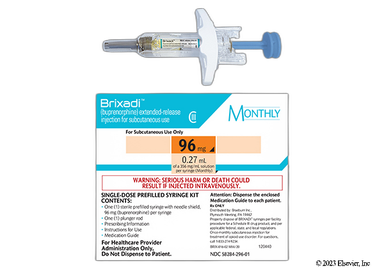
Brixadi (buprenorphine) is an injection given under the skin by a healthcare professional for moderate to severe opioid use disorder. It's typically given along with counseling, as well as social and emotional support. Brixadi (buprenorphine) is conveniently given once per week or once per month, but it's only for people who've previously tolerated another form of buprenorphine (e.g., buprenorphine (Zubsolv) film or buprenorphine (Subutex)). Some side effects of Brixadi (buprenorphine) include injection site reactions (e.g., pain or swelling), headache, and constipation.

Brixadi (buprenorphine) is a partial opioid agonist. It works by attaching to the same receptors in the brain as opioids, but less strongly. It helps ease cravings and lower the risk for withdrawal symptoms, but shouldn't cause the same "high" as opioids.
When Brixadi (buprenorphine) is injected into your body, it turns into a solid gel (called a depot) under the skin. This gel then slowly releases a steady amount of medication throughout the month.
| Common Brands | Brixadi |
|---|---|
| Drug Class | Opioid partial agonist |
| Controlled Substance Classification | Schedule III |
| Generic Status | No lower-cost generic available |
| Availability | Prescription only |

Brixadi (buprenorphine) can cause some serious health issues. This risk may be even higher for certain groups. If this worries you, talk to your doctor or pharmacist about other options.
 Brixadi (buprenorphine) should only be given as an injection under the skin (subcutaneous). It should never be given into the veins (intravenous, or IV) because it can cause serious harm, including death.
Brixadi (buprenorphine) is part of the FDA's Risk Evaluation and Mitigation Strategy (REMS) program because of its risk of serious harm if given as an IV. Under the REMS program, your provider(s) will be trained on how to inject Brixadi (buprenorphine) properly.
Take Brixadi (buprenorphine) only as directed by your provider. This medication is a controlled substance because it does have a risk for addiction and misuse.
Brixadi (buprenorphine) can cause dangerously slow breathing, which can be life-threatening. This can happen at any time, even with recommended doses. Your risk is higher if you're taking medications that can slow breathing (e.g., benzodiazepines, opioids, sedatives), drinking alcohol, or have breathing problems (e.g., COPD, asthma). Your provider will likely prescribe you naloxone (Narcan) that you should carry with you at all times in case you experience breathing problems and need to reverse the effects of Brixadi (buprenorphine). If you or your loved one notice you have trouble breathing or have bluish-colored lips, fingers, or toes, give yourself naloxone (Narcan) if you have it and call 911 to get medical help right away.
If you take Brixadi (buprenorphine) during pregnancy, you can pass the medication to your unborn baby. Long-term use during pregnancy can cause your unborn baby to become dependent on opioids and cause withdrawal symptoms at birth. Symptoms of withdrawal can include high-pitched crying, poor feeding and sucking behavior, and seizures. This condition can be life-threatening if not recognized and treated in time. Make sure to tell your provider if you've received Brixadi (buprenorphine) during pregnancy. Providers who are experts in this area will know how to treat your newborn and will make sure your baby gets the care they need once they're born.
Though rare, taking opioids, like Brixadi (buprenorphine), can cause your adrenal hormone levels to drop. This is more likely to happen after taking opioids for longer than 1 month. Symptoms include nausea, vomiting, not feeling hungry, tiredness, dizziness, and weakness. Let your provider know right away if you experience these symptoms because you might need to stop Brixadi (buprenorphine) and be treated with corticosteroids.
Suddenly stopping Brixadi (buprenorphine) might lead to symptoms of opioid withdrawal. Don't suddenly stop taking Brixadi (buprenorphine) without first talking with your provider. If you want to stop this medication, your provider can help you do so safely by lowering your dose slowly over time.
There have been reports of liver damage in people who take Brixadi (buprenorphine). This medication isn't recommended for you if you already have liver problems. Your provider might ask that you get blood tests before and during Brixadi (buprenorphine) treatment to make sure your liver is healthy. Let your provider know if you experience symptoms of liver problems such as feeling tired, nausea, dark urine, pale stool, and yellowing of the whites of the eyes and skin.
If you need to take pain medications for whatever reason, make sure to let your provider know that you're already taking Brixadi (buprenorphine). Since Brixadi (buprenorphine) is an opioid, it's best to start with non-opioid pain medications first. This is because opioid medications might not work as well for you and treatment can put you at risk for opioid toxicity and side effects, such as trouble breathing. If you need opioid therapy, you'll only be able to receive care under a provider's supervision.
There have been reports of deaths of people who haven't taken opioids before and received 2 mg of buprenorphine. Brixadi (buprenorphine) is only for people who are currently taking opioids.
Buprenorphine can cause QT prolongation, a potentially life-threatening heart rhythm problem. Your risk for these problems is higher if you already have heart problems or are taking other medications that cause QT prolongation that can change your heartbeat and heart rhythm, such as amiodarone (Pacerone), beta-blockers, and moxifloxacin (Avelox). Make sure to tell your provider about all the medications you're taking and also check with them before you start any new medications. If you feel symptoms of heart problems, such as pounding chest, trouble breathing, feeling faint or lightheaded, or chest pain while taking Brixadi (buprenorphine), call 911 right away.

The following side effects may get better over time as your body gets used to the medication. Let your healthcare provider know immediately if you continue to experience these symptoms or if they worsen over time.
Contact your healthcare provider immediately if you experience any of the following.
Side effects that you should report to your care team as soon as possible:
Side effects that usually do not require medical attention (report these to your care team if they continue or are bothersome):




If you've never taken buprenorphine before, your provider will give you buprenorphine 4 mg, either under the tongue or absorbed through the cheek (e.g., buprenorphine (Zubsolv) film or buprenorphine (Subutex)), as a test dose.

Contraindications are specific health conditions or situations in which a person should not take a medication due to safety concerns. If you have any of the following conditions or if any of the following apply to you, let your healthcare provider know because Brixadi (buprenorphine) will not be safe for you to take.


Prescription savings
Stop paying too much for your prescriptions. Compare prices, get pharmacy coupons, and save up to 80%. Find expert answers to your health questions so you can make the best decisions for yourself and your family.
Health conditions
Medications & treatment
Access & affordability
 Our monthly healthcare membership can help you save thousands on your prescription costs.
Resources

Both Brixadi and Sublocade are buprenorphine medications that are injected under the skin by a healthcare provider. A major difference is Brixadi can be given in the buttock, thigh, stomach, or upper arm, whereas Sublocade can only be given in the stomach. Another difference is Brixadi can be given once per week or once per month, whereas Sublocade is just given once per month.
People currently being treated with a transmucosal (under the tongue or in the cheek) form of buprenorphine (e.g., buprenorphine (Zubsolv) film, buprenorphine (Subutex), etc.) can receive Brixadi weekly or monthly. But people who haven't been on any form of buprenorphine must first receive a 4 mg test-dose of transmucosal buprenorphine. If the person tolerates that, they can start getting Brixadi once weekly. After a certain amount of time of weekly injections, your provider can decide if you should continue receiving Brixadi weekly or if you can change to once-monthly dosing.
Since Brixadi can put you at risk for serious harm or death if injected into the veins, it's only available through a restricted program under a Risk Evaluation and Mitigation Strategy (REMS) called the Brixadi REMS program. You and your provider must be registered with the REMS program, and your provider must be trained on the proper way to inject Brixadi. This is to make sure the medication is distributed and taken under the safest conditions possible for you.
While Brixadi is used to treat opioid use disorder, it can also cause misuse and dependence if not used properly, which can lead to addiction. Because of this risk, Brixadi is a controlled (Schedule III) medication. If you have any questions or concerns, talk with your provider.
No, unlike some other buprenorphine-containing medications, Brixadi isn't something you can pick up at the pharmacy and give to yourself at home. Brixadi is only available under a REMS program and must be given by a healthcare provider.
