Key takeaways:
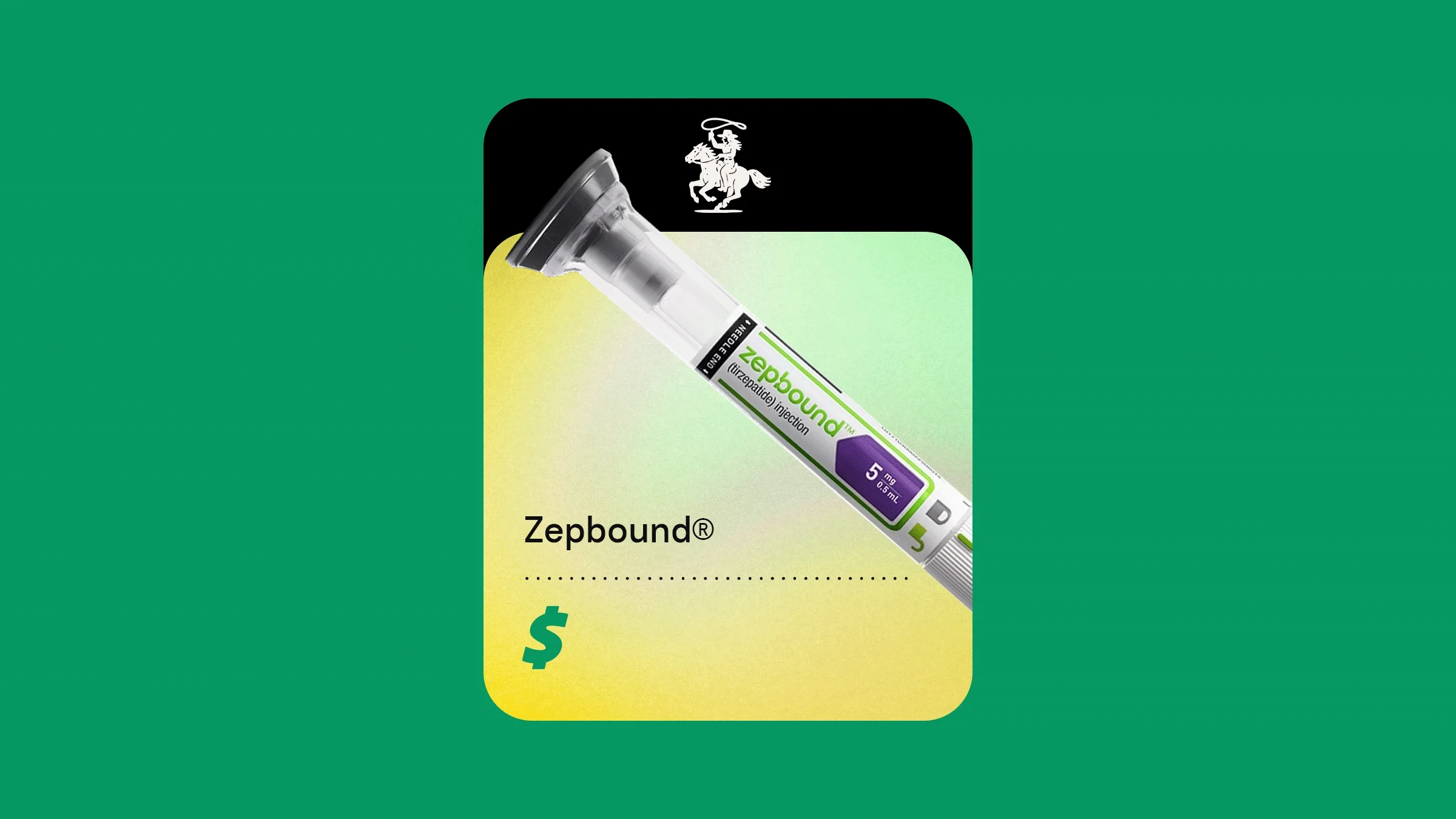
Zepbound (tirzepatide) is a prescription-only medication that’s FDA approved for weight management in adults. It’s available as single-dose injection pens, multi-dose KwikPens, and vials. A box of prefilled Zepbound pens may cost an average of $1292.28, while a KwikPen may cost about $600.68.
If you have commercial insurance and qualify for manufacturer savings, or use the direct-to-consumer cash-pay program, you’ll likely have lower out-of-pocket costs for Zepbound.
Because of the high prices of certain weight-loss medications, some health insurance plans don’t cover them. Other insurers may have these medications on their formularies but require costly copays or prior authorization.
You can pay as little as $299 per month for Zepbound KwikPen with a free GoodRx coupon. Subscribers to GoodRx for Weight Loss can also access FDA-approved, brand-name GLP-1 medications like Zepbound.
Save on related medications
Some people find success losing weight through diet and exercise alone. But others turn to medical interventions, such as bariatric surgery and medication. Zepbound (tirzepatide) is a weight-management medication that was first FDA approved in 2023.
Interest in GLP-1 medications such as Zepbound has rapidly increased in recent years and is expected to continue. In fact, 15 million adults in the U.S. may be taking weight-loss medication by 2030, according to Goldman Sachs research. But weight-loss medications can be costly, and not all health insurance plans will cover them.
Zepbound overview
Zepbound is a long-term option for adults managing their body weight. It’s also approved to treat moderate-to-severe obstructive sleep apnea among adults living with obesity. Zepbound is a once-weekly, injectable medication that has the same active ingredient as the Type 2 diabetes treatment Mounjaro (tirzepatide).
You can find Zepbound as single-dose injection pens, multi-dose KwikPens, and vials.
How much is Zepbound without insurance?
As of January 2026, the manufacturer list price for a 28-day supply of Zepbound ranges from $499 to $1,086. This means that, without insurance or manufacturer discounts, the medication can cost more than $14,000 per year.
However, the list price isn’t the same as what you’ll pay at the pharmacy. Your cost can vary based on pharmacy and wholesaler markups, as well as your dosage, the form you use, and where you live.
Here are the average monthly retail costs of Zepbound 2.5 mg without insurance, based on dosage form:
Does insurance cover Zepbound?
Some health insurance plans cover Zepbound, but the landscape for GLP-1 (glucagon-like peptide-1) coverage is rapidly changing.
For prefilled pens, about two-thirds of commercial plans, Medicaid plans, and plans purchased through an Affordable Care Act (ACA) marketplace cover this medication. About half of these plans cover Zepbound vials. Prior authorization is common for either dosage form. Medicare rarely covers Zepbound.
If you have insurance, review your plan’s summary of benefits and coverage and formulary (list of covered medications) to determine whether Zepbound is covered. If not, contact your plan provider and ask about your coverage options. You can also discuss alternatives with your prescriber or a pharmacist.
GoodRx is tracking GLP-1 insurance changes and providing updates — such as coverage restrictions — as they happen.
How insurance covers Zepbound
The following charts show the likelihood of having coverage for 2.5 mg/0.5 mL prefilled pens and vials with different types of insurance plans. They also show the likelihood of having prior authorization and step therapy requirements.
Insurance coverage for Zepbound (2.5 mg/0.5 mL prefilled pens)
Insurance type | Enrollees covered for Zepbound single-dose pens | Enrollees required to get prior authorization | Enrollees required to do step therapy |
|---|---|---|---|
Commercial plans (not including plans purchased through an ACA marketplace) | 71.3% | 63.6% | 14.9% |
60.2% | 55.8% | 5.75% | |
Medicare (Medicare Advantage and Part D plans) | 2.1% | 1.9% | 0.1% |
Medicaid, including state-run and managed care plans | 70% | 47.1% | 15.2% |
Source: Managed Markets Insight & Technology, LLC™, as of August 4, 2025. (See methodology below.)
Insurance coverage for Zepbound (2.5 mg/0.5 mL vials)
Insurance type | Enrollees covered for Zepbound vials | Enrollees required to get prior authorization | Enrollees required to do step therapy |
Commercial plans (not including plans purchased through an ACA marketplace) | 40% | 33.2% | 1% |
ACA plans | 50% | 43.7% | 0.1% |
Medicare (Medicare Advantage and Part D plans) | 1.9% | 1.7% | 0% |
Medicaid, including state-run and managed care plans | 54.9% | 32.1% | 7.6% |
Source: Managed Markets Insight & Technology, LLC™, as of August 4, 2025. (See methodology below.)
Keep in mind: Coverage information does not include Zepbound KwikPen, as this dosage form was approved after the data was collected.
Tips if your medication isn’t covered by insurance
If your insurance doesn’t cover Zepbound, you have options:
Use a GoodRx coupon to save on your prescription.
Ask your prescriber about less costly options that meet your needs. This could mean switching to a low-cost, generic medication.
Ask your insurance plan if there is a preferred alternative to Zepbound in the same class, though this may not provide the same results for you.
Request a formulary exception from your insurance company. If your request is denied, you have the right to file an appeal with your plan.
During open enrollment, compare different health insurance plans to find one that provides the coverage you need.
How can you get Zepbound at an affordable price?
If you have commercial insurance, you may be eligible to pay as little as $25 per prescription using the manufacturer’s copay savings card. If your plan doesn’t cover Zepbound, you may still be able to save with the copay card, but prices vary by formulation. People covered by government-sponsored insurance, including Medicare and Medicaid, aren’t eligible for this discount program.
Lower-cost single-dose vials and KwikPens are also available through LillyDirect for $299 (2.5 mg), $399 (5 mg), and $449 (7.5 mg, 10 mg, 12.5 mg, and 15 mg) per month. You can access Zepbound KwikPen through GoodRx starting at $299 per month, too.
What's more, subscribers to GoodRx for Weight Loss can access FDA-approved, brand-name GLP-1 medications like Zepbound.
At the time of publication, Zepbound has not been added to the Lilly Cares Foundation Patient Assistance Program, which provides certain medications free of cost to qualifying people.
Compounded medication
Now that the Zepbound and Mounjaro shortage has ended, pharmacies are no longer allowed to regularly compound tirzepatide injections. Also, beware of counterfeit Zepbound or tirzepatide, particularly if you can access these medications without a prescription.
Frequently asked questions
If Zepbound isn’t covered by your prescription plan, you can request a formulary exception from your insurance company. If your request is denied, you have the right to file an appeal with your plan.
At publication time, Zepbound was not included in the Lilly Cares Foundation Patient Assistance Program, but other patient assistance programs may be able to help you afford this medication. For instance, the PAN Foundation assists with Zepbound through its obesity fund and Type 2 diabetes fund. At publication time, neither fund was accepting new applications. But if you qualify, you can sign up for either or both wait lists.
Zepbound works for weight loss by simulating two gut hormones that play a role in appetite and digestion. The result is that the body releases more insulin after eating, creates less new sugar, and feels fuller longer. It also helps regulate your appetite and lessen cravings. People taking Zepbound typically start with the lowest dosage and work with their healthcare team to gradually increase it over time.
If Zepbound isn’t covered by your prescription plan, you can request a formulary exception from your insurance company. If your request is denied, you have the right to file an appeal with your plan.
At publication time, Zepbound was not included in the Lilly Cares Foundation Patient Assistance Program, but other patient assistance programs may be able to help you afford this medication. For instance, the PAN Foundation assists with Zepbound through its obesity fund and Type 2 diabetes fund. At publication time, neither fund was accepting new applications. But if you qualify, you can sign up for either or both wait lists.
Zepbound works for weight loss by simulating two gut hormones that play a role in appetite and digestion. The result is that the body releases more insulin after eating, creates less new sugar, and feels fuller longer. It also helps regulate your appetite and lessen cravings. People taking Zepbound typically start with the lowest dosage and work with their healthcare team to gradually increase it over time.
The bottom line
Zepbound (tirzepatide) is an injectable weight-loss medication. You can find it as single-dose injection pens, multi-dose KwikPens, and vials. People tend to prefer the pens due to their relative ease of use, but prices for all formulations can vary by pharmacy, location, dosage, and more. On average, a box of single-dose Zepbound 2.5 mg pens cost about $1292.28 without insurance, while a 2.5 mg KwikPen may cost about $600.68.
There are several ways to save. In addition to copay cards and Lilly Direct, subscribers to GoodRx for Weight Loss can access FDA-approved brand-name GLP-1 medications like Zepbound.

Why trust our experts?




Methodology
We obtained national prescription coverage data for each medication from Managed Markets Insight & Technology (MMIT). The data reflects health insurance coverage as of August 2025.
We calculated the percentage of enrollees in plans that cover each medication by dividing the number of enrollees covered for the medication within a specific insurance channel (e.g., ACA, Medicare, Medicaid) by the total number of enrollees in all plans within that channel.
We determined the percentage of enrollees in plans with a prior authorization requirement by calculating the proportion of enrollees in plans that required prior authorization for the medication within each channel.
Finally, we measured the percentage of enrollees in plans with a step therapy requirement by calculating the proportion of enrollees in plans that imposed step therapy requirements for the medication in each channel.
These estimates, derived from national MMIT coverage data, provide insight into health insurance coverage for each medication. They take into account restrictions such as prior authorization, step therapy, and quantity limits. The percentages are expressed relative to the total number of enrollees covered by various insurance channels, including the ACA, commercial (excluding ACA) plans, Medicare, and Medicaid (both state-run and managed care plans).
References
Eli Lilly and Company. (n.d.). How much should I expect to pay for Zepbound (tirzepatide)?
Eli Lilly and Company. (2023). FDA approves Lilly’s Zepbound (tirzepatide) for chronic weight management, a powerful new option for the treatment of obesity or overweight with weight-related medical problems. PR Newswire.
Eli Lilly and Company. (2026). Zepbound- tirzepatide injection [package insert]. DailyMed.
Lilly Cares Foundation. (n.d.). Available medications.
Lilly Cares Foundation. (n.d.). Lilly Cares Foundation patient assistance program.
PAN Foundation. (n.d.). Obesity.
PAN Foundation. (n.d.). Type 2 diabetes.
PAN Foundation. (n.d.). We’re here to help with out-of-pocket costs.