Key takeaways:
Sleep has two main stages: rapid eye movement (REM) sleep and non-REM sleep.
REM sleep is characterized by quick eye movements, decreased muscle tone, and increased brain activity.
REM sleep is the stage when you dream. It’s thought to play a role in procedural learning, creativity, and emotional regulation.
You can get more REM sleep by practicing good sleep hygiene, minimizing sleep disruptions, and getting 7 to 9 hours of sleep each night.
After a full day of being awake and active, your brain and body need sleep. While sleep may seem uneventful, there’s actually a lot going on in your body and brain.
Humans have two main stages of sleep: rapid eye movement (REM) sleep and non-REM sleep.
What is REM sleep?
REM sleep is the stage of sleep when dreaming usually happens. The name comes from the rapid eye movements that happen during this stage. Researchers continue to learn about why and how people dream. What’s clear is that REM sleep is a complex and surprisingly active state.
Search and compare options
There are three parts of REM sleep in humans:
Rapid eye movements: Your eyes move around rapidly in different directions, even though your eyelids stay closed. But your eyes don’t send visual information to your brain.
Muscle atonia: During REM sleep, the muscles in your arms and legs experience a type of temporary paralysis known as muscle atonia. Researchers are still studying how and why this happens. But it seems to be caused by changes in signals that your brain sends to your muscles.
Increased brain activity: During REM sleep, your brain is quite active. Brain activity during this stage is similar to when you’re awake, but without the same level of conscious awareness.
How much REM sleep do you need?
How much REM sleep you need depends on your age and how long you sleep. If you sleep 7 to 9 hours each night (the recommended amount of sleep for most adults), you should get about 90 to 120 minutes of REM sleep.
For adults, REM sleep usually makes up about 25% of total sleep time. As you get older, you may get less REM sleep. This may sound surprising, but there are steps you can take to get more REM sleep.
To learn how much REM sleep you’re getting, you can try using a sleep tracker. Keep in mind that sleep trackers don’t always report sleep stages correctly.
What are the different stages of sleep?
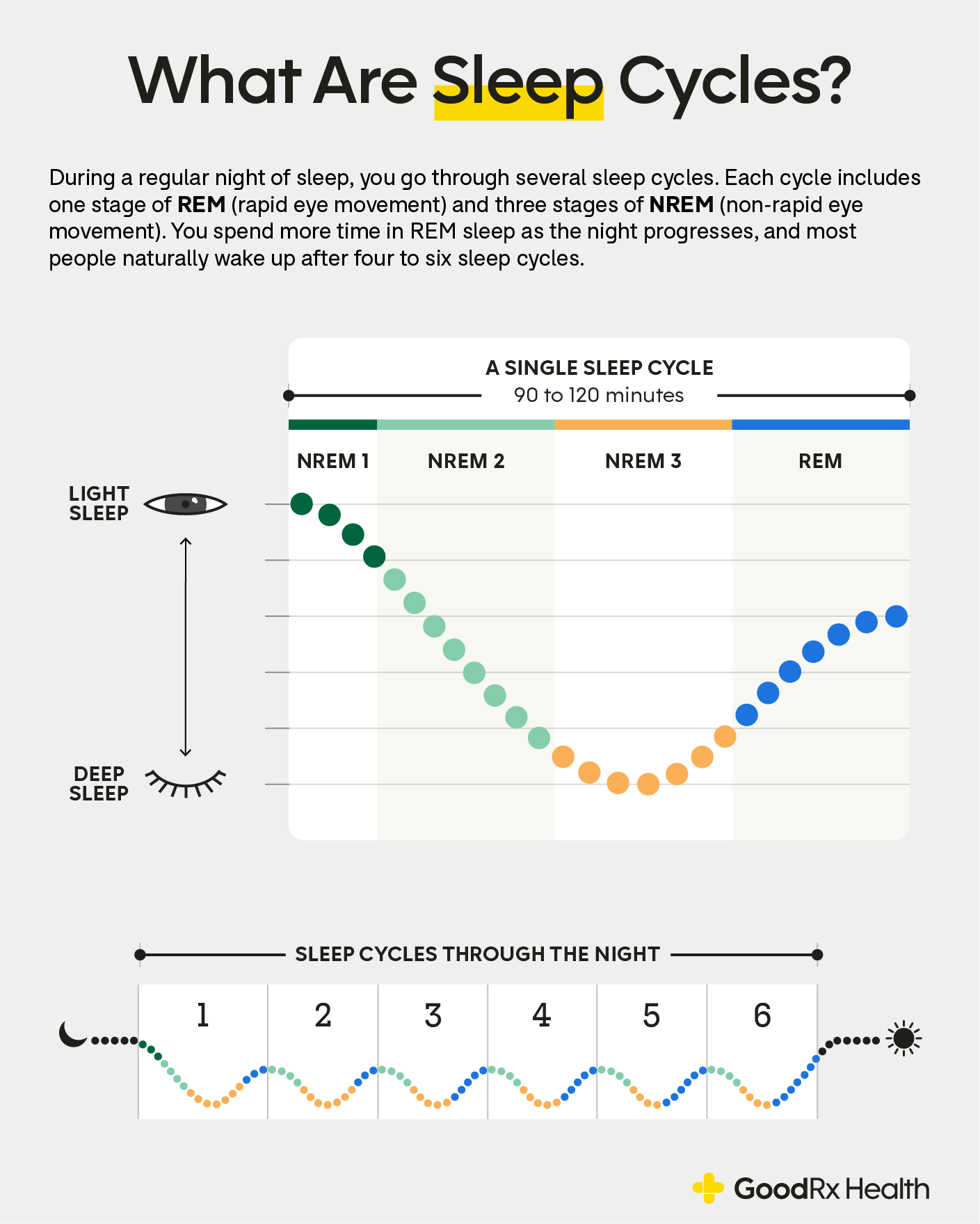
In a typical night of sleep, you go through several sleep cycles. In each sleep cycle, you move through four stages of sleep. There are two main sleep stages: REM sleep and non-REM (NREM) sleep. NREM sleep has three phases:
Light sleep (NREM 1): This stage happens just after you move from wakefulness into sleep. Your breathing rate stays the same as when you’re awake, and your muscle tone is normal. This is the lightest and shortest sleep stage and usually lasts up to 5 minutes.
Deeper sleep (NREM 2): In this stage, you start to enter deeper sleep and your heart rate and body temperature drop. Teeth grinding tends to occur during this stage.
Deepest sleep (NREM 3): This is the deepest stage of sleep and the hardest to wake up from. Even loud sounds might not wake you during this stage. If you do wake up, you might have some mental fogginess for the first 30 minutes or so. Even though it’s the stage of deepest sleep, sleep disturbances like sleepwalking, sleep talking, and bedwetting tend to happen during this phase.
REM sleep: This is actually not a “restful” phase of sleep. Most of your muscles become weak and don’t move, but your breathing muscles and eye muscles are active. Your breathing rate tends to become more irregular. This is the stage when most dreaming happens.
After REM sleep, the cycle starts again. Each cycle lasts about 90 to 120 minutes. Most people naturally wake up after 4 to 6 sleep cycles.
The length of time you spend in each sleep stage changes during the night. Right after you fall asleep, your sleep cycles will mostly be non-REM sleep. (You get most of your deep sleep in the early part of the night.)
But as the night progresses, you spend more time in REM sleep. After about 6 hours, most of your sleep will be REM sleep. This is why many dreams take place in the morning.

Read more like this
Explore these related articles, suggested for readers like you.



What’s the difference between REM sleep and deep sleep?
Deep sleep occurs during NREM 3. In this stage, your muscles are still functional. This is why sleepwalking and sleep talking tend to happen in this stage. Contrary to popular belief, these common sleep disturbances don’t happen while you’re dreaming. Most dreaming happens during REM sleep, when your muscles can’t move, so it’s not possible to sleepwalk.
Deep sleep and REM sleep also have different functions in your body. During the deep sleep of NREM 3, your body builds muscle and bone, repairs tissues, and strengthens your immune system.
During REM sleep, your brain is very active, and blood flow to your brain increases. Many people believe that this is a critical stage for memory and learning. You can think of deep sleep as the stage that heals your body, and REM sleep as the stage that restores your brain.
Why is REM sleep important?
Scientists have been studying why REM sleep is important for decades. Most of the benefits of REM sleep that researchers are exploring are related to brain function, since it’s very active during REM sleep. But there’s still a lot to learn about how REM sleep affects your body and mind. Here are a few areas where REM sleep helps.
Learning new information
Researchers think that REM sleep may be important for learning new information and skills. But this is an area of some controversy.
In animal studies, REM sleep has been shown to play a role in learning. But in human studies, the role of REM sleep in learning is less clear.
Recent studies seem to show that REM sleep is important for “procedural learning.” This includes things like learning a foreign language or learning Morse code. When people are deprived of REM sleep, it doesn’t seem to affect how well they remember lists of words or facts. But it can worsen their memory for procedural tasks.
Brain development
REM sleep may support brain development. This may be one reason children sleep more than adults and spend more time in REM sleep.
Newborn babies spend about half of their sleep time in REM sleep. Adults spend only about 25% of their sleep time in REM sleep.
Dreams
Most dreams (but not all dreams) take place during REM sleep. Scientists can’t completely explain what’s happening when you’re dreaming. But some research suggests that dreaming might be important for creativity.
One study surveyed over 1,000 people and found that dreams played an important role in helping people solve problems and gain insights. Dreams even pushed them to do new things in their lives.
Better mental health
Getting enough REM sleep is important for mental health. This is because REM sleep may be particularly important for emotional processing, the complex relationship between memory and emotion.
That said, much of what experts know about this subject comes from animal research. So there’s still a lot to learn. Sleep scientists continue to study how sleep affects mental health.
What happens if you don’t get enough REM sleep?
What happens when you don’t get enough REM sleep is still an area of active research. But not getting enough REM sleep has been linked to a variety of problems, including:
Trouble managing mood and emotions: Research suggests that missing out on REM sleep might lead to emotional reactivity and anxiety.
Difficulty with certain skills: You may have trouble remembering procedural skills.
Increased inflammation in the brain: Some animal research suggests that a lack of REM sleep can lead to increased inflammation in the brain.
Increased risk of death: One study found that every 5% decrease in REM sleep was associated with a 13% increase in mortality rate. Researchers don’t know what causes this link. It’s possible that less REM sleep is a marker of other health problems, not the direct cause. More studies are needed to understand how REM sleep affects aging.
How can you get more REM sleep?
Since REM sleep tends to be concentrated in the second half of the night, it’s important not to skimp on morning sleep. If you wake up before you get a full 7 to 9 hours of sleep, you’re mostly missing out on REM sleep. To get enough REM sleep, make sure you’re getting enough sleep overall and minimizing disruptions.
Here are several helpful “sleep hygiene” habits that you can adopt to get more quality sleep:
Follow a nightly bedtime routine. Try to go to bed and wake up around the same time every day.
Avoid caffeine and alcohol several hours before bedtime.
Soak up sunlight in the morning when you wake up.
Get plenty of physical activity. Exactly when you workout depends on your goals, but try to avoid exercising 90 minutes before you go to sleep.
Avoid big meals 2 to 3 hours before you go to bed.
Frequently asked questions
There are lots of supplements that claim to help boost your sleep quality. But there’s limited research on how they affect REM sleep. Some research suggests that tryptophan supplements may help improve sleep in people with REM sleep disorders linked to Parkinson’s disease.
Insomnia is a common side effect of many medications, including certain decongestants, corticosteroids, antidepressants, and stimulants. Selective serotonin reuptake inhibitors (SSRIs) are a type of antidepressant that may specifically disrupt REM sleep. If you’re taking an SSRI and having trouble sleeping, connect with your healthcare team. They can help you decide the best time to take your SSRI or suggest an alternative medication.
Foods that naturally contain hormones and chemicals involved in the sleep-wake cycle, also called your circadian rhythm, can help promote better sleep. These include foods with melatonin, serotonin, and tryptophan. Turkey, chicken, dairy products, and whole grains are all good sources of tryptophan. Certain nuts and seeds, including walnuts and pistachios, contain melatonin.
There are lots of supplements that claim to help boost your sleep quality. But there’s limited research on how they affect REM sleep. Some research suggests that tryptophan supplements may help improve sleep in people with REM sleep disorders linked to Parkinson’s disease.
Insomnia is a common side effect of many medications, including certain decongestants, corticosteroids, antidepressants, and stimulants. Selective serotonin reuptake inhibitors (SSRIs) are a type of antidepressant that may specifically disrupt REM sleep. If you’re taking an SSRI and having trouble sleeping, connect with your healthcare team. They can help you decide the best time to take your SSRI or suggest an alternative medication.
Foods that naturally contain hormones and chemicals involved in the sleep-wake cycle, also called your circadian rhythm, can help promote better sleep. These include foods with melatonin, serotonin, and tryptophan. Turkey, chicken, dairy products, and whole grains are all good sources of tryptophan. Certain nuts and seeds, including walnuts and pistachios, contain melatonin.
The bottom line
Rapid eye movement (REM) sleep is a surprisingly active phase of sleep. Even though your muscles decrease in tone and don’t move during REM sleep, your brain is actively engaged. Researchers are still learning about the purpose and benefits of this sleep phase, when most dreams happen. REM sleep appears to be involved in procedural memory, emotional regulation, and general mental health. But there’s still a lot to learn about this somewhat elusive state of sleep. To get enough REM sleep, make sure you get enough overall sleep and follow healthy sleep hygiene habits.

Why trust our experts?



References
Barrett, D. (2017). Dreams and creative problem-solving. Annals of the New York Academy of Sciences.
Boyce, R., et al. (2017). REM sleep and memory. Current Opinion in Neurobiology.
Brooks, P. L., et al. (2012). Identification of the transmitter and receptor mechanisms responsible for REM sleep paralysis. Journal of Neuroscience.
Chow, H. M., et al. (2013). Rhythmic alternating patterns of brain activity distinguish rapid eye movement sleep from other states of consciousness. Proceedings of the National Academy of Sciences of the United States of America.
De Zambotti, M., et al. (2019). The sleep of the ring: Comparison of the ŌURA sleep ring tracker against polysomnography. Behavioral Sleep Medicine.
Hirshkowitz, M., et al. (2015). National Sleep Foundation’s sleep time duration recommendations: Methodology and results summary. Sleep Health.
Jiang, F. (2019). Sleep and early brain development. Annals of Nutrition and Metabolism.
Karni, A., et al. (1994). Dependence on REM sleep of overnight improvement of a perceptual skill. Science.
Krause, A. J., et al. (2017). The sleep-deprived human brain. Nature Reviews. Neuroscience.
Leary, E. B., et al. (2020). Association of rapid eye movement sleep with mortality in middle-aged and older adults. JAMA Neurology.
Mason, I. C., et al. (2022). Light exposure during sleep impairs cardiometabolic function. Proceedings of the National Academy of Sciences of the United States of America.
Meloni, M., et al. (2022). Preliminary finding of a randomized, double-blind, placebo-controlled, crossover study to evaluate the safety and efficacy of 5-hydroxytryptophan on REM sleep behavior disorder in Parkinson’s disease. Sleep & Breathing.
Mukai, Y., et al. (2023). Functional roles of REM sleep. Neuroscience Research.
National Institute of Neurological Disorders and Stroke. (2023). Brain basics: Understanding sleep.
Neuroscience. 2nd edition. (2001). The possible functions of REM sleep and dreaming. Sinauer Associates.
Ohayon, M. M., et al. (2004). Meta-analysis of quantitative sleep parameters from childhood to old age in healthy individuals: Developing normative sleep values across the human lifespan. Sleep.
Patel, A. K., et al. (2022). Physiology, sleep stages. StatPearls.
Peever, J., et al. (2017). The biology of REM sleep. Current Biology.
Rasch, B., et al. (2013). About sleep’s role in memory. Physiological Reviews.
Schredl, M., et al. (2007). Self-reported effects of dreams on waking-life creativity: An empirical study. The Journal of Psychology.
Suresh, K., et al. (2021). Impact of REM sleep deprivation and sleep recovery on circulatory neuroinflammatory markers. Sleep Science.
Tempesta, D., et al. (2018). Sleep and emotional processing. Sleep Medicine Reviews.
Trouche, S., et al. (2020). The role of sleep in emotional processing: Insights and unknowns from rodent research. Current Opinion in Physiology.