Key takeaways:
A home sleep apnea test (HSAT) is a sleep test that you do in your own home, rather than in a sleep lab.
For many people, at-home sleep apnea testing is a convenient and reliable way to diagnose obstructive sleep apnea (OSA).
For other types of sleep disorders, testing in a sleep lab is still the best option.
Sleep apnea is a common health condition where your breathing starts and stops while you sleep. This can happen many times during the night and make it hard to get a good night’s sleep. In some cases, sleep apnea can lead to other health problems, like high blood pressure and heart disease.
Fortunately, there’s treatment for sleep apnea. The first step is getting diagnosed. In the past, this meant sleeping overnight in a lab. But these days, home sleep apnea tests (HSAT) are a convenient alternative for many people.
Are you wondering if at-home sleep apnea testing might be right for you? Find out how these tests work and whether they could be a good option for you or a loved one.
What is an at-home sleep apnea test?
A home sleep apnea test (HSAT) is a portable test you use overnight in your own bed to see if you have obstructive sleep apnea (OSA). Instead of sleeping in a lab, you wear a small device that tracks key breathing-related signals, like airflow, oxygen levels, and sometimes heart rate or body position.
HSATs are recommended for people who:
Have symptoms that strongly suggest OSA
Don’t have major medical conditions that could interfere with accuracy
Unlike an in-lab sleep study, an HSAT doesn’t record brain waves or sleep stages, so it can’t diagnose other sleep disorders like parasomnias, limb movement disorders, or seizures.
When used in the right situation and interpreted by a trained sleep specialist, HSATs are a reliable and convenient way to diagnose many cases of OSA. But a negative or unclear HSAT result may still require a follow-up sleep study in a lab.
How do home sleep apnea tests work?
An HSAT uses special devices to record information while you sleep. Depending on the test, this could include data about your breathing, heart rate, body movements, and more. After the test, the information is sent electronically to your sleep specialist. They’ll interpret the test results and decide whether you have sleep apnea.
Diagnosing sleep apnea in a sleep lab vs. at home
You can get screened for sleep apnea with a sleep study that’s done in a sleep lab or one done in your own home. Let’s take a closer look at the difference between a sleep study in a sleep lab and at home with an HSAT.
Polysomnography
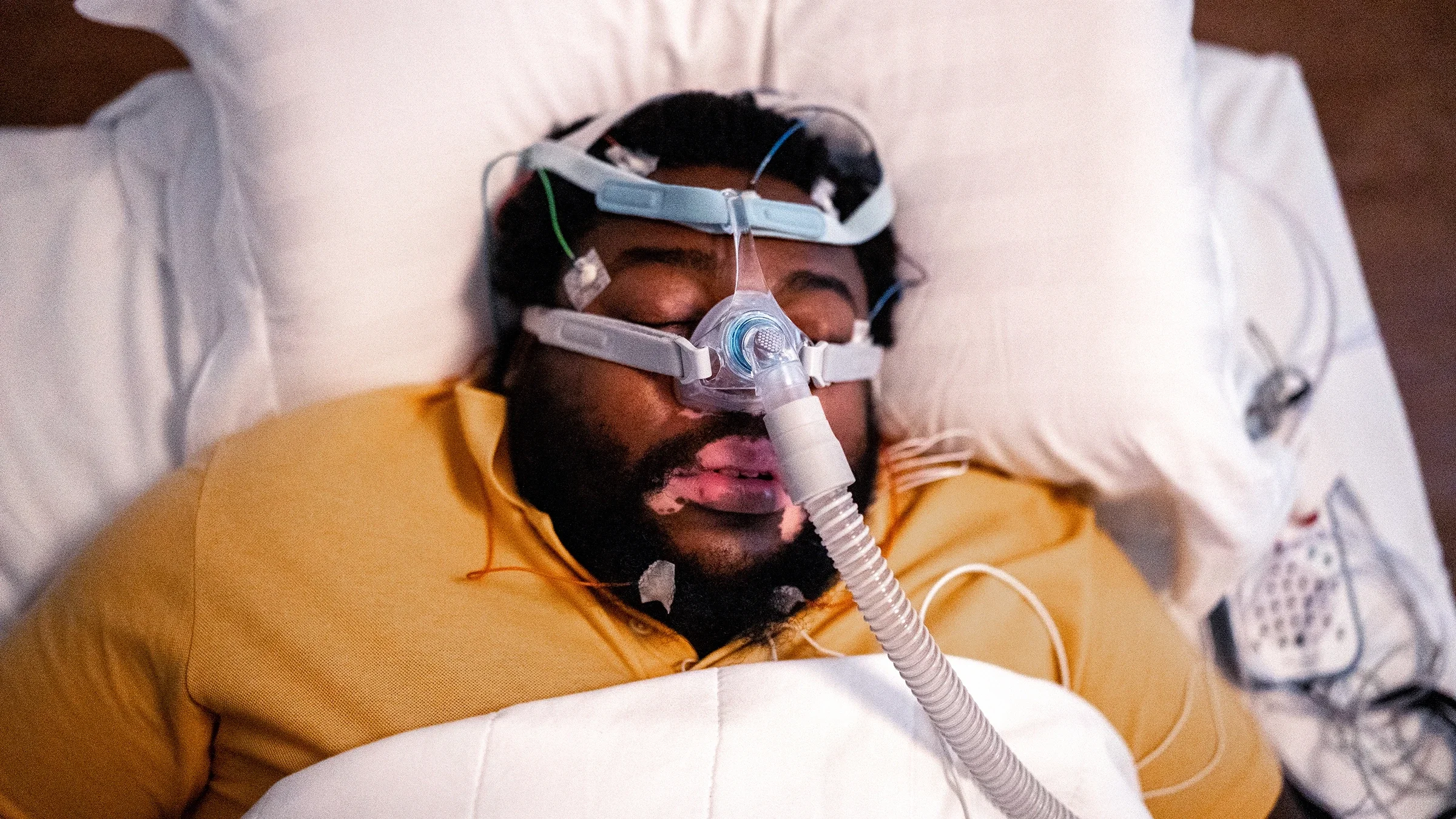
Sleep specialists diagnose sleep apnea with a sleep study, or a polysomnography (PSG). A PSG happens overnight at a sleep lab. While you sleep, a technician uses equipment to monitor your:
Eye movements
Breathing patterns
Body movements
A PSG can be helpful in diagnosing many different types of sleep disorders, including sleep apnea.
Home sleep apnea testing
An HSAT is done overnight in your own home. You sleep in your own bed while wearing special equipment that collects data. Though HSATs are convenient, they don't capture as much information as PSGs. Because of their limitations, HSATs are mostly used for diagnosing people with OSA.
What at-home tests are available for sleep apnea?
According to the American Academy of Sleep Medicine, an “adequate” HSAT should monitor at least one of the following:
The airflow in your nose, your breathing patterns, and the amount of oxygen in your blood
The blood flow in your vessels, your physical movements, and the amount of oxygen in your blood
Types of home sleep apnea tests
Several kinds of HSAT meet these requirements. Let’s review them below:
WatchPAT is a popular test that’s especially easy to use. You only need to wear a small device on your wrist and finger.
With ApneaLink Air, you wear a chest belt, nasal cannula, and fingertip sensor.
When using the Alice NightOne Home Sleep Test, you also wear a chest belt, nasal cannula, and fingertip sensor.
Nox T3 includes a chest and abdominal belt, nasal cannula, and wrist and fingertip sensors.
BresoDX1 is a home test that was FDA approved in 2023. It uses a simple neck sensor and finger oximeter to record your breathing patterns and oxygen levels. It isn’t currently commercially available though.
What are the benefits and drawbacks of home sleep apnea testing?
A PSG is the gold standard when it comes to diagnosing many sleep disorders, including sleep apnea. So how does an HSAT compare? Here are some pros and cons to keep in mind.
Pros
Benefits of an HSAT include:
It’s more convenient.
You get to sleep in your own bed.
It’s usually less expensive than a PSG.
It’s easier to repeat over time.
It’s a good test for diagnosing OSA.
Cons
Drawbacks of an HSAT include:
It might not be covered by insurance as easily as a PSG.
It can be hard to use the equipment correctly.
It might not be an option if you have other health problems.
It’s not good for diagnosing other types of sleep disorders, like central sleep apnea or parasomnias (like sleepwalking or nightmares).
What do at-home sleep apnea test results show?
It depends on which test you use. Most HSATs monitor at least four of the following:
Breathing patterns
Airflow in your nose
Heart rate
Heart activity (electrocardiogram)
Oxygen levels in your blood (pulse oximetry)
Body position
Body movement
Blood flow through your vessels (peripheral arterial tonometry)
A healthcare professional will use this information to figure out if you have sleep apnea — and whether or not you need follow-up testing or treatment.
Are there some results you can’t get from an at-home sleep study?
Yes. Home tests are good at monitoring breathing but not sleep patterns. Some things can only be monitored in an actual sleep lab. For example, your home test won’t be able to record information about:
Brain activity
Eye movements
Total sleep time
Sleep quality
Appearance when you’re sleeping
How to prepare for a home sleep apnea test
If you and a healthcare professional decide on an HSAT, a few simple preparations can help you get the most accurate results.
Get a proper evaluation first. The American Academy of Sleep Medicine (AASM) recommends having an HSAT only after a clinician reviews your symptoms and medical history.
Learn the setup in advance. Your testing service should show you how to place each sensor correctly. Incorrect placement is one of the most common causes of unusable data.
Follow your usual nighttime routine. Go to bed at your normal time, and try to keep your typical unwinding habits. Keeping things familiar helps you fall asleep more naturally so the device captures a typical night of breathing.
Limit caffeine intake. Caffeine can make it harder to fall asleep and may shorten your total sleep time, which can reduce the amount of data your healthcare team has to work with.
Avoid alcohol or sedatives unless advised otherwise. These can change your breathing patterns and interfere with test accuracy.
Check your technology. If your test uses telemonitoring or a smartphone app, make sure you have a reliable internet connection, a well-charged phone, and any required apps downloaded before bedtime.
Plan for next-day follow-up. After the test, a sleep specialist will review your results and decide whether you need repeat testing or an in-lab study.
HSATs depend on correct setup and a reasonably typical night of sleep. So anything that disrupts your routine can limit how useful the results are. In some cases, a healthcare professional may recommend repeating the test or completing an in-lab sleep study for a clearer diagnosis.
How can you get an at-home sleep apnea test?
If you’re interested in an at-home sleep test, talk to a healthcare professional. HSATs should only be used as part of a thorough sleep evaluation, as prescribed by a trained professional. To get a test, you can either see an in-person or telehealth (online) sleep specialist.
How much does a home sleep apnea test cost?
HSATs are generally more affordable than in-lab studies. Most HSATs cost about $150 to $500 out of pocket, depending on the device and testing service. In comparison, an overnight in-lab sleep study can cost $1,000 or more.
Are home sleep apnea tests covered by insurance?
Many health plans cover HSATs when they’re medically necessary and ordered by a qualified clinician. Coverage can vary based on your specific plan, such as if:
Prior authorization is needed
The testing healthcare professional is in-network for your insurance
If the company offering the HSAT doesn’t bill insurance directly, you may need to pay upfront and submit your own reimbursement claim.
It’s a good idea to call your insurer before scheduling the test so you know exactly what to expect in terms of coverage and cost.
When should you get help about sleep apnea?
Talk to a healthcare professional if you notice any of the following symptoms of sleep apnea:
Snoring frequently
Feeling tired during the day
Waking up a lot at night
Feeling like you’re choking or being smothered at night
Having morning headaches or dry mouth
Experiencing low sex drive (low libido)
If you’re seeing a primary care provider, they may also recommend that you talk with a sleep specialist. A sleep specialist is a healthcare professional who has experience diagnosing and treating sleep disorders.
Frequently asked questions
No. Smartwatches and other fitness trackers aren’t a good substitute for HSATs. Although some can track your sleep, research shows that personal devices aren’t very reliable when it comes to detecting sleep apnea. If you’re worried about sleep apnea, an HSAT or a PSG are your best options.
Yes. Other sleep disorders can be mistaken for sleep apnea — especially if they cause daytime fatigue or get in the way of a good night of sleep. Examples include:
Yes. Many people with sleep apnea don’t snore at all. Snoring happens when the airway vibrates. But sleep apnea can also occur when breathing repeatedly stops or becomes very shallow without causing those vibrations. This is more common in certain groups, like children, women, and people with central sleep apnea. If you’re tired during the day, wake up frequently at night, or have morning headaches, it’s worth getting evaluated even if you don’t snore.
No. Smartwatches and other fitness trackers aren’t a good substitute for HSATs. Although some can track your sleep, research shows that personal devices aren’t very reliable when it comes to detecting sleep apnea. If you’re worried about sleep apnea, an HSAT or a PSG are your best options.
Yes. Other sleep disorders can be mistaken for sleep apnea — especially if they cause daytime fatigue or get in the way of a good night of sleep. Examples include:
Yes. Many people with sleep apnea don’t snore at all. Snoring happens when the airway vibrates. But sleep apnea can also occur when breathing repeatedly stops or becomes very shallow without causing those vibrations. This is more common in certain groups, like children, women, and people with central sleep apnea. If you’re tired during the day, wake up frequently at night, or have morning headaches, it’s worth getting evaluated even if you don’t snore.
The bottom line
If you’re concerned about sleep apnea, talk to a healthcare professional. Based on your symptoms, they might recommend getting tested for sleep apnea. If you’re interested in a home sleep apnea test (HSAT), be sure to ask about your options. For many people, at-home sleep apnea testing is a convenient and reliable way to diagnose obstructive sleep apnea (OSA) — from the comfort of your own home.

Why trust our experts?




References
American Academy of Sleep Medicine. (n.d.). Frequently asked questions: Sleep disorders, fatigue and professional operators.
American Academy of Sleep Medicine. (2017). AASM releases position statement on home sleep apnea testing.
Badr, M. S., et al. (2025). Treatment of central sleep apnea in adults: An American Academy of Sleep Medicine clinical practice guideline. Journal of Clinical Sleep Medicine.
Chiang, A. A., et al. (2024). OSA diagnosis goes wearable: Are the latest devices ready to shine? Journal of Clinical Sleep Medicine.
Itamar Medical Ltd. (n.d.). A new era of home sleep apnea testing.
Joshi, C. (2019). Sleep-related hypermotor epilepsy (SHE). Epilepsy Foundation.
Kapur, V. K., et al. (2017). Clinical practice guideline for diagnostic testing for adult obstructive sleep apnea: An American Academy of Sleep Medicine clinical practice guideline. Journal of Clinical Sleep Medicine.
Kundel, V., et al. (2025). Home sleep apnea testing for obstructive sleep apnea in adults. UpToDate.
MedlinePlus. (2023). Central sleep apnea.
National Heart, Lung, and Blood Institute. (2022). Sleep studies.
National Heart, Lung, and Blood Institute. (2025). Sleep apnea: Symptoms.
National Heart, Lung, and Blood Institute. (2025). Sleep apnea: Treatment.
Nox Medical. (n.d.). Nox T3s HST.
ResMed. (n.d.). Reimbursement fast facts: Home sleep apnea testing.
ResMed. (2019). ApneaLinkAir patient instructions.
Rundo, J. V., et al. (2019). Polysomnography. Handbook of Clinical Neurology.
Victoria State Government. (2021). Sleep apnoea. Better Health Channel.