Key takeaways:
Tai chi and yoga are mind-body practices that involve movement, meditation, and breathwork.
Both methods share similar benefits, such as better balance, flexibility, and mood.
Tai chi and yoga have different origins and approaches to mind-body movement.
At first glance, it might be easy to confuse tai chi and yoga. Both of these mind-body practices include exercises, controlled breathing, and meditation. Each offers many mental and physical health benefits. But the differences in their origins and methods help set tai chi and yoga apart.
More than 34 million people in the U.S. practice yoga. While yoga is more commonly practiced, tai chi is growing in popularity, with roughly 3.8 million practitioners in the U.S.
Still, one isn’t necessarily better than the other. Both methods may be worth adding to your exercise and self-care routine. Read on to learn more.
Search and compare options
What’s the difference between tai chi and yoga?
Both tai chi and yoga use meditative movement to deepen the connection between your mind and body. But these key differences help set them apart:
Origins: Tai chi originated in China as a traditional martial art. It focuses on balancing qi, or energy, within your body. Yoga, on the other hand, originated in India as a spiritual practice. The word “yoga” comes from the Sanskrit word “yuj,” which means to yoke or join together.
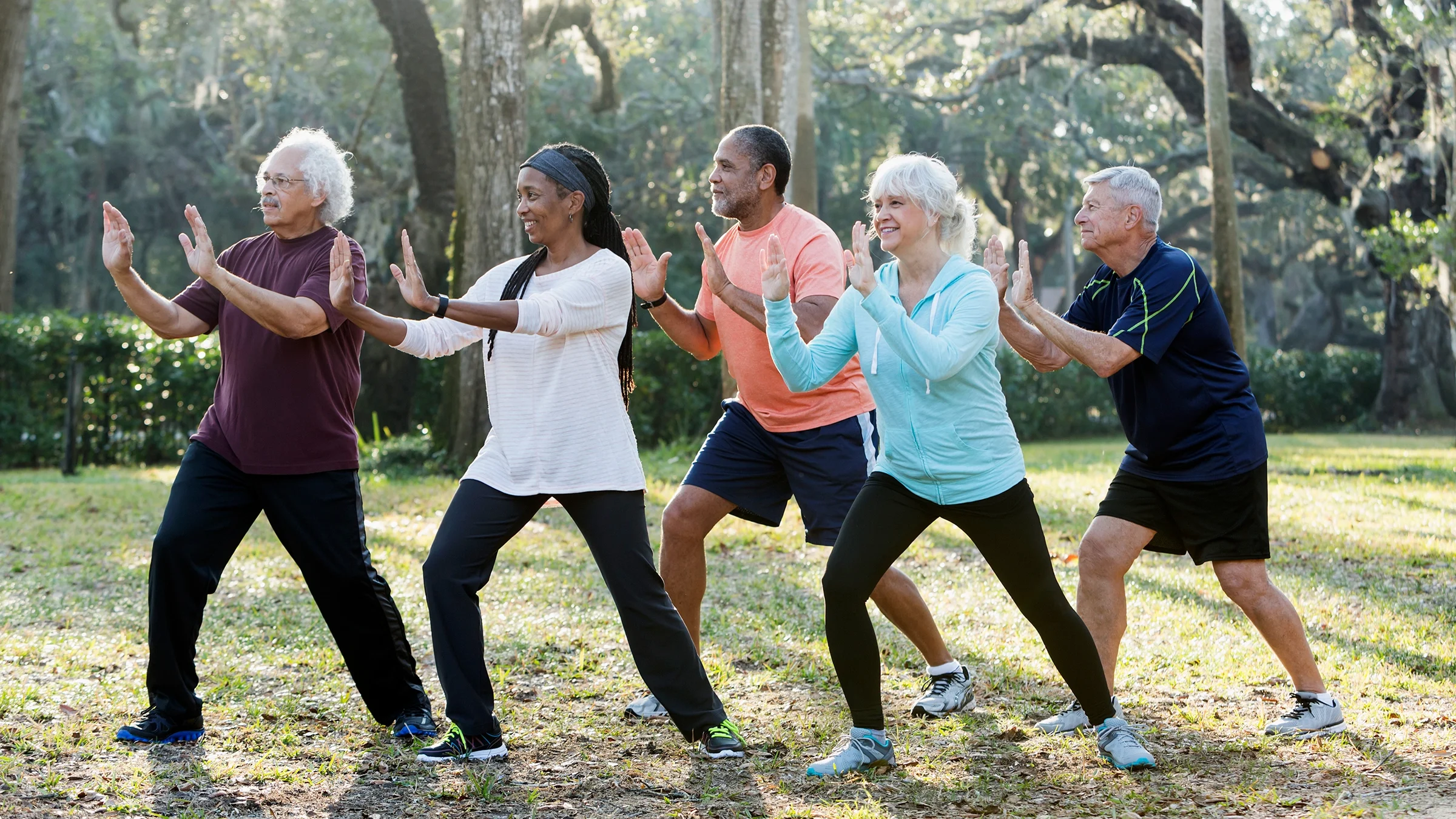
Physical position: Tai chi is typically practiced while standing. Yoga includes positions that involve sitting, standing, or lying down. Both practices can be modified for people with limited mobility.
Physical execution: Tai chi and yoga use different techniques to work your muscles. Tai chi involves dynamic movements, while yoga includes mostly fixed postures.
With tai chi, a series of continuous, dance-like movements are linked with the rhythm of your breath. Many of the moves are named after animals or their characteristic actions. For example, white crane spreads its wings mimics a crane in flight. As you flow through each exercise, tai chi encourages deep breathing and focusing on the present moment.
Yoga, on the other hand, consists of a series of postures called asanas, which sync movement with breath. Each posture has a Sanskrit name, which may include animals, shapes, or physical moves. For example, pigeon pose, triangle pose, and extended hand-to-big-toe pose are common yoga postures.
Unlike tai chi, yoga requires you to hold poses for varying periods of time. This can make it more challenging.
Benefits of tai chi vs. yoga
Tai chi and yoga share many physical and mental health benefits. Research shows that these mind-body disciplines may:
Build muscle strength and endurance
Increase flexibility
Improve balance and mobility
Boost mood and mental health
Enhance cognitive function
Help people manage chronic pain
Better balance and flexibility may be the trademark benefits of tai chi and yoga. And for good reason. Both practices are designed to enhance body awareness and have been linked to these improvements. But strong research points to tai chi for better balance, while yoga is better for increasing flexibility.
The difference may come down to how each practice is executed. In tai chi, standing poses require you to shift your weight from one foot to the other. These graceful moves may increase lower body strength, improve reflexes, and increase range of motion. All of these factors help keep you steady on your feet.
Yoga, on the other hand, includes seated, standing, or lying-down poses. These poses stretch your muscles, increasing flexibility and range of motion. Improvements in balance and flexibility can also mean more mobility for older tai chi and yoga practitioners.

Read more like this
Explore these related articles, suggested for readers like you.
Which is better for you: tai chi or yoga?
Tai chi and yoga challenge your muscles in different ways. But both mind-body practices use movement, meditation, and breathwork to support health and wellness. Choosing between tai chi and yoga depends on your health goals and personal preferences.
For example, extensive research shows that tai chi and yoga may improve fitness and quality of life for older adults. But if your primary concern is fall prevention, tai chi might be a good place to start.
Tai chi has been shown to help older adults overcome a fear of falling and boost confidence in their abilities. But if you’re more concerned with increasing flexibility and range of motion, you might want to start with yoga.
Many studies on tai chi and yoga focus on older adults. This is because the methods may help manage chronic pain and age-related conditions such as:
Dementia or other cognitive impairments
But people of many ages and fitness levels can enjoy tai chi and yoga. You can incorporate one or both practices into your fitness routine.
How can a beginner get started with tai chi or yoga?
There are five main styles of tai chi. Some styles –– like Chen –– are faster-paced and more challenging than others. The slower-paced Yang style is the most popular form today, especially in the Western world.
There are also different types of yoga, many of which are beginner-friendly. Options range from slower-paced yin or restorative yoga to higher-intensity styles like Ashtanga yoga.
If you’re new to tai chi or yoga, check with a healthcare professional first. Then, start with beginner or level 1 classes once a week. Avoid forcing yourself into any positions you’re not ready for yet. Tai chi and yoga movements may be challenging, but they shouldn’t hurt.
Yoga classes will likely be easier to find since yoga is more popular. But tai chi classes are often available in major cities. If you can’t find a local class, online options are also a great way to get started.
Frequently asked questions
Though yoga is generally safe, it can also lead to injuries, such as muscle or tendon strains. If you have any physical issues, like back or shoulder pain, it’s important to talk to a healthcare professional first to see if yoga is safe for you. Also, choose a beginner class to ease into the practice and avoid positions that feel uncomfortable to you.
Before class, talk to the yoga instructor about your concerns. They can suggest gentler alternative poses.
Tai chi and yoga tend to be gentle activities that most people can do. But some styles of yoga are very challenging and may not necessarily be for beginners. Always talk to your primary care provider if you have any health concerns before starting any new fitness activity.
Qigong, pronounced “chi gong,” is a mind-body practice that stems from Traditional Chinese Medicine. Tai chi is actually a form of qigong. Qigong also uses breath and movement to improve flexibility, balance, and well-being. But qigong focuses slightly more on meditation. Like tai chi, there are more active and gentler versions of qigong. If you’re looking for more active strength training, yoga may be better than either tai chi or qigong.
Though yoga is generally safe, it can also lead to injuries, such as muscle or tendon strains. If you have any physical issues, like back or shoulder pain, it’s important to talk to a healthcare professional first to see if yoga is safe for you. Also, choose a beginner class to ease into the practice and avoid positions that feel uncomfortable to you.
Before class, talk to the yoga instructor about your concerns. They can suggest gentler alternative poses.
Tai chi and yoga tend to be gentle activities that most people can do. But some styles of yoga are very challenging and may not necessarily be for beginners. Always talk to your primary care provider if you have any health concerns before starting any new fitness activity.
Qigong, pronounced “chi gong,” is a mind-body practice that stems from Traditional Chinese Medicine. Tai chi is actually a form of qigong. Qigong also uses breath and movement to improve flexibility, balance, and well-being. But qigong focuses slightly more on meditation. Like tai chi, there are more active and gentler versions of qigong. If you’re looking for more active strength training, yoga may be better than either tai chi or qigong.
The bottom line
Tai chi and yoga are beneficial practices for your body and mind. They can improve balance and flexibility, relieve stress, and more. So, which one should you choose? Try beginner-friendly tai chi and yoga classes to find the right fit for you. Ultimately, the best activity is one that you enjoy and will want to practice in the long term.

Why trust our experts?




References
Amin, D. J., et al. (2014). The effects of selected asanas in Iyengar yoga on flexibility: Pilot study. Journal of Bodywork and Movement Therapies.
Brenes, G. A., et al. (2019). The effects of yoga on patients with mild cognitive impairment and dementia: A scoping review. American Journal of Geriatric Psychiatry.
Cramer, H., et al. (2019). The risks and benefits of yoga for patients with chronic obstructive pulmonary disease: A systematic review and meta-analysis. Clinical Rehabilitation.
Forseth, B., et al. (2020). Range of yoga intensities from savasana to sweating: A systematic review. Journal of Physical Activity and Health.
Grabara, M., et al. (2015). Effects of hatha yoga exercises on spine flexibility in women over 50 years old. Journal of Physical Therapy Science.
Hackney, M. E., et al. (2014). Impact of Tai Chi Chu’an practice on balance and mobility in older adults. Journal of Geriatric Physical Therapy.
Huang, Y., et al. (2015). Improvement of balance control ability and flexibility in the elderly Tai Chi Chuan (TCC) practitioners: A systematic review and meta-analysis. Archives of Gerontology and Geriatrics.
Hwang, H. (2021). The moving meditation: A Tai Chi journey begins with one step. The University of California, Irvine.
Jahnke, R., et al. (2010). A comprehensive review of health benefits of qigong and Tai Chi. American Journal of Health Promotion.
Lam, P. (n.d.). Comparing Chen and Sun styles. Tai Chi for Health Institute.
Li, F., et al. (2012). Tai Chi and postural stability in patients with Parkinson’s disease. The New England Journal of Medicine.
Li, J. X., et al. (2009). Changes in muscle strength, endurance, and reaction of the lower extremities with Tai Chi intervention. Journal of Biomechanics.
Lim, K. H., et al. (2019). The effectiveness of Tai Chi for short-term cognitive function improvement in the early stages of dementia in the elderly: A systematic literature review. Clinical Interventions in Aging.
Mortazavi, H., et al. (2018). The effect of Tai Chi exercise on the risk and fear of falling in older adults: A randomized clinical trial. Materia Socio-Medica.
National Center for Complementary and Integrative Health. (2022). Qigong: What you need to know.
National Center for Complementary and Integrative Health. (2023). Chronic pain and complementary health approaches.
National Center for Complementary and Integrative Health. (2023). Tai Chi: What you need to know.
National Center for Complementary and Integrative Health. (2023). Yoga: Effectiveness and safety.
National Institutes of Health. (2017). Yoga eases moderate to severe chronic low back pain.
Statista. (2022). Number of participants in Tai Chi in the United States from 2008 to 2018.
Statista. (2024). Number of people doing yoga in the United States from 2014 to 2023.
The University of Tennessee Chattanooga. (n.d.) The story of Tai Chi (or taijiquan).
Tulloch, A., et al. (2018). Yoga-based exercise improves health-related quality of life and mental well-being in older people: A systematic review of randomised controlled trials. Age and Ageing.
Wang, D., et al. (2020). Effectiveness of Tai Chi exercise on overall quality of life and its physical and psychological components among older adults: A systematic review and meta-analysis. Brazilian Journal of Medical and Biological Research.
Wang, Y. T., et al. (2017). Tai Chi, yoga, and qigong as mind-body exercises. Evidence-Based Complementary and Alternative Medicine.
Woodyard, C. (2011). Exploring the therapeutic effects of yoga and its ability to increase quality of life. International Journal of Yoga.
Yan, J., et al. (2013). Efficacy of Tai Chi on pain, stiffness and function in patients with osteoarthritis: A meta-analysis. PLoS One.
Youkhana, S., et al. (2016). Yoga-based exercise improves balance and mobility in people aged 60 and over: A systematic review and meta-analysis. Age and Ageing.
Zhong, D., et al. (2020). Tai Chi for improving balance and reducing falls: An overview of 14 systematic reviews. Annals of Physical and Rehabilitation Medicine.