Key takeaways:
The planetary health diet focuses on eating in a way that’s good for the environment.
Eating more plants and fewer animal-based foods has been shown to have health benefits.
Eating mostly plants can have a positive impact on the planet.
What we eat affects our health. But it affects the health of the planet, too. Our diets have the potential to hurt the planet, help it thrive, or something in between.
If you’re interested in eating well and doing more to help reverse climate change, consider the planetary health diet: a meal plan that aims to benefit both your own health and that of the earth.
Here’s more on the diet, including its nutritional benefits and limitations.
What is the planetary health diet?
The planetary health diet (PHD) links a person’s diet to the health of the planet. It focuses on foods that are both sustainable and good for your health. The PHD’s goal is to create a sustainable food system that supplies healthy and nutritious food to a growing population.
Where did the diet come from?
The EAT-Lancet Commission created the diet. Thirty-seven leading scientists from 16 different countries worked together to come up with the plan. It uses scientific research to determine targets for healthy diets and sustainable food production.
How does the planetary health diet compare to other diets?
The PHD is similar to a vegetarian diet but allows for more flexibility. In general, the diet:
Limits meat consumption
Urges eating more fruits, vegetables, nuts, legumes, and whole grains
Focuses on dry beans, lentils, peas, and other nuts as sources of protein
Supports regenerative farming practices
Encourages diversity (eating many different types of foods)
Encourages cooking at home
Keeps portion sizes in mind
What does a planetary health plate look like?
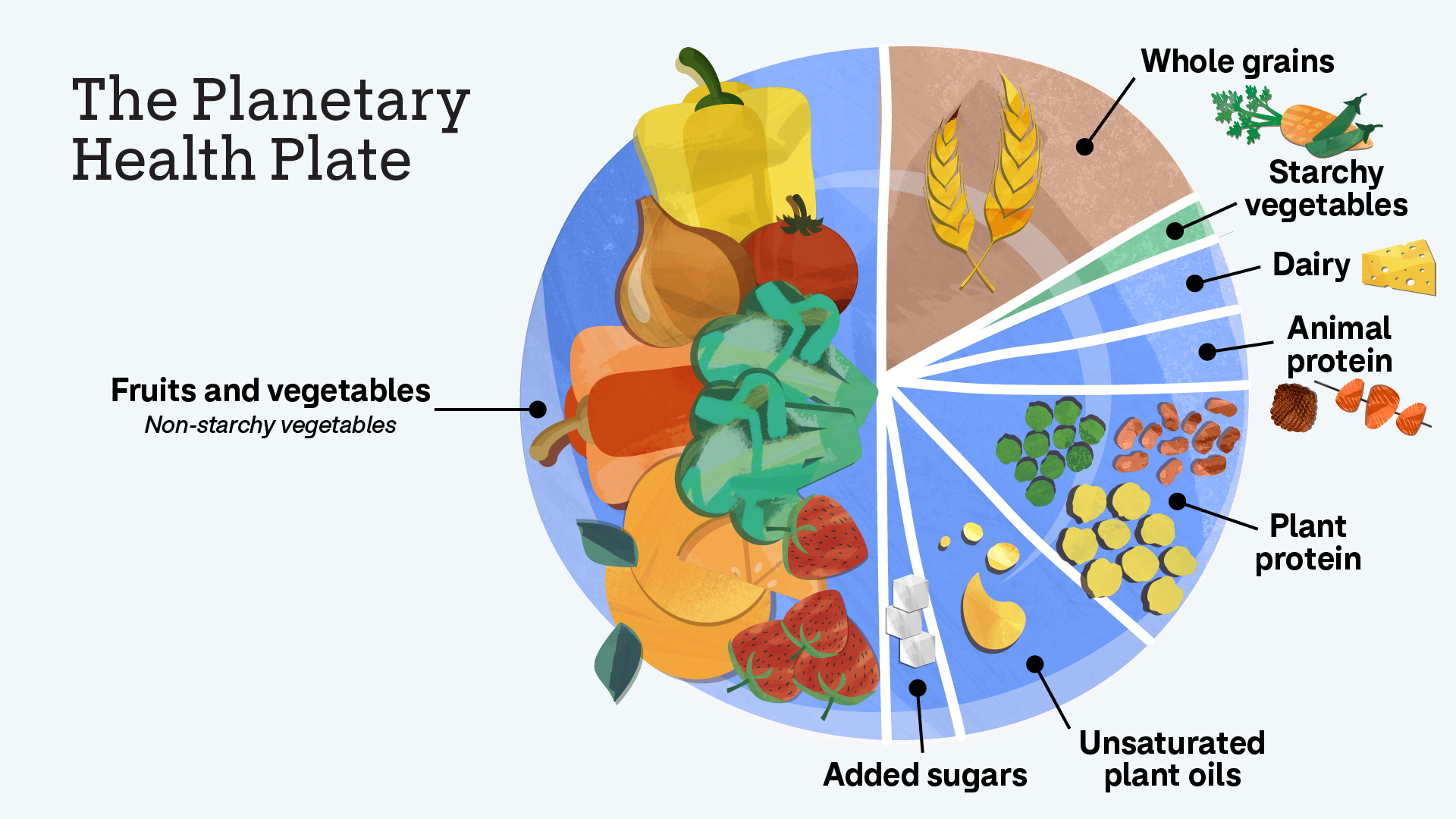
The planetary health plate is made up of half a plate of fruits and vegetables and half a plate of a mixture of plant-based proteins, whole grains, and unsaturated plant-based oils. It also allows for small portions of dairy foods, animal protein, added sugars, and starchy vegetables.
What does research say about the planetary health diet and the environment?
Food production is responsible for over one-third of global greenhouse gas emissions and 70% of freshwater use. Some foods have a greater carbon footprint than others, though. The production of 100 grams of beef, for example, emits nearly 50 kg of greenhouse gasses, while producing the same amount of tofu emits 1.98 kg.
Because greenhouse gasses are part of the reason the earth’s temperature is rising, limiting beef in diets (a main component of the PHD) can help reduce these emissions. In fact, research suggests that eating less meat is one of the best ways a person can help decrease the threat of climate change.

Read more like this
Explore these related articles, suggested for readers like you.




The U.S. eats the most meat of any country. According to a recent study, if everyone in the U.S. ate a quarter less meat and substituted that with plant proteins, we’d save about 82 million metric tons of greenhouse gas emissions per year.
What’s more, Oxford University researchers found that if the world stopped eating meat and dairy, we’d use around 75% less land for agriculture globally. Farming (especially related to livestock) and agriculture play a large role in climate change, so reducing our reliance on these practices would help support a healthier planet.
Choosing to produce and eat foods that are less taxing on the environment — namely plants — is a step in the right direction for fighting climate change.
What are the nutritional benefits of the planetary health diet?
It’s hard to know the exact nutritional benefits of following the PHD. There isn’t data yet on those who follow it.
But the EAT-Lancet Commission notes that the planetary health diet is similar to the Mediterranean diet, which is based on the foods of people living in countries surrounding the Mediterranean Sea. The Mediterranean diet has been extensively studied and shown to:
Support heart health
Offer protection from cancer
Lower inflammation
Support brain health
Lower the overall risk of death
There has also been plenty of research on plant-based foods in general. These foods have numerous benefits:
Plant-based foods have been shown to support a healthy immune system.
The nutrients in plant-based foods have anti-inflammatory effects.
Eating more fruits and vegetables can help reduce cancer cases.
Plant-based foods support heart health and have been found to greatly reduce the risk of heart disease.
Eating more plant-based foods may lower your cholesterol.
Also, research finds that the planetary health diet would cost around $2.84 per day, which would be more affordable for people in places like the U.S., Australia, and other regions.
What are the limitations of the planetary health diet?
While there’s a lot of promise around this type of eating plan, it’d be unrealistic to expect the majority of people to take it on. The EAT-Lancet Commission’s report is clear that it’d be difficult to get people to adapt to this way of eating.
“Humanity has never aimed to change the global food system on the scale envisioned,” the researchers write. “Achieving this goal will require rapid adoption of numerous changes and unprecedented global collaboration and commitment: nothing less than a Great Food Transformation.”
Some critics also note that eating such small portions of animal-based protein could lead to nutritional deficiencies (such as B12 and calcium) without supplementation.
The bottom line
Following the planetary health diet — or any eating plan that stresses meat reduction and promotes eating plants — can have benefits for human health and the health of our environment. Eating less meat can help reduce greenhouse gas emissions, which is critical in the fight against climate change.
That said, there are real barriers to following this diet plan, including convenience. But even swapping a few meat-based meals for plant-based ones each week, and focusing on whole foods, is a great place to start.
References
American Cancer Society. (n.d.). Cancer facts & figures 2019.
Economic Research Service. (2020). Climate change: Overview. U.S. Department of Agriculture.
Eshel, G., et al. (2019). Environmentally optimal, nutritionally sound, protein and energy conserving plant based alternatives to U.S. meat. Scientific Reports.
Goulding, T., et al. (2020). The affordability of a healthy and sustainable diet: An Australian case study. Nutrition Journal.
Heller, M. C., et al. (2018). Greenhouse gas emissions and energy use associated with production of individual self-selected U.S. diets. Environmental Research Letters.
Kahleova, H., et al. (2018). Vegetarian dietary patterns and cardiovascular disease. Progress in Cardiovascular Diseases.
Nutrition Coalition. (2019). EAT-Lancet report is one-sided, not backed by rigorous science.
Our World in Data. (n.d.). Greenhouse gas emissions per 100 grams of protein.
Physicians Committee for Responsible Medicine. (2020). Foods to boost the immune system.
Ritchie, H. (2021). If the world adopted a plant-based diet we would reduce global agricultural land use from 4 to 1 billion hectares. Our World in Data.
Statista. (2020). The countries that eat the most meat.
The EAT-Lancet Commission on Food, Planet, Health. (n.d.). Five questions on EAT-Lancet.
The EAT-Lancet Commission on Food, Planet, Health. (n.d.). The commissioners.
The EAT-Lancet Commission on Food, Planet, Health. (n.d.). The planetary health diet.
United Nations. (2021). Food systems account for over one-third of global greenhouse gas emissions.
U.S. Environmental Protection Agency. (2021). Sources of greenhouse gas emissions.
Watzl, B. (2013). Anti-inflammatory effects of plant-based foods and of their constituents. International Journal for Vitamin and Nutrition Research.
Widmer, R. J., et al. (2015). The Mediterranean diet, its components, and cardiovascular disease. The American Journal of Medicine.
World Bank Group Water Global Practice. (2020). Water in agriculture.

Why trust our experts?