

8 Trikafta Side Effects and How to Manage Them
Learn about the possible side effects of Trikafta, from common to rare, and how to manage them.
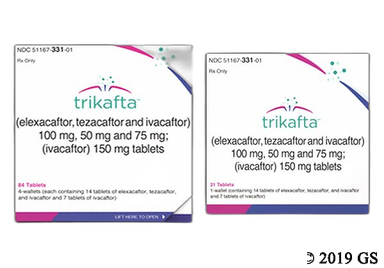
Trikafta is a combination medication containing elexacaftor, tezacaftor, and ivacaftor. It's used to treat cystic fibrosis (CF) in people 2 years and older. It's for those with specific gene mutations that cause problems with the CFTR protein. Trikafta works as a CFTR modulator to relieve some CF symptoms of CF. It comes as tablets and packets of oral granules for young children that are taken by mouth twice a day. Side effects include headache, stomach pain, and upper respiratory tract infections. As of mid-2025, there's no generic version available.

Trikafta is a combination of three medications. Together, they work as CFTR modulators. They act directly on a protein in the body called cystic fibrosis transmembrane conductance regulator (CFTR). This helps the CFTR protein work better.
This is important for people with cystic fibrosis (CF) because they have genetic mutations that make the CFTR protein not work right. This causes problems in the body, like a buildup of thick, sticky mucus in the lungs.
By helping CFTR proteins work properly, Trikafta helps relieve some symptoms of CF.
Note: There are many different gene mutations that can cause CF. Trikafta can only treat CF that's caused by specific mutations.
| Common Brands | Trikafta |
|---|---|
| Drug Class | CFTR modulator |
| Controlled Substance Classification | Not a controlled medication |
| Generic Status | No lower-cost generic available |
| Availability | Prescription only |

The following side effects may get better over time as your body gets used to the medication. Let your healthcare provider know immediately if you continue to experience these symptoms or if they worsen over time.
Contact your healthcare provider immediately if you experience any of the following.
Side effects that you should report to your care team as soon as possible:
Side effects that usually do not require medical attention (report these to your care team if they continue or are bothersome):



What to do if you miss a dose of Trikafta:

Trikafta can cause some serious health issues. This risk may be even higher for certain groups. If this worries you, talk to your doctor or pharmacist about other options.
 Trikafta can sometimes cause higher liver enzyme levels. This can be a sign of liver damage. In some cases, liver damage can be serious and potentially life-threatening. Liver damage has happened within the first month and up to a year and a half after starting Trikafta.
 Before starting Trikafta, tell your CF specialist if you have a history of liver problems. It's usually not recommended if you have moderate or severe liver problems. Your CF specialist will help you understand the risks and benefits. They'll help you decide if you should start Trikafta or not.
Your CF specialist will check your liver with blood tests before you start Trikafta. Then, you'll need these blood tests every month for the first 6 months, then every 3 months for the next year. After that, you'll need to get tested at least every year. If you have a history of liver problems, you might need blood tests more often.
If your blood tests show liver problems or if you have signs of liver damage, you'll need to stop Trikafta until you feel better. Watch for signs like stomach pain, dark urine, pale stools, or yellow skin or eyes. If this happens, get medical help right away.
Some people have had allergic reactions to Trikafta. They can sometimes be very serious. Signs can include swelling of the face or lips, tight feeling in the throat, and trouble breathing. Other signs of anaphylaxis are possible as well. If this happens, get medical help right away.
Trikafta can interact with other medications. These drug interactions can change the amount of Trikafta in your body. This affects how well it works and the risk of side effects. Trikafta can affect some medications as well.
Some medications, like carbamazepine (Tegretol) and St. John's wort, can lower the amount of Trikafta in your body. This can make Trikafta work less well. Other medications, like amiodarone (Pacerone) and clarithromycin, can raise Trikafta levels. This can put you at risk of side effects.
Tell your CF specialist and pharmacist about all the medications and supplements you take or plan to take. Also let them know if you change the way to take any of your medications. They can help make sure everything is safe and adjust doses if needed.
Some children who took ivacaftor, one of the medications in Trikafta, got cataracts. Some had other risk factors, like taking steroids or getting exposed to radiation. It's recommended for your child to get an eye exam before starting Trikafta. They should also have regular eye check-ups while taking the medication.

 Carton
| Dosage | Quantity | Price as low as | Price per unit |
|---|---|---|---|
| 56 packets of 80mg/40mg/60mg | 1 carton | $27,274.31 | $27,274.31 |
| 56 packets of 100mg/50mg/75mg | 1 carton | $27,274.31 | $27,274.31 |
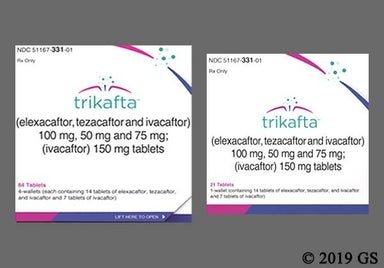
Your CF specialist will find the dose for you based on your body weight and age. Trikafta comes as prepackaged blister cards with the exact doses you need.
In general, you have a morning dose and an evening dose that you take about 12 hours apart. Take the medication with a high-fat meal or snack.
People 12 years and older
Children ages 6 to less than 12 years old
Weighing 66 lbs or more: Follow the dosing for people 12 years and older.
Weighing less than 66 lbs:
Children ages 2 to less than 6 years old (use the oral granule packets)
Weighing 31 lbs or more:
Weighing less than 31 lbs:
Your dose might be different depending on the other medications you take. It also might be different if you have liver problems.







Prescription savings
Stop paying too much for your prescriptions. Compare prices, get pharmacy coupons, and save up to 80%. Find expert answers to your health questions so you can make the best decisions for yourself and your family.
Health conditions
Medications & treatment
Access & affordability
Medication discounts

No, Trikafta doesn't cure cystic fibrosis (CF). In fact, there's currently no cure for CF. But there are medications like Trikafta that help manage CF and help stop it from getting worse. Trikafta is made up of 3 CF medications: elexacaftor, tezacaftor, and ivacaftor. It works by helping abnormal CFTR proteins work properly again. This helps relieve certain symptoms of CF, like mucus buildup in the lungs. Studies showed that Trikafta helped improve lung function. Trikafta also improved symptoms like cough, mucus production, and trouble breathing.
In a study, people 12 years and older who took Trikafta had improved lung function in as early as 2 weeks. They felt their symptoms get better after a month of treatment. This included cough, mucus production, and ability to breathe. Lung function and symptoms continued to improve and lasted for the rest of the study (another 5 months). Keep in mind that everyone has a different experience with Trikafta. So, this might be different for you. Talk to your CF specialist if you're not sure if Trikafta is working for you.
Talk to your CF specialist about if you can drink alcohol while taking Trikafta. This medication isn't known to interact with alcohol directly. But drinking alcohol can make some symptoms of cystic fibrosis (CF) worse. For example, CF and a lot of alcohol can cause damage to similar parts of the body, like the liver, pancreas, and stomach. What's more, Trikafta also has a risk of causing liver damage. Be sure to tell your CF specialist if you drink alcohol regularly to see if Trikafta is safe for you. If it's hard for you to cut out alcohol completely, ask your care team about what to do and for resources to help you quit.
There's not much information about how long common Trikafta side effects, like headache, stomach pain, and diarrhea, last. But your care team can help recommend ways to manage them. Stay hydrated to help with headache and to manage any diarrhea. If needed, ask your care team about over-the-counter pain killers or antidiarrheals that might be right for you. They can also guide you to ways to relieve upper respiratory infections like a cold at home. Talk to your care team if you have any side effects from Trikafta and they start to bother you.
It's not clear how Trikafta affects mood. People with CF already have a higher chance of depression or anxiety. There have been studies looking at how Trikafta might affect mood, but results are mixed. One study has suggested that Trikafta might affect people's mental health. Another study found that it made mental health problems worse for a small group of people. Changes could be managed with appropriate medications or a lower Trikafta dose, though. But one other small study found that Trikafta might improve depression in some people. Talk to your CF specialist if you're worried about how Trikafta might affect your mental health.
It isn't clear if Trikafta causes weight gain because there isn't enough information. There are some reports of children and young adults who gained weight while taking Trikafta. After taking the medication for 3 months, they gained an average of 5.5 lbs from their weight 2 years earlier. This weight gain was made up of a gain in fat and lean body mass. It could possibly be linked to symptom improvement from treatment. The proportion of fat and muscles in your body can affect cystic fibrosis. So it's important to talk to your care team about what you might expect after starting Trikafta.
Maybe. Researchers from one study predicted that Trikafta can increase life expectancy. The study reported a median projected survival of 82.5 years for people who start Trikafta between the ages of 12 and 17. This is about double the lifetime of people who use only supportive care for cystic fibrosis. Remember, these are predictions. So speak to your cystic fibrosis specialist about what Trikafta can do for you.
Toast or bagels with butter on top, peanut butter, eggs, and avocados are good examples of healthy foods that are high in fat. Other examples include whole-milk dairy products like milk, yogurt, and cheese. These high-fat foods will help your body absorb Trikafta better. You won't get as much medication in your system if you take it on an empty stomach or with a low-fat meal. Talk to your care team if you need help finding high-fat foods to take with Trikafta.
