


Melasma in Women With Darker Skin Tones: Here’s Why It’s Often Worse (With Images)
Melasma is a type of hyperpigmentation that occurs more commonly in people with darker skin tones. Explore the causes and learn how to treat melasma.
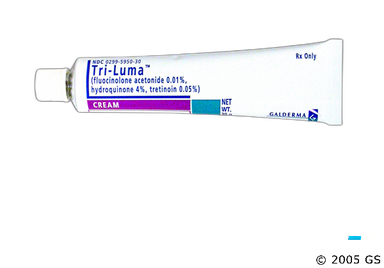
Tri-Luma is a cream that's used for melasma, a condition that causes dark patches on the face. It contains three active ingredients: fluocinolone (a steroid), hydroquinone (a melanin synthesis inhibitor), and tretinoin (a retinoid). They help lessen skin inflammation, lighten the skin, and promote new skin growth to help improve skin appearance. Tri-Luma is applied onto the dark patches on the face once a day. But side effects like skin redness and burning are common. It can take about 1 to 2 months of treatment to see results. Tri-Luma is only approved for adults. It's not approved to treat hyperpigmentation due to other reasons.

Tri-Luma is a combination of three ingredients. These ingredients work together to help treat melasma on the face.
Fluocinolone is a corticosteroid. It works to lessen skin irritation and inflammation.
Hydroquinone is a melanin synthesis inhibitor. It works by blocking the skin cells from making melanin, which is what gives color to your skin. This helps fade dark spots.
Tretinoin is a retinoid. It's a form of vitamin A that helps speed up skin cell turnover. This helps replace old skin cells with new, healthy ones.
| Common Brands | Tri-Luma |
|---|---|
| Drug Class | Corticosteroid / Melanin synthesis inhibitor / Retinoid |
| Controlled Substance Classification | Not a controlled medication |
| Generic Status | No lower-cost generic available |
| Availability | Prescription only |

The following side effects may get better over time as your body gets used to the medication. Let your healthcare provider know immediately if you continue to experience these symptoms or if they worsen over time.
Contact your healthcare provider immediately if you experience any of the following.
Along with its needed effects, a medicine may cause some unwanted effects. Although not all of these side effects may occur, if they do occur they may need medical attention.
Check with your doctor immediately if any of the following side effects occur:
More common
Redness, peeling, drying, itching, or burning of the skin
Less common
Darkening of normal skin color
irritated skin
rash
Incidence not known
Blistering, crusting, or flaking of the skin
burning and itching of the skin with pinhead-sized red blisters
lightening of normal skin color
redness and scaling around the mouth
severe redness, soreness, or scaling of the skin
thinning of the skin with easy bruising
Some side effects may occur that usually do not need medical attention. These side effects may go away during treatment as your body adjusts to the medicine. Also, your health care professional may be able to tell you about ways to prevent or reduce some of these side effects. Check with your health care professional if any of the following side effects continue or are bothersome or if you have any questions about them:
Other side effects not listed may also occur in some patients. If you notice any other effects, check with your healthcare professional.
Call your doctor for medical advice about side effects. You may report side effects to the FDA at 1-800-FDA-1088.




Tri-Luma can cause some serious health issues. This risk may be even higher for certain groups. If this worries you, talk to your doctor or pharmacist about other options.
Tri-Luma contains a sulfite, which can rarely cause a serious allergic reaction. Let your healthcare team know if you have a sulfite allergy.
Get medical help right away if you have signs of an allergic reaction after using Tri-Luma. Watch for hives, a rash, swelling of the lips or tongue, or trouble breathing.
Tri-Luma contains hydroquinone, which might cause blue-black patches to appear on the skin over time. This might be more common if you're Black, but it can also happen to people of any race. In some cases, the discoloration can become permanent.
Call your care team as soon as you can if you notice unusual changes in your skin color or if your melasma gets worse. This effect might be easier to manage when it's caught early.
Tri-Luma contains fluocinolone, a steroid. Using steroid medications for a long time can cause more of the medication to be absorbed into your body. In rare cases, this can affect your body's natural adrenal hormone levels.
Changes in your adrenal hormone levels can lead to high blood sugar. It might also lead to symptoms of Cushing's syndrome, like muscle weakness and easy bruising. And if you suddenly stop using Tri-Luma after long-term use, you might feel very tired, weak, or have stomach upset.
Be sure to use Tri-Luma as directed. Don't use it for a longer period of time than your prescriber instructed.
Skin irritation is common with Tri-Luma. This can include skin redness, peeling, dry skin, itching, and mild burning. They're usually mild and happen where you applied the medication on the skin.
Tell your care team if these skin reactions become severe, bother you too much, or don't go away. It's especially important to let them know if these reactions happen on areas where you didn't apply Tri-Luma.

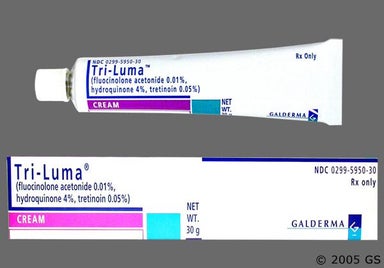
 Tube of cream
| Dosage | Quantity | Price as low as | Price per unit |
|---|---|---|---|
| 30g of 0.05% | 1 tube | $227.92 | $227.92 |

Although certain medicines should not be used together at all, in other cases two different medicines may be used together even if an interaction might occur. In these cases, your doctor may want to change the dose, or other precautions may be necessary. When you are taking this medicine, it is especially important that your healthcare professional know if you are taking any of the medicines listed below. The following interactions have been selected on the basis of their potential significance and are not necessarily all-inclusive.
Using this medicine with any of the following medicines is not recommended. Your doctor may decide not to treat you with this medication or change some of the other medicines you take.
Using this medicine with any of the following medicines is usually not recommended, but may be required in some cases. If both medicines are prescribed together, your doctor may change the dose or how often you use one or both of the medicines.
Using this medicine with any of the following medicines may cause an increased risk of certain side effects, but using both drugs may be the best treatment for you. If both medicines are prescribed together, your doctor may change the dose or how often you use one or both of the medicines.


Contraindications are specific health conditions or situations in which a person should not take a medication due to safety concerns. If you have any of the following conditions or if any of the following apply to you, let your healthcare provider know because Tri-Luma will not be safe for you to take.




Prescription savings
Stop paying too much for your prescriptions. Compare prices, get pharmacy coupons, and save up to 80%. Find expert answers to your health questions so you can make the best decisions for yourself and your family.
Health conditions
Medications & treatment
Access & affordability
Medication discounts

No, you can't buy Tri-Luma over the counter. It's only available with a prescription. You might be able to buy Tri-Luma online through a licensed U.S. online pharmacy, but you still need a valid prescription for it. Ask a healthcare professional or dermatologist where to get Tri-Luma if it's prescribed for you.
No, Tri-Luma hasn't been taken off the market. It's still available by prescription to treat melasma. You might've heard about some skin-lightening products being removed from stores. Those products contained hydroquinone but were not approved by the FDA. Tri-Luma also contains hydroquinone. ButTri-Luma is different because it's FDA approved. It remains available for safe use. Ask a healthcare professional or dermatologist if you have questions.
No, there's currently no generic version of Tri-Luma available. It only comes as a brand-name product.
You might start to see your melasma improve within 4 weeks of using Tri-Luma. In studies, many people noticed clearer skin after about 1 month of treatment. And by 8 weeks, the majority had complete or near-complete clearing of their melasma. Keep using Tri-Luma every day as prescribed, even if you don't see results right away. If you don't see improvement after using the medication regularly for 2 months, talk to your prescriber. In general, Tri-Luma isn't meant for long-term use. So, you might need to switch to other treatments to help keep your melasma under control.
Apply Tri-Luma only to the melasma patches on your face and about one-half inch of skin around them. If melasma covers most of your face, you might need to apply the cream to a larger area. Avoid getting Tri-Luma near your eyes, nose, mouth, or any open wounds because it can cause irritation.
Yes, you can use a moisturizer after applying Tri-Luma. This medication can cause dry skin, flaking, and skin redness. A gentle moisturizer can help soothe your skin and protect it from irritation. Ask a healthcare professional or dermatologist how long you should wait to use a moisturizer after applying Tri-Luma. You can keep using moisturizer throughout the day if needed.
Yes. Keep the tube of Tri-Luma in the refrigerator (36ºF to 46ºF). Make sure that the medication doesn't freeze though.
Yes, Tri-Luma can expire. There should be an expiration date written on the box that the tube of cream came in or on the tube itself. Don't use Tri-Luma after the expiration date because it's not guaranteed to work well for you. Contact your pharmacy for a refill if it's past the expiration date on your medications.
