


Need Quick Relief From Constipation? Here’s How to Give Yourself an Enema at Home
At-home enemas can relieve constipation. With GoodRx, learn how to give yourself an enema in a safe and effective way.
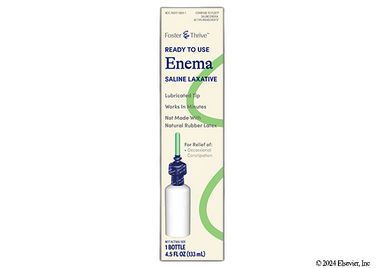
Saline enema (Fleet Enema) is an over-the-counter (OTC) enema that's used to relieve constipation in children and adults. It's an osmotic laxative that works to help make your stool softer so it's easier to pass. This medication is inserted into the rectum, and it works very fast (usually within 2 to 15 minutes) to cause a bowel movement. Side effects can include stomach pain and discomfort of the rectal area. There are different types of "Fleet" enemas, including saline, mineral oil, and bisacodyl. But this page refers only to saline enemas.

Saline enema (Fleet Enema) is a type of osmotic laxative called a saline laxative. It contains salt, which pulls water into your intestines (gut). This helps make your stool softer and easier to pass. It also encourages gut movement to help empty your bowels.
| Common Brands | Fleet Enema, Fleet Enema Extra, Pedia-Lax |
|---|---|
| Drug Class | Osmotic laxative |
| Controlled Substance Classification | Not a controlled medication |
| Generic Status | Lower-cost generic available |
| Availability | Over-the-counter |

The following side effects may get better over time as your body gets used to the medication. Let your healthcare provider know immediately if you continue to experience these symptoms or if they worsen over time.
Contact your healthcare provider immediately if you experience any of the following.
Side effects that you should report to your care team as soon as possible:
Side effects that usually do not require medical attention (report to your care team if they continue or are bothersome):




Saline enema (Fleet Enema) can cause some serious health issues. This risk may be even higher for certain groups. If this worries you, talk to your doctor or pharmacist about other options.
Saline enema (Fleet Enema) is an osmotic laxative that's made from salt (sodium). This can be an issue if you have certain kidney or heart conditions or if you need to watch your salt intake. Speak with your primary care provider (PCP) or pharmacist before you use saline enema (Fleet Enema) if you have kidney or heart problems or if you're on a low-salt diet. Ask them if this medication is safe for you to use.
Don't use more than the recommended dose of saline enema (Fleet Enema) per day. Using more than the recommended dose of the medication can be harmful. Although rare, this can cause severe dehydration and changes in the electrolyte levels in the blood, which can lead to serious and sometimes life-threatening harm to the kidneys and heart.

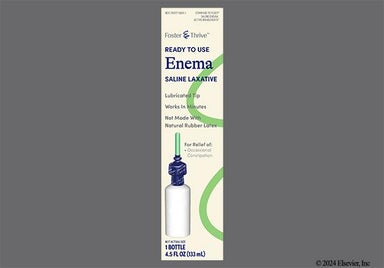
 Enema
Enema| Dosage | Quantity | Price as low as | Price per unit |
|---|---|---|---|
| 4.5 ounces | 1 enema | $5.67 | $5.67 |
Different manufacturers make different sizes of saline enema (Fleet Enema), which are meant for different age groups. Make sure to check the label, and follow the instructions carefully.
General dosing is listed below.



Prescription savings
Stop paying too much for your prescriptions. Compare prices, get pharmacy coupons, and save up to 80%. Find expert answers to your health questions so you can make the best decisions for yourself and your family.
Health conditions
Medications & treatment
Access & affordability
 Our monthly healthcare membership can help you save thousands on your prescription costs.
Resources

Saline Laxative typically causes you to have a bowel movement in 2 to 15 minutes. Ask your primary care provider for advice if you don't have a bowel movement after 30 minutes of inserting the enema.
When you insert Saline Laxative, lie on your left side with your right knee bent up towards your chest. Another option is to kneel on your knees with your chest forward and the left side of your face resting on a surface. Follow the instructions on the package; there are typically pictures that show you which body positions to be in to insert the enema properly.
Insert the tip of the Saline Laxative bottle into your rectum. The tip is about a few inches long. To make it easier to insert, some products already come lubricated. If not, you can purchase a lubricant (e.g., petroleum jelly) separately. Either apply the lubricant to your anus or coat the tip of the bottle with lubricant before inserting. Stop sliding the tip into the rectum if it's hard to insert; don't force it in because this could injure your rectum. Once the tip is inserted, squeeze the fluid into your rectum. Try to hold the fluid in your rectum for a few minutes before you go to the toilet to release it.
No. Using more than one enema in 24 hours can cause harm (e.g., severe dehydration). You should contact your primary care provider if you don't have a bowel movement within 30 minutes of using Saline Laxative. They might ask you questions to see whether your stool is impacted (stuck in your bowels) or whether your constipation is due to another health condition. In general, you can use one enema per day for three days in a row. Just make sure they're separated by at least 24 hours.
Saline Laxative is generally safe to use for most people when it's used as directed on the product labeling. But you should ask your primary care provider (PCP) before you use Saline Laxative if you've noticed a sudden change in your bowel habits that have lasted for over 2 weeks. Your PCP will want to rule out more serious medical conditions. You should also ask a healthcare professional before you use Saline Laxative if you're on a low-salt diet or if you have kidney or heart problems. Since Saline Laxative contains salt, using the enema might raise the risk of worsening these medical conditions.
While Saline Laxative isn't classified as a stool softener, it can help soften your stool by drawing water into your gut. This can make it easier to have a bowel movement.
