

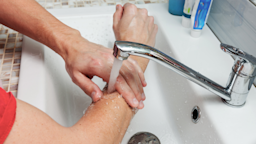
How to Treat a Burn, and What to Put on It for Relief
Minor burns (first and second degree) are treatable at home. Here’s the proper way to heal a burn at home, including what to put on it.
Polysporin (bacitracin / polymyxin B) is a combination medication that contains two antibiotics. It's an ointment that's applied on the skin to prevent bacterial infections in minor cuts and burns. Typically, you can apply this medication onto your skin 1 to 3 times daily. Most people have few to no side effects when they use Polysporin (bacitracin / polymyxin B) as directed.

Polysporin (bacitracin / polymyxin B) is a combination of two medications.
| Common Brands | Polysporin |
|---|---|
| Drug Class | Topical antibiotic |
| Controlled Substance Classification | Not a controlled medication |
| Generic Status | Lower-cost generic available |
| Availability | Over-the-counter |

The following side effects may get better over time as your body gets used to the medication. Let your healthcare provider know immediately if you continue to experience these symptoms or if they worsen over time.
See Risks and Warnings.
Side effects that you should report to your care team as soon as possible:
Side effects that usually do not require medical attention (report these to your care team if they continue or are bothersome):




Polysporin (bacitracin / polymyxin B) can cause some serious health issues. This risk may be even higher for certain groups. If this worries you, talk to your doctor or pharmacist about other options.
In some rare cases, Polysporin (bacitracin / polymyxin B) can cause an allergic reaction. Stop using the ointment and contact a provider if you develop a skin rash or other reaction while you're using this medication. Get emergency medical help right away if you have a more serious allergic reaction, such as shortness of breath or swelling of your tongue, lips, or face.
Polysporin (bacitracin / polymyxin B) should only be used on your skin. Don’t put it in your eyes, nose, mouth, ears, or genitals. Get medical help or contact a Poison Control Center right away by calling 1-800-222-1222 if someone accidentally swallows the ointment.

 Tube of ointment
| Dosage | Quantity | Price as low as | Price per unit |
|---|---|---|---|
| 14.2g of 500iu/10000iu | 1 tube | $8.40 | $8.40 |
| 28g of 500iu/10000iu | 1 tube | $7.12 | $7.12 |
Apply a small amount (about the size of the tip of your finger) to the affected area(s) 1 to 3 times daily.



Prescription savings
Stop paying too much for your prescriptions. Compare prices, get pharmacy coupons, and save up to 80%. Find expert answers to your health questions so you can make the best decisions for yourself and your family.
Health conditions
Medications & treatment
Access & affordability
 Our monthly healthcare membership can help you save thousands on your prescription costs.
Resources

Polysporin and Neosporin are two different medications that are applied onto your skin to prevent bacterial skin infection after minor injury. Both medications contain bacitracin and polymyxin B. But Neosporin also contains neomycin, which is another antibiotic. You can get both Neosporin and Polysporin over the counter.
Polysporin is an ointment that has two active ingredients: bacitracin and polymyxin B. Both of these active ingredients are antibiotics that help prevent an infection by killing or weakening bacteria around your injury.
No, Polysporin shouldn’t be used to treat an active skin infection. This medication is only meant to help to prevent an infection, not to fight off an infection. Don't use Polysporin to treat a skin infection even if you already have it at home. Doing so might make your infection worse since it might not be the right medication for the infection. See a provider right away for appropriate treatment if your cut looks red, swollen, or has pus coming out.
Polysporin helps prevent a skin infection from small cuts, scrapes, and burns. It isn't clear whether the ointment itself can heal wounds. But in general, preventing a skin infection from developing can help with this process. Covering your wound with a bandage after you've applied Polysporin can also help with wound healing since it protects the skin from further harm.
Yes. Applying Polysporin to a blister can help prevent an infection, especially if the blister breaks and some raw skin gets exposed. In addition, one of the inactive ingredients of Polysporin is petrolatum, which can also help lessen friction when your skin rubs against something. Blisters typically take 1 to 2 weeks to get better. While you wait for your blister to go away, make sure you cover it with a bandage and avoid draining it to prevent infection as well.
Yes, Polysporin can expire. Always check the expiration date on the tube before you use it. Don't use the medication if it's expired because it might not work well to prevent skin infections. Discard the expired tube and purchase a new one over-the-counter.
Yes, Polysporin is available as a lower-cost generic medication over the counter. You can purchase this medication at most pharmacies. Please note that Polysporin is only used to prevent infections, not to treat one. Talk to your provider right away if you need to use this medication for longer than a week, if your wound is getting worse, or if you get a skin rash.
No, it's not recommended to put Polysporin near your eye, such as your eyelid. Your eyes are much more sensitive than your skin. The medication might accidentally get into your eyes if you put it near your eye. This might hurt or injure your eyes. Talk to your provider if you have a cut or injury on your eyelid.
