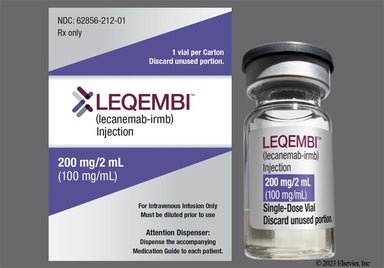
Leqembi (lecanemab or lecanemab-irmb) is FDA approved to treat people with early Alzheimer's disease. This is when they have mild cognitive impairment or mild dementia. Leqembi (lecanemab) is a type of monoclonal antibody that's given as an infusion into a vein. It's given at an infusion center once every 2 weeks. Later on during treatment, there's an option to get the infusions once every 4 weeks. Common side effects include infusion-related reactions and headache. Leqembi (lecanemab) is not a cure for Alzheimer's disease.
Leqembi (lecanemab) is a type of monoclonal antibody. It finds and attaches to proteins in the brain called amyloid beta (or beta-amyloid). In Alzheimer's disease, these proteins clump together. This forms plaques that can be harmful to your brain cells.
The following side effects may get better over time as your body gets used to the medication. Let your healthcare provider know immediately if you continue to experience these symptoms or if they worsen over time.
Not studied in people with moderate or severe Alzheimer's disease
Pharmacist tips for Leqembi (lecanemab)
Make sure to put your appointments for your Leqembi (lecanemab) infusions on your calendar. This helps you stay on track with your treatment. Also put in your scheduled MRI scans. These are important for making sure the medication isn't causing any serious problems. Have a caregiver help you keep track of your appointments.
If you miss a Leqembi (lecanemab) infusion, call your care team to reschedule it as soon as possible.
Bring a book or something to do to help pass the time during your Leqembi (lecanemab) infusion. Each infusion takes about 1 hour. But it can sometimes take longer if you have reactions to the infusion and your nurse needs to slow it down.
During your Leqembi (lecanemab) infusion, tell your nurse if you don't feel well. Let them know if you have any flu-like symptoms, dizziness, nausea, or trouble breathing. These could be signs of infusion-related reactions. Your nurse might slow down the infusion and give you medications to help you feel better.
If you've had a reaction to the infusion, you might need to take certain medications before the rest of your Leqembi (lecanemab) infusions. These medications can help prevent infusion reactions or make them less severe. Some examples are antihistamines, acetaminophen (Tylenol), and steroids.
Tell your prescriber if you take medications that help lower the risk of blood clots. This includes aspirin and blood thinners. Your prescriber will check for possible bleeding problems in your brain more often while you're taking Leqembi (lecanemab).
Leqembi (lecanemab) can cause some serious health issues. This risk may be even higher for certain groups. If this worries you, talk to your doctor or pharmacist about other options.
Amyloid related imaging abnormalities (ARIA)
Risk factors: Having two copies of the apolipoprotein E ε4 (ApoE ε4) gene | Taking medications that can raise bleeding risk
Leqembi (lecanemab) can cause a side effect called amyloid related imaging abnormalities (ARIA). They're usually found on MRI scans and look like swelling or bleeding in the brain.
Check with your prescriber about your risk of ARIA with Leqembi (lecanemab). ARIA can also happen to anyone, but the risk seems higher for those with the ApoE ε4 gene. Also let them know about any medications you take or plan to take. Certain medications like aspirin or clopidogrel (Plavix) might raise your risk of bleeding in the brain.
ARIA most commonly happens early in treatment (within the first 14 weeks, or 3.5 months). But it's important to note that it can happen at anytime. It can also happen more than one time during treatment.
Most people with ARIA don't notice any symptoms. That's why you'll need to get an MRI before and during treatment to watch out for it. If you do have symptoms, they usually go away over time. But some can be more serious and life-threatening. Call your care team right away if you have a headache, vision changes, dizziness, nausea, trouble walking, or a seizure.
Infusion-related reactions
Some people can have a reaction from the Leqembi (lecanemab) infusion itself. These reactions can include fever, chills, body aches, and feeling shaky. It can also cause nausea, vomiting, and changes in your blood pressure. Most times, these reactions are mild. But some can be serious. In studies, most reactions happened with the first infusion.
Tell the nurse if you don't feel well, have trouble breathing, or feel your chest pounding during your Leqembi (lecanemab) infusion. The nurse can slow down the infusion or stop it completely. They can give you supportive care to help with symptoms if needed. Your prescriber might give you medications for you to take before your next infusion. This can help lower your chance of having another reaction.
Allergic reactions
Some people have had very serious allergic reactions to Leqembi (lecanemab). They can include severe swelling, trouble breathing, and anaphylaxis. Get medical help right away if you notice hives, swelling in your face or throat, or trouble breathing.
Leqembi (lecanemab) dosage
Typical dosage for Leqembi (lecanemab)
Leqembi (lecanemab) is given as an intravenous (IV) infusion. This means it's injected into a vein. It's given by a healthcare professional at an infusion center.
Your prescriber will calculate the dosage based on body weight.
The typical starting dose is 10 mg/kg of weight given as an IV infusion once every 2 weeks. After a year and a half, you have the option to get infusions once every 2 weeks or once every 4 weeks.
What are alternatives to Leqembi (lecanemab)?
There are a number of medications that your doctor can prescribe in place of Leqembi (lecanemab). Compare a few possible alternatives below.
GoodRx Health has strict sourcing policies and relies on primary sources such as medical organizations, governmental agencies, academic institutions, and peer-reviewed scientific journals. Learn more about how we ensure our content is accurate, thorough, and unbiased by reading our editorial guidelines.
Prescription savings
Stop paying too much for your prescriptions. Compare prices, get pharmacy coupons, and save up to 80%.
Leqembi is given as an infusion through a vein. It's given by a trained healthcare professional at an infusion center. You get the infusion once every 2 weeks. After a year and a half of treatment, you can keep getting infusions once every 2 weeks or change to once every 4 weeks. Each infusion usually takes 1 hour. But it can take longer if you have any infusion-related reactions and need the care team to help. If you have questions about the Leqembi infusion, talk to your care team.
No. But Leqembi might be able to slow down Alzheimer's disease in people at the early stage. Studies showed that the medication can lower the amount of toxic proteins (amyloid beta plaques) that build up in the brain. This is thought to help slow down symptoms of Alzheimer's disease from getting worse.
There isn't a specific amount of time that's recommended for you to take Leqembi. Your prescriber help you decide how long to take it. It depends on how long the medication seems to be helping your Alzheimer's from getting worse. It also depends on if you have dangerous or bothersome side effects from it. Discuss with your prescriber about how long to take Leqembi.
There isn't a specific number of Leqembi infusions that you should get. This is because there isn't a set amount of time that you should take the medication. In general, you get a Leqembi infusion once every 2 weeks. After a year and a half of treatment, you have the option to get infusions either once every 2 weeks or once every 4 weeks. This is as long as the medication is helping you and that you're not having serious problems from it.
Before you can start Leqembi, you'll need to have had a recent MRI within the past year. Once you start treatment, you'll need to get an MRI within a week before your 3rd, 5th, 7th, and 14th infusion. These MRI scans help check for side effects called amyloid related imaging abnormalities (ARIA). Not everyone has symptoms from this side effect. So, MRIs are helpful for your prescriber to make sure the medication is safe for you. And if you do have ARIA symptoms like headache, confusion, and trouble walking, you'll need to get an MRI to check what's going on. Ask your prescriber to learn more about your MRI schedule.
Leqembi is made by a pharmaceutical company called Eisai.
Leqembi and Kisunla (donanemab) are both treatments for mild Alzheimer's disease. They're both given as infusions through the vein with the help of a nurse. But the logistics of how they're given is different. Leqembi is a 1-hour infusion given either every 2 or 4 weeks. Kisunla is a 30-minute infusion that's given once every 4 weeks. Also, the dose for Leqembi is based on body weight but Kisunla is given as fixed doses. To date, there aren't studies that directly compare these medications to each other. Talk to your Alzheimer's specialist about the similarities and differences between the medications.
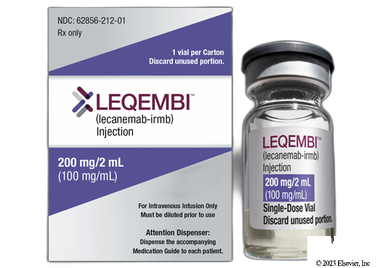







 Leqembi (lecanemab) can cause a side effect called amyloid related imaging abnormalities (
 Check with your prescriber about your risk of ARIA with Leqembi (lecanemab). ARIA can also happen to anyone, but the risk seems higher for those with the