Kisunla
Kisunla (donanemab or donanemab-azbt) is FDA approved to treat people with early Alzheimer's disease (AD). It's a type of monoclonal antibody called an amyloid beta-directed antibody. Kisunla (donanemab) is given as an infusion into a vein by a healthcare professional every 4 weeks. Potential side effects include small bleeds on the brain and headache.


What is Kisunla (donanemab)?
What is Kisunla (donanemab) used for?
- Early Alzheimer's disease (when there's mild cognitive impairment or mild dementia)
How Kisunla (donanemab) works
Kisunla (donanemab) is a type of monoclonal antibody. It attaches to proteins in the brain called amyloid beta (or beta-amyloid). In Alzheimer's disease, these proteins clump together. This forms plaques that can be harmful to your brain cells.
Kisunla (donanemab) works to lessen plaque buildup in the brain. This might help slow Alzheimer's from getting worse.
Drug facts
| Common Brands | Kisunla |
|---|---|
| Drug Class | Amyloid beta-directed antibody |
| Controlled Substance Classification | Not a controlled medication |
| Generic Status | No lower-cost generic available |
| Availability | Prescription only |

Side effects of Kisunla (donanemab)
The following side effects may get better over time as your body gets used to the medication. Let your healthcare provider know immediately if you continue to experience these symptoms or if they worsen over time.
Common Side Effects
- Bleeding in the brain (up to 25%)
- Swelling or fluid buildup in the brain (24%)
- Headache (13%)
- Infusion-related reaction (9%)
Kisunla (donanemab) serious side effects
Contact your healthcare provider immediately if you experience any of the following.
- Problems in the brain: headache, confusion, dizziness, vision changes, trouble communicating, weakness, trouble walking, nausea, seizure
- Infusion-related reaction: trouble breathing, fever, chills, flushing, sweating, skin irritation, headache, chest pain, nausea, vomiting
- Severe allergic reaction: swelling in the face or throat, tightening of the throat, chest tightness, trouble breathing
The following Kisunla (donanemab) side effects have also been reported
Side effects that you should report to your care team as soon as possible:
- Allergic reactions or angioedema—skin rash, itching or hives, swelling of the face, eyes, lips, tongue, arms, or legs, trouble swallowing or breathing
- Headache, worsening confusion, dizziness, change in vision, nausea, seizures
- Infusion reactions—chest pain, shortness of breath or trouble breathing, feeling faint or lightheaded
Side effects that usually do not require medical attention (report these to your care team if they continue or are bothersome):
- Headache

Pros and cons of Kisunla (donanemab)

Pharmacist tips for Kisunla (donanemab)

- Each Kisunla (donanemab) infusion is given every 4 weeks. Mark your infusion dates on your calendar to help you stay on track with your treatment.
- If you miss a Kisunla (donanemab) infusion, call your care team to reschedule it as soon as possible.
- Your prescriber will order MRI scans before starting Kisunla (donanemab). You'll also need an MRI before your 2nd, 3rd, 4th, and 7th infusions. These are important to make sure the medication isn't causing serious problems like bleeding or swelling in your brain.
- During your Kisunla (donanemab) infusion, let a member of your care team know if you don't feel well. Tell them if you have any trouble breathing, chills, chest pain, or nausea. These could be signs of an infusion-related reaction. Your nurse might slow down the infusion and give you medications to help you feel better. Also tell them if these symptoms happen a few hours after you leave the infusion center.
- If you've had a reaction to an infusion, your care team have you take some medications before your next Kisunla (donanemab) infusions. These medications can help prevent another reaction or make it less severe. They can include an antihistamine, acetaminophen (Tylenol), or a steroid.
- Let your prescriber know if you take medications that help lower the risk of blood clots. This includes aspirin and blood thinners. Your prescriber will talk to you about your risk of possible bleeding problems with Kisunla (donanemab) treatment.
- You're encouraged to join research programs that help experts learn more about Alzheimer's disease. They also help explore more about how treatments can make a difference. For more information, ask your prescriber or call 1-800-545-5979.

Risks and warnings for Kisunla (donanemab)
Kisunla (donanemab) can cause some serious health issues. This risk may be even higher for certain groups. If this worries you, talk to your doctor or pharmacist about other options.
Amyloid related imaging abnormalities (ARIA)
- Risk factors: Having two copies of the apolipoprotein E ε4 (ApoE ε4) gene | Taking medications that can raise bleeding risk
Kisunla (donanemab) can cause a side effect called amyloid related imaging abnormalities (ARIA). They're usually found on MRI scans and look like swelling or bleeding in the brain.
Check with your prescriber about the benefits of Kisunla (donanemab) and the risk of ARIA. ARIA can happen to anyone with Alzheimer's disease. But the risk seems higher for those with the ApoE ε4 gene. Also tell your prescriber about all the other medications you take or plan to take. Medications like aspirin or other blood thinners such as clopidogrel (Plavix) might raise your risk of bleeding in the brain.
ARIA most commonly happens early in treatment (within the first 24 weeks, or 6 months). But it's important to note that it can happen at anytime. It can also happen more than one time during treatment.
Most people don't notice any symptoms from ARIA. That's why you'll need an MRI before and periodically during treatment to watch out for it. If you do have symptoms, they usually go away over time. But some can be more serious and life-threatening. Call your care team right away if you have a headache, vision changes, confusion, dizziness, nausea, trouble walking, or a seizure.
Infusion-related reactions
Some people can have a reaction to the Kisunla (donanemab) infusion itself. These reactions usually happen during the infusion or within 30 minutes after, but they can also occur hours after. They happen most often within the first 4 infusions, especially with the first one.
Infusion-related reactions can include chills, headache, flushing, sweating, and chest pain. Some people might also feel nauseous, vomit, have trouble breathing, or have changes in blood pressure. Most reactions are mild or moderate in severity, but some can be serious.
Tell the nurse if you don't feel well, have trouble breathing, or have chest pain during or after your Kisunla (donanemab) infusion. The nurse can slow down the infusion or stop it completely. They can give you supportive care to help with symptoms if needed. Your prescriber might give you medications for you to take before your next infusion. This can help lower your chance of having another reaction.
Allergic reactions
Some people have had very serious allergic reactions to Kisunla (donanemab). They can include severe swelling, trouble breathing, and anaphylaxis. Get medical help right away if you notice hives, swelling in your face or throat, or trouble breathing.

Kisunla (donanemab) dosage
Typical dosage for Kisunla (donanemab)
Kisunla (donanemab) is given as an intravenous infusion (IV), meaning it's injected into a vein. It's given by a healthcare professional at an infusion center.
The infusion is given every 4 weeks. You start at a lower dose, and then the dose is raised at each infusion until you get to a maintenance dose.
- Infusion 1: The typical dose is 350 mg IV.
- Infusion 2: The typical dose is 700 mg IV.
- Infusion 3: The typical dose is 1,050 mg IV.
- Infusion 4 and thereafter: The typical dose is 1,400 mg IV.

What are alternatives to Kisunla (donanemab)?

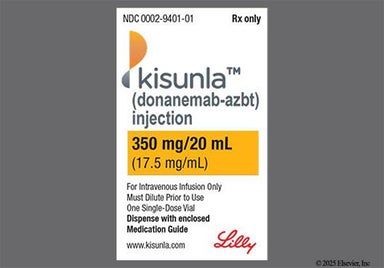
Kisunla (donanemab) images