Key takeaways:
Viruses are the most common cause of sore throats. Antibiotics won’t help a sore throat caused by a virus.
You may need antibiotics to treat a sore throat that’s caused by a bacteria, like strep throat.
Many sore throats can be treated at home with over-the-counter (OTC) medications or home remedies. Signs you need medical attention for a sore throat include fever, trouble swallowing or speaking, and neck swelling.
Sore throat is one of the most common reasons people seek medical care. In fact, sore throats make up about 1% to 2% of all office visits each year. But most sore throats will go away on their own without antibiotics or prescription treatments.
So, how do you know if you really need medical care for a sore throat? Let’s look at the common causes of sore throats, when you can treat them at home, and when you should seek medical care.
What causes a sore throat?
The medical term for a sore throat is pharyngitis. Pharyngitis can be caused by germs like viruses and bacteria. Viruses — like the ones that cause the common cold — are the most common cause of sore throats.
Some of these viruses include:
Epstein-Barr virus
Rhinovirus
Parainfluenza
But bacteria and viruses aren’t the only causes of sore throats. Other things that can irritate your throat include:
Acid reflux and gastroesophageal reflux disease (GERD)
Smoking
Dry air
Throat injury
Vocal strain from singing or yelling too much
Can you use antibiotics to treat a sore throat?
Sometimes, antibiotics can be used to treat a sore throat. But they don’t help with the most common causes, like viruses, acid reflux, allergies, or vocal strain. Antibiotics are only helpful when your sore throat is caused by bacteria.
Taking antibiotics for a sore throat not caused by bacteria won’t help you feel better faster. And taking unnecessary antibiotics puts you at risk for side effects (like diarrhea). It also contributes to antibiotic resistance.
How do you know if you need antibiotics for a sore throat?
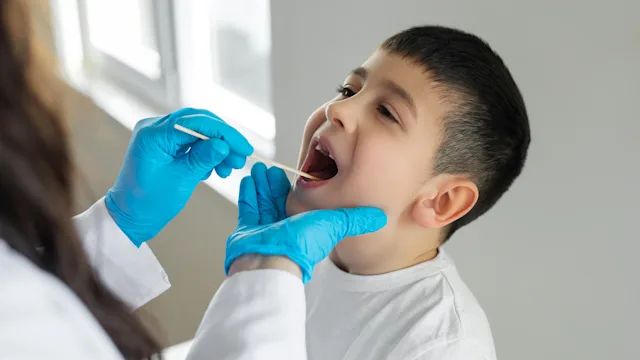
The only way to know if your sore throat is caused by bacteria is with a throat swab. This is a test that’ll quickly check for bacteria, like group A Streptococcus. Most primary care offices and urgent care centers can do a rapid strep test.

Kids are prone to strep throat. Adults can get strep throat too, but it’s not common.
Not sure if you should get checked out? Our experts explain when to seek medical care for a sore throat.
Got diagnosed with strep throat? Here are nine strep throat remedies to try while you wait for your antibiotics to kick in.
A healthcare professional will rub the back of your throat with a medical swab that looks like a long Q-tip.
Group A Streptococcus is the main cause of strep throat, a bacterial throat infection that needs to be treated with antibiotics.
Other bacteria can also cause throat infections and may also need antibiotic treatment. These include:
Group C and G Streptococcus
Neisseria gonorrhoeae
Chlamydia trachomatis
Arcanobacterium haemolyticum
Read more like this
Explore these related articles, suggested for readers like you.




But how can you tell if it’s worth going for a strep test in the first place? Your symptoms will give you important clues.
Viral sore throats often cause:
Coughing
Sneezing
Watery eyes
Runny nose
Hoarse voice
Oral ulcers
Meanwhile, signs and symptoms of strep throat include:
Sore throat that starts suddenly
Pain with swallowing
Fever
Tiny red spots on the back of your throat (called petechiae)
White, patchy spots on your tonsils (called exudates)
Tender lymph nodes in the front part of your neck
Do you need antibiotics for strep throat?
Yes, you should take antibiotics if you have strep throat. While strep throat may go away without antibiotics, untreated strep throat can lead to serious health complications.
Strep throat is usually treated with penicillin or amoxicillin. If you’re allergic to penicillin, you may be treated with an alternative antibiotic like clindamycin or azithromycin. You can’t get amoxicillin, penicillin, or other antibiotics for strep throat over the counter. Antibiotics are prescription-only medications.
Quiz: Do I have strep throat?
What are the benefits of taking antibiotics to treat strep throat?
A sore throat caused by strep throat may go away on its own, but antibiotics may help you feel better faster. They can shorten your symptoms by about 16 hours.
More importantly, antibiotics can prevent complications from strep throat. Without treatment, strep throat can lead to rheumatic fever, a serious complication that can cause long-term heart disease. Antibiotics can also prevent complications like throat abscesses.
Another benefit to taking antibiotics for strep throat is that they stop you from being contagious. People who take antibiotics are no longer contagious within 12 to 24 hours after starting treatment. Without antibiotics, you can stay contagious for days to weeks, passing the bacteria to others.
How long do antibiotics take to work for strep throat?
People usually feel better within 1 to 2 days after starting antibiotics for strep throat. Call your health team if your symptoms don’t start getting better within 48 hours of starting antibiotics.
Your team may need to check for other causes of your sore throat. They’ll also make sure you haven’t developed a complication from strep throat, like a throat abscess.
Group A Streptococcus isn’t resistant to penicillin. So if you’re taking penicillin or amoxicillin for strep throat, it’s unlikely that your medicine isn’t working. But if you were prescribed a different antibiotic because of a penicillin allergy, there’s a small possibility that the antibiotics aren’t working against the bacteria.
What are some home remedies for sore throat?
There are many ways to treat a sore throat at home. If your sore throat is because of a viral infection, nothing can “cure” it. Your body just needs time to clear the virus. While you’re waiting, it’s helpful to stay as comfortable as possible.
If you have a bacterial infection, like strep throat, these remedies can help relieve throat pain until your antibiotics start working.
Over-the-counter pain medication
Over-the-counter (OTC) pain medications like acetaminophen (Tylenol) or ibuprofen (Advil, Motrin) will help relieve a sore throat. There’s some evidence that ibuprofen works better than acetaminophen for throat pain.
These medications usually start working within 1 to 2 hours, and their effects last 4 to 6 hours. You can start with lower doses of acetaminophen or ibuprofen and still get great pain relief.
Lozenges and sprays
Various lozenges (drops) and sprays are available OTC to help with sore throat. Lozenges and sprays act faster than acetaminophen or ibuprofen, but the relief doesn’t last as long. It’s best to use a lozenge or spray along with an OTC pain reliever. Currently, there’s no evidence that one type of spray or lozenge works better than another. Most people choose based on personal preference, taste, and availability.
It’s important to remember, lozenges are a choking hazard and shouldn’t be given to young children. Use sprays instead for kids.
Cold fluids
There’s some evidence that cold fluids can relieve a sore throat by temporarily numbing the nerves in the back of your throat. While the effects don’t last long, it can help keep you comfortable until OTC pain medication kicks in.
Very cold fluids or foods work best — popsicles and ice chips are great options.
Warm fluids
Warm fluids like tea, broth, or soup can also help temporarily relieve your sore throat. Make sure liquids aren’t too hot. Hot liquids can scald the back of your throat, making the pain worse.
Saltwater gargles
Gargling with salt water can also help relieve a sore throat:
Mix ¼ tsp to ½ tsp of regular table salt in 8 oz of warm water.
Gargle for 10 to 20 seconds, as tolerated. Then spit it out.
Children who are too young to understand how to gargle shouldn’t use this remedy.
Saltwater gargles won’t kill the germs causing your sore throat — whether from a virus or bacteria, including COVID. But it can ease your symptoms.
When should you see your doctor about a sore throat?
Consider getting a strep test if you have symptoms of strep throat and you’re at high risk for getting it.
Children, especially those between 5 and 15 years old, are more likely than adults to get strep throat. But adults can get strep throat too — especially if they spend a lot of time around children.
In general, you should seek medical care if:
You have a fever.
You think you could have COVID (sore throat is a common symptom of COVID-19 illness).
Your sore throat is getting worse. A sore throat from a virus should go away within a few days and shouldn’t get worse over time. If your sore throat hasn’t improved after 2-3 days, even if home remedies are giving you temporary relief, see a healthcare professional. You could have a sore throat for a different reason.
You have severe symptoms like neck swelling, trouble swallowing or speaking, voice changes, or pain that makes it hard to move your neck.
Frequently asked questions
No. Antibiotics are available by prescription only, so you’ll need to see a healthcare professional and be tested for a bacterial infection before taking an antibiotic for strep throat.
No. Unfortunately, there’s no cure for the common cold. Colds are caused by viruses, and antibiotics don’t work on viruses.
Tonsillitis is inflammation of the tonsils. Inflamed tonsils are most often caused by a viral infection. That means that antibiotics won’t help most cases of tonsillitis.
It can be tough to tell the difference. But a sore throat that starts suddenly, along with fever, no cough, and patchy white spots in your throat, is more likely to be caused by a bacterial infection.
No. Antibiotics are available by prescription only, so you’ll need to see a healthcare professional and be tested for a bacterial infection before taking an antibiotic for strep throat.
No. Unfortunately, there’s no cure for the common cold. Colds are caused by viruses, and antibiotics don’t work on viruses.
Tonsillitis is inflammation of the tonsils. Inflamed tonsils are most often caused by a viral infection. That means that antibiotics won’t help most cases of tonsillitis.
It can be tough to tell the difference. But a sore throat that starts suddenly, along with fever, no cough, and patchy white spots in your throat, is more likely to be caused by a bacterial infection.
The bottom line
Many things can cause a sore throat, but viruses are the most common cause. Only sore throats caused by bacteria need antibiotic treatment. People with both fever and sore throat are more likely to need antibiotics. Some helpful remedies for sore throat include OTC pain medications, cold and warm fluids, and throat sprays or lozenges.

Why trust our experts?




References
Bathala, S., et al. (2013). A review on the mechanism of sore throat in tonsillitis. The Journal of Laryngology and Otology.
Centers for Disease Control and Prevention. (2025). Clinical guidance for Group A streptococcal pharyngitis.
Goldin, J., et al. (2024). Bacterial pharyngitis. StatPearls.
Kocher, J. J., et al. (2014). Antibiotics for sore throat. American Family Physician.
McCraig, L. F., et al. (2002). Trends in antimicrobial prescribing rates for children and adolescents. JAMA.
National Health Service. (2024). Sore throat.
Sauve, L., et al. (2021). Group A streptococcal (GAS) pharyngitis: A practical guide to diagnosis and treatment. Paediatrics and Child Health.
Schachtel, B. P., et al. (1988). Sore throat pain in the evaluation of mild analgesics. Clinical Pharmacology and Therapeutics.
Schappert, S. M., et al. (2008). Ambulatory medical care utilization estimates for 2006. National Health Statistics Reports.
Smith, K. L., et al. (2023). Tonsillitis and Tonsilloliths: Diagnosis and Management. American Family Physician.
Thomas, M., et al. (2000). How effective are treatments other than antibiotics for acute sore throat? The British Journal of General Practice.
Tiong, V., et al. (2021). The effectiveness of various gargle formulations and salt water against SARS-CoV-2. Scientific Reports.