Key takeaways:
The idea that you shouldn’t swim after you eat is likely based on the fact that blood is shifted from your muscles to your stomach during digestion.
Strenuous exercise after you eat could be somewhat uncomfortable. But there’s no medical evidence that this makes swimming after eating dangerous.
You shouldn’t drink alcohol before water activities. This can increase the risk of drowning.
You might have heard that you should wait 30 to 60 minutes after a meal to go swimming. But where exactly did this idea come from? And is it true?
Growing up, you may have heard many reasons why swimming on a full stomach is a bad idea. But there’s not much evidence of there being danger in hopping back into the pool right after eating a meal.
Can you swim right after eating?
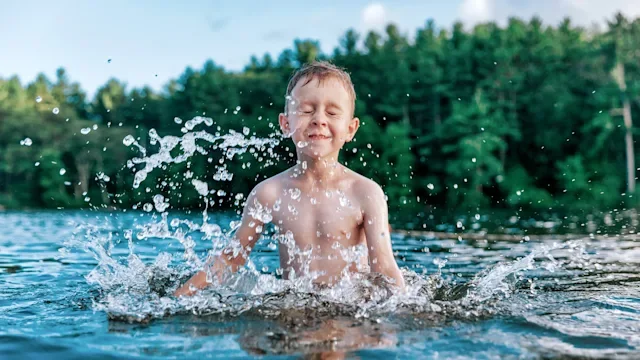
Yes, you can swim after eating. That’s the case as long as your body feels comfortable and the swimming is recreational — as in, just for fun.
Search and compare options
There’s no evidence that swimming after eating poses a health risk. You can feel free to have lunch by the pool and then immediately hop into the water to cool off. This is true for all ages, including both adults and children.
But it’s a good idea to wait after eating if you’re aiming to do something more vigorous, such as swimming laps or competing in a swim meet. This is because eating too soon before any intense exercise can cause gastrointestinal upset. But it’s not dangerous or life-threatening.
The research on swimming after you eat
In a 1968 study, 24 swimmers were fed a carb-heavy breakfast of cereal, toast, sugar, butter, and whole milk. They were then instructed to wait for varying periods of time before swimming laps. None of the swimmers reported any negative effects, no matter how long they waited to swim after breakfast.
More recently, a review of research published by the American Red Cross in 2011 found that there was no danger posed by swimming after eating. And in 2013, the International Life Saving Federation also declared that the recommendation to avoid food before swimming was “unfounded,” based on a review of the medical evidence.
Where did the idea that you shouldn’t swim after eating come from?
It’s not clear where or when the idea originated, but it has been around for at least a century. In the 1908 British Boy Scout handbook, Scouting for Boys, there was a warning to avoid bathing in deep water “soon after a meal.” The claim was that you’d develop cramps that would cause you to drown.
In the 1911 Boy Scouts of America handbook, there was a similar warning about swimming too soon after eating. It also mentioned the possibility of developing paralyzing cramps and that it could lead to “disastrous” results.
It’s true that after a big meal, blood flow shifts from your muscles and into your stomach to help with the digestion process. And during exercise, blood flow shifts away from your stomach toward your working muscles and lungs. It seems the fear was that if blood was sent toward your stomach, there wouldn’t be enough left for your muscles. And this would deprive them of oxygen — causing you to cramp up and drown.
But the truth is, there’s enough blood in your body to keep all of your body parts functioning after a big meal.
Can you swim after drinking alcohol?
While there’s little evidence to suggest much risk in swimming after eating, swimming after drinking alcohol is a real danger.

Read more like this
Explore these related articles, suggested for readers like you.



Alcohol use is involved in up to 70% of water deaths. Alcohol can decrease your coordination, balance, and judgment. And it increases risk-taking behavior. In short, avoiding alcohol when swimming is a key part of staying safe in the water.
How long should you wait to swim after eating?
Your body needs food as fuel to perform during exercise. And swimming is an excellent full-body workout with a range of health benefits. But eating the wrong food or eating at the wrong time can affect your body’s ability to function at its best. This is true whether you’re doing a land-based workout like running or jumping into the pool to swim laps.
Eating too close to exercise, or eating heavy foods that are hard for the body to digest, could lead to an upset stomach during your workout.
While it’s not dangerous, you might be more comfortable if you wait a bit between eating and working out. As a rule of thumb, before you do a workout, you should wait:
3 to 4 hours after a large meal
1 to 2 hours after a small meal
30 to 60 minutes after a light snack
What should you eat before swimming for exercise?
If you’re having a meal before a workout, the American Heart Association suggests that you:
Eat complex carbohydrates: Whole grains are a great choice, as are beans and brown rice.
Avoid fatty and slowly digested foods: Limit saturated fats, such as those found in butter, cheese, and red meat. Also limit large amounts of protein, as they take a while for your stomach to digest.
Drink water: There are no exact rules for how much to drink before you exercise. But a good starting point is: 1 to 2 cups of water 4 hours ahead of time — and then ½ to 1½ cups of water 2 hours or less before you work out.
If you’re hungry and need to eat something just before your swim workout, reach for a piece of fruit.
The bottom line
There’s no evidence that you need to wait to enter the water after you eat. If you’re going to swim laps or swim competitively, however, you may want to wait a little while to let your food digest. Eating too close to any type of vigorous activity could cause digestive upset. But it’s still not dangerous.

Why trust our experts?



References
811.novascotia.ca. (n.d.). Athletes – The importance of good hydration.
American Heart Association. (2024). Food as fuel before, during and after workouts.
American Heart Association. (2024). Saturated fat.
Asprey, G. M., et al. (2013). Effect of eating at various times on subsequent performances in the one-mile freestyle swim. Research Quarterly. American Association for Health, Physical Education and Recreation.
Baden-Powell, R. (2021). Scouting for boys. Project Gutenberg.
Boy Scouts of America. (2009). Boy Scouts handbook the first edition, 1911. Project Gutenberg.
Brouns, F., et al. (1993). Is the gut an athletic organ? Digestion, absorption and exercise. Sports Medicine.
Chambers, P., et al. (2011). American Red Cross Scientific Advisory Committee scientific review: Eating before swimming. International Journal of Aquatic Research and Education.
International Life Saving Federation. (2014). Medical position statement — MPS 18: Eating before swimming.
Kerksick, C., et al. (2008). International Society of Sports Nutrition position stand: Nutrient timing. Journal of the International Society of Sports Nutrition.
Mohr, C. R. (2019). Timing your pre- and post-workout nutrition. Eatright.org.
Uren, B. (2018). Dispelling ‘dry drowning’ and other swimming safety myths. University of Michigan Medicine.