Key takeaways:
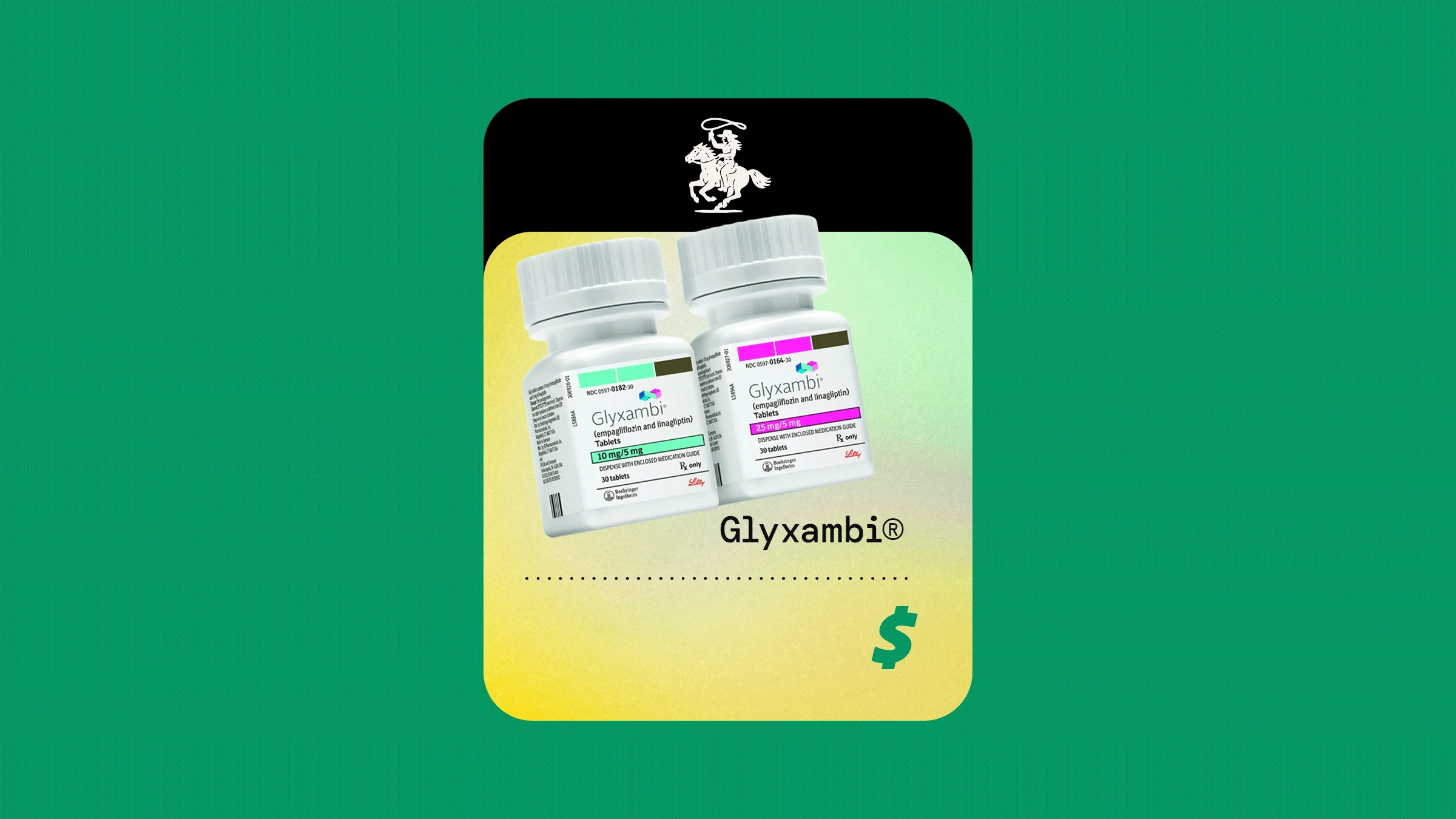
Glyxambi (empagliflozin / linagliptin) is a prescription-only medication used to help manage blood glucose (sugar) levels in adults with Type 2 diabetes. Glyxambi is a brand-name medication that doesn’t have a generic version available yet.
Without insurance or discounts, 30 tablets of Glyxambi 10 mg/5 mg cost an average of $635.70. But a GoodRx discount could lower the cost to as little as $353.94.
Insurance plans commonly cover Glyxambi. If you qualify for the manufacturer’s patient assistance program, you may receive Glyxambi at no cost.
Save on related medications
Glyxambi (empagliflozin / linagliptin) is a prescription-only medication used to help manage blood glucose (sugar) in adults with Type 2 diabetes. These tablets combine two medications that work in different ways to lower blood sugar.
The typical starting dosage for Glyxambi is one 10 mg/5 mg tablet taken by mouth once a day, in the morning. Your prescriber may increase your dosage to one 25 mg/5 mg tablet a day if you need extra blood sugar reduction.
There isn’t a generic version of Glyxambi currently available, and out-of-pocket costs for the medication can reach a few hundred dollars per month without insurance. You may be able to reduce your costs with a GoodRx discount or the manufacturer’s patient assistance program.
How much does Glyxambi cost?
Without insurance or discounts, 30 tablets of Glyxambi 10 mg/5 mg cost an average of $635.70. The average cost for 30 tablets of Glyxambi 25 mg/5 mg is $618.81.
Factors that can affect your out-of-pocket costs for Glyxambi include your:
Pharmacy: If you have insurance, what you pay can depend on whether you use a pharmacy that’s in your plan’s network or an approved mail-order pharmacy. If you’re uninsured, cash prices can vary among pharmacies — even in the same area.
Location: Medication prices can also vary by geographic area. GoodRx research shows that people in cities such as Houston and Denver, for example, often pay less for prescription medications than those in New Orleans and Little Rock, Arkansas.
Insurance: If you have prescription medication coverage, your plan’s deductibles, copays, and coinsurance amounts determine what you pay.
Discounts: Your out-of-pocket costs for Glyxambi could be reduced if you qualify for the manufacturer’s patient assistance program or use a GoodRx discount.
Does insurance cover Glyxambi?
Insurance plans commonly cover Glyxambi. About 9 in 10 people enrolled in Affordable Care Act (ACA) marketplace plans have coverage for Glyxambi. But nearly 1 in 4 ACA enrollees may need to try other medications first (a process known as step therapy), and some may be required to get prior authorization.
Nearly all commercial plan enrollees have coverage for Glyxambi, though step therapy is required for half of them. Prior authorization is needed for some commercial plan members.
Nearly everyone enrolled in Medicaid has coverage for Glyxambi. But about 6 in 10 enrollees are required to get prior authorization, and around 4 in 10 are subject to step therapy requirements. The majority of Medicare beneficiaries have coverage for Glyxambi, with prior authorization and step therapy rarely being required.
To learn more about your specific coverage details and any approval requirements, review your plan’s formulary (list of covered medications) or contact your insurance company directly.
How different insurance plans cover Glyxambi
The table below details how various insurance types cover Glyxambi, plus whether prior authorization or step therapy may be required.
Insurance type | Enrollees covered for Glyxambi (10 mg/5 mg tablets) | Enrollees required to get prior authorization | Enrollees required to do step therapy |
|---|---|---|---|
90% | 13% | 24.5% | |
Commercial plans (excluding ACA plans) | 98.9% | 7.2% | 49.1% |
Medicare (Medicare Advantage and Part D plans) | 85.9% | 0.9% | 0.2% |
Medicaid, including state-run and managed care plans | 99.9% | 60.3% | 40.7% |
Source: Managed Markets Insight & Technology, LLC™, as of January 10, 2026. (See methodology below.)
If your insurance doesn’t cover Glyxambi or if your out-of-pocket costs are too high, try the following options:
Apply for the manufacturer’s patient assistance program. (See below for more information.)
Ask your prescriber about other Type 2 diabetes treatments that may be covered by your plan and could have lower out-of-pocket costs.
Submit a formulary exception request to your health plan to try to get coverage for Glyxambi. Your prescriber will likely need to submit a letter of medical necessity and documentation explaining why this medication is the best option for you.
File an appeal if your insurer denies the formulary exception request.
Compare health plans during the next open enrollment period. You might find a plan that offers better coverage for your medications with lower out-of-pocket costs.
Ways to save on Glyxambi
Glyxambi can cost hundreds of dollars per month without insurance coverage or a discount. But here are five ways you may be able to save on the medication.
1. Apply for the manufacturer’s patient assistance program
The Boehringer Ingelheim Cares Patient Assistance Program provides Glyxambi at no cost to eligible people who can’t afford the medication.
To qualify, the guidelines state that you must:
Live in the U.S. or a U.S. territory
Be receiving outpatient treatment from a U.S.-licensed healthcare professional
Have a valid prescription for Glyxambi
Be uninsured, have insurance that does not cover Glyxambi, or have Medicare Part D but be unable to afford the medication
Not qualify for the Extra Help/Low-Income Subsidy program if you’re covered by Medicare Part D
Not have access to other coverage or financial assistance for this medication
Meet the program’s household income guidelines and be able to submit proof of income
You also can’t be enrolled in an insurance plan that requires you to apply to manufacturer assistance programs through alternate funding vendors — sometimes known as patient advocacy programs or specialty networks — such as Paydhealth, Payer Matrix, or SHARx.
To apply, you and your prescriber must complete and submit the enrollment form to print then mail or fax. (There’s also an option to join online if your healthcare professional submits the application.) If you’re approved, you’ll receive your medication at no cost for up to 12 months. For people who become newly eligible for Medicare Part D and enroll between October 15 and December 31, approval may extend through December 31 of the following year, for up to 15 months of free medication.
2. Save with a GoodRx discount
With or without insurance, you may pay as low as $353.94 for 30 tablets of Glyxambi 10 mg/5 mg, or as low as $352.59 for 30 tablets of the 25 mg/5 mg dose, with a free GoodRx discount.
To get a GoodRx coupon for Glyxambi:
Visit www.goodrx.com or download the GoodRx app.
Search for “Glyxambi,” then select “Start saving.”
Choose your prescribed dose and quantity, and enter your location to see prices at nearby pharmacies.
Select if you’d like to receive the coupon by text or email, or print it out. If you use the app, you can also have the coupon available on your phone screen or save it to your digital wallet.
To avoid delays at the pharmacy, let the staff know you’ll be using a GoodRx discount before they process your prescription.
3. Compare prices at different pharmacies
If you have insurance that covers Glyxambi, using one of your plan’s preferred pharmacies can help you avoid higher out-of-pocket costs associated with using a pharmacy outside of your coverage network.
You can also use the GoodRx website or app to compare prices and see which pharmacies may offer a better deal for Glyxambi. In some cases, switching pharmacies can help you save money when paying for the medication entirely out of pocket.
4. Ask about a 90-day supply
Getting a 90-day supply of Glyxambi instead of a monthly refill could help lower your overall costs. If you have insurance, your plan may reduce copays when you fill a 90-day supply, and your plan’s approved mail-order pharmacy may offer additional savings. Or if you’re paying for the medication entirely out of pocket, you may be able to get bulk discounts at some pharmacies.
To take advantage of these savings, and reduce the number of refills you have to track, ask your prescriber to write you a 90-day prescription. Then, check with your pharmacy and insurance plan, if applicable, to see whether this option saves you money.
5. Use your tax-free healthcare dollars
If you have a health savings account (HSA), a flexible spending account (FSA), or a health reimbursement arrangement (HRA), consider using those tax-free funds to pay for Glyxambi and other eligible healthcare expenses.
FSA funds must be used by the end of your plan year, unless your employer offers a grace period or limited rollover. HSA money rolls over from year to year and never expires. If you have an HRA, check with your benefits administrator because rules vary by employer.
The bottom line
Without insurance or discounts, 30 tablets of Glyxambi (empagliflozin / linagliptin) 10 mg/5 mg cost an average of $635.70. What you actually pay will depend on the pharmacy you use, your location, and your insurance coverage, if applicable.
If you meet the manufacturer’s patient assistance program requirements, you may receive Glyxambi at no cost. Other ways to save include using a GoodRx discount, comparing prices at different pharmacies, and filling a 90-day supply. You can also use funds from a tax-advantaged healthcare account to help pay for your prescription.

Why trust our experts?




Methodology
We obtained national prescription coverage data for each medication from Managed Markets Insight & Technology (MMIT). The data reflects health insurance coverage as of January 2026.
We calculated the percentage of enrollees in plans that cover each medication by dividing the number of enrollees covered for the medication within a specific insurance channel (e.g., ACA, Medicare, Medicaid) by the total number of enrollees in all plans within that channel.
We determined the percentage of enrollees in plans with a prior authorization requirement by calculating the proportion of enrollees in plans that required prior authorization for the medication within each channel.
Finally, we measured the percentage of enrollees in plans with a step therapy requirement by calculating the proportion of enrollees in plans that imposed step therapy requirements for the medication in each channel.
These estimates, derived from national MMIT coverage data, provide insight into health insurance coverage for each medication. They take into account restrictions such as prior authorization, step therapy, and quantity limits. The percentages are expressed relative to the total number of enrollees covered by various insurance channels, including ACA plans, commercial (excluding ACA) plans, Medicare, and Medicaid (both state-run and managed care plans).
References
Boehringer Ingelheim. (n.d.). Boehringer Cares Patient Assistance Program.
Boehringer Ingelheim. (n.d.). Boehringer Cares Patient Assistance Program: How to apply.
Boehringer Ingelheim. (2025). Boehringer Ingelheim Cares Foundation: Patient assistance program application form.
Boehringer Ingelheim. (2026). Boehringer Ingelheim Cares Foundation: Patient assistance program: Federal poverty guidelines document.
Boehringer Ingelheim Pharmaceuticals. (2026). Glyxambi - empagliflozin and linagliptin tablet, film coated [package insert]. DailyMed.
Healthcare.gov. (n.d.). Appealing a health plan decision: Internal appeals.
Medicaid.gov. (n.d.). Managed care.