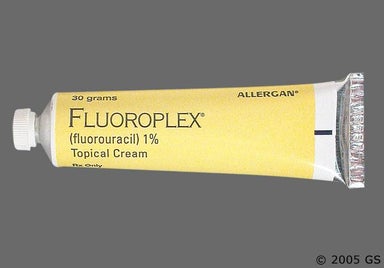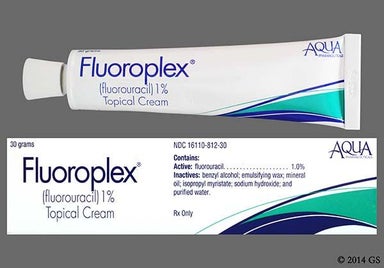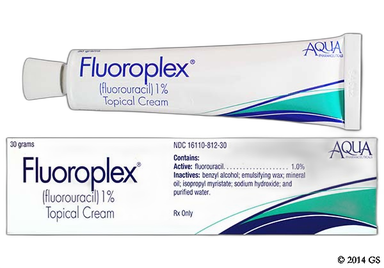
Fluoroplex
Fluoroplex (fluorouracil) 1% cream is used to treat actinic keratosis (scaly pre-cancerous spot or growth on the skin) in adults. It belongs to the antimetabolite drug class, which works by stopping skin cells from dividing and growing. It's applied to the affected skin area(s) twice per day, usually for 2 to 6 weeks. Side effects of this medication include skin burning, crusting, and itching.
Note: Fluoroplex (fluorouracil) 1% cream has been discontinued. Talk to your dermatologist about other topical fluorouracil products for actinic keratosis.


What is Fluoroplex (fluorouracil) 1% cream?
What is Fluoroplex (fluorouracil) 1% cream used for?
- Actinic (or solar) keratosis (scaly pre-cancerous spot or growth on the skin)
How Fluoroplex (fluorouracil) 1% cream works
Fluoroplex (fluorouracil) 1% cream is an antimetabolite. It works by getting in the way of cells making copies of their genetic material. When applied on pre-cancerous or cancerous skin cells, Fluoroplex (fluorouracil) 1% cream prevents them from being able to grow.
Drug facts
| Common Brands | Fluoroplex |
|---|---|
| Drug Class | Antimetabolite |
| Controlled Substance Classification | Not a controlled medication |
| Generic Status | No lower-cost generic available |
| Availability | Discontinued |

Fluoroplex (fluorouracil) 1% cream dosage
 Tube of cream
| Dosage | Quantity | Price as low as | Price per unit |
|---|---|---|---|
| 30g of 1% | 1 tube | $1,086.38 | $1,086.38 |
Typical dosage for Fluoroplex (fluorouracil) 1% cream

Interactions between Fluoroplex (fluorouracil) 1% cream and other drugs
Although certain medicines should not be used together at all, in other cases two different medicines may be used together even if an interaction might occur. In these cases, your doctor may want to change the dose, or other precautions may be necessary. When you are taking this medicine, it is especially important that your healthcare professional know if you are taking any of the medicines listed below. The following interactions have been selected on the basis of their potential significance and are not necessarily all-inclusive.
Using this medicine with any of the following medicines is not recommended. Your doctor may decide not to treat you with this medication or change some of the other medicines you take.
- Brivudine
- Measles Virus Vaccine, Live
- Mumps Virus Vaccine, Live
- Rotavirus Vaccine, Live
- Rubella Virus Vaccine, Live
- Tegafur
- Varicella Virus Vaccine, Live
- Zoster Vaccine, Live
Using this medicine with any of the following medicines is usually not recommended, but may be required in some cases. If both medicines are prescribed together, your doctor may change the dose or how often you use one or both of the medicines.
- Acenocoumarol
- Adenovirus Vaccine
- Allopurinol
- Azanidazole
- Bacillus of Calmette and Guerin Vaccine, Live
- Benznidazole
- Cholera Vaccine, Live
- Cimetidine
- Dengue Tetravalent Vaccine, Live
- Influenza Virus Vaccine, Live
- Isoconazole
- Levoleucovorin
- Methotrexate
- Metronidazole
- Nimorazole
- Ornidazole
- Oxypurinol
- Phenprocoumon
- Poliovirus Vaccine, Live
- Secnidazole
- Smallpox Vaccine
- Tamoxifen
- Tinidazole
- Typhoid Vaccine, Live
- Warfarin
- Yellow Fever Vaccine
Using this medicine with any of the following medicines may cause an increased risk of certain side effects, but using both drugs may be the best treatment for you. If both medicines are prescribed together, your doctor may change the dose or how often you use one or both of the medicines.
- Fosphenytoin
- Leucovorin
- Levamisole
- Phenytoin
- Thiamine

How much does Fluoroplex (fluorouracil) 1% cream cost?
$1,086.38

What are alternatives to Fluoroplex (fluorouracil) 1% cream?

Fluoroplex (fluorouracil) 1% cream images