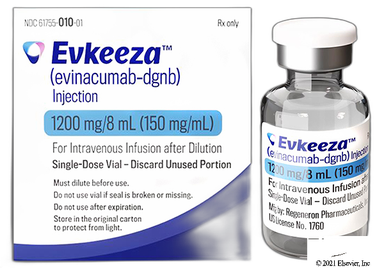
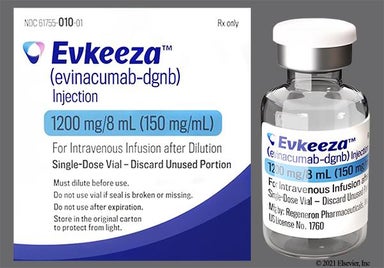
Evkeeza (evinacumab or evinacumab-dgnb) is a monoclonal antibody that treats homozygous familial hypercholesterolemia (HoFH), a rare genetic condition that causes extremely high cholesterol levels. It's an add-on medication for adults and children aged 5 years and older who aren't able to reach their cholesterol goals even with diet changes and other medications. Evkeeza (evinacumab) is given as an infusion through the veins (IV) once a month. Side effects can include dizziness and cold- or flu-like symptoms.
The following side effects may get better over time as your body gets used to the medication. Let your healthcare provider know immediately if you continue to experience these symptoms or if they worsen over time.
Common Side Effects
Common cold symptoms (16%)
Flu-like symptoms (7%)
Dizziness (6%)
Runny nose (5%)
Nausea (5%)
Less Common Side Effects
Constipation
Stomach pain
Pain in arms or legs
Weakness
Fever
Stuffy nose
Itchiness at infusion site
Evkeeza (evinacumab) serious side effects
Contact your healthcare provider immediately if you experience any of the following.
Severe allergic reaction: swelling of the lips, tongue, or throat; breathing problems; feeling dizzy; fainting; itchiness; anaphylaxis
Can use if you have mild or moderate kidney problems
No special diet needed to start the medication; can continue eating a heart-healthy diet
Cons
Only available as an IV infusion given by a healthcare provider
Each infusion takes one hour
Might not be safe during pregnancy
Only available as a brand-name medication
Pharmacist tips for Evkeeza (evinacumab)
Evkeeza (evinacumab) is given as an IV infusion by trained healthcare providers in a clinic or infusion center or sometimes even at home. Discuss with your provider to find an option that works best for you.
Set reminders for your appointments, and tell a loved one when your Evkeeza (evinacumab) infusions are scheduled. This can help make sure you don't miss a dose. But if you do, reschedule your appointment right away. The rest of your infusions will be scheduled every month from the day you had your last infusion.
Be sure to get any blood tests that your provider orders on time. These blood tests make sure that Evkeeza (evinacumab) is working well to lower your cholesterol levels.
Your healthcare team will watch out for side effects that you might have, such as cold-like symptoms, nausea, and any allergic reactions, during and after your Evkeeza (evinacumab) infusion.
Your provider might recommend or give you ibuprofen (Advil) or antihistamines to help with mild allergic reactions like flushing, headache, and rash. Get medical help as soon as possible if you have trouble breathing or swelling of the face or tongue, since these are signs of a more serious allergic reaction.
If you can become pregnant, you should use birth control during treatment and for at least 5 months after your last dose of Evkeeza (evinacumab). This medication can cause harm to an unborn baby. Consult with your provider to determine the best birth control options for you. And let your provider know right away if you become pregnant during treatment.
Risks and warnings for Evkeeza (evinacumab)
Evkeeza (evinacumab) can cause some serious health issues. This risk may be even higher for certain groups. If this worries you, talk to your doctor or pharmacist about other options.
Serious allergic reaction
Though rare, it's possible to have a serious allergic reaction to Evkeeza (evinacumab). These allergic reactions can include anaphylaxis (closing of the throat), hives, trouble breathing, and swelling of the face or tongue. Your nurse will watch out for allergic reactions during your infusion, but be sure to tell your care team right away if you think you're having an allergic reaction to the medication. Call 911 if it happens after you've left the infusion center or clinic or when you're at home.
Harm to unborn baby
Risk factors: Currently pregnant
Based on findings from animal studies, Evkeeza (evinacumab) can cause birth defects when it's used during pregnancy. If you’re a woman who can have children, your provider might ask you to take a pregnancy test to make sure you're not pregnant before you start treatment. You'll need to also use reliable birth control during treatment and for at least 5 months after your last dose of Evkeeza (evinacumab). Let your provider know if you’re planning to become pregnant or are currently pregnant. Your provider will help you find safer ways to lower your cholesterol.
Evkeeza (evinacumab) dosage
Typical dosage for Evkeeza (evinacumab)
Evkeeza (evinacumab) is an intravenous (IV) infusion that's given by a healthcare provider. The typical dose is based on your body weight at 15 mg/kg that's infused IV once a month.
GoodRx Health has strict sourcing policies and relies on primary sources such as medical organizations, governmental agencies, academic institutions, and peer-reviewed scientific journals. Learn more about how we ensure our content is accurate, thorough, and unbiased by reading our editorial guidelines.
Prescription savings
Stop paying too much for your prescriptions. Compare prices, get pharmacy coupons, and save up to 80%.
Yes, Evkeeza is FDA approved to treat homozygous familial hypercholesterolemia (HoFH), a rare genetic condition causing extremely high cholesterol levels. It was first approved in 2021 for adults and children 12 years and older. A few years later in March 2023, the FDA approved the medication for younger children (those 5 to 11 years old). The approval means that the FDA reviewed clinical studies with Evkeeza and decided that it works well to lower triglycerides (fats) and LDL ("bad" cholesterol) and is safe to use.
Evkeeza is given as an intravenous (IV) infusion. A healthcare provider will set up an infusion pump to inject the medication into a vein in your arm. The infusion will take about 1 hour to complete. To best prepare for your IV infusion, wear comfortable, loose-fitting clothing allows easy access to your arms and bring snacks or entertainment to help pass the time.
No, Evkeeza is a medication that gets added on to your current medication plan. For people with homozygous familial hypercholesterolemia (HoFH), it can be hard to manage cholesterol levels even with diet changes and other medications. Taking medications from different drug classes at the same time can help you reach your cholesterol goals. This is because each medication in your treatment plan lowers your cholesterol levels by working on different aspects of how cholesterol is either made or removed from your body. Talk to your provider about how Evkeeza fits in with your current treatment plan.
No, Evkeeza is only approved for the treatment of homozygous FH at this time. Talk to your provider about other treatment options if you have another form of FH called heterozygous FH (HeFH).
No, you shouldn't take Evkeeza if you're pregnant or planning on becoming pregnant. The medication might harm your unborn baby. Discuss with your provider to find the best birth control option for you to avoid getting pregnant while you're taking Evkeeza. If you're a woman who can become pregnant, you must use birth control during treatment and for 5 months after your final dose of the medication.
Talk to your provider about the risks and benefits of breastfeeding while you're taking Evkeeza. There's not much information about whether the medication is found in breast milk, whether it causes side effects in babies who nurse, and whether it affects milk supply. Your provider might recommend other ways to feed your baby, such as using formula.