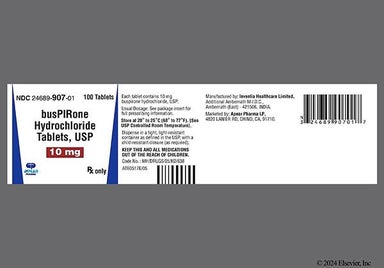
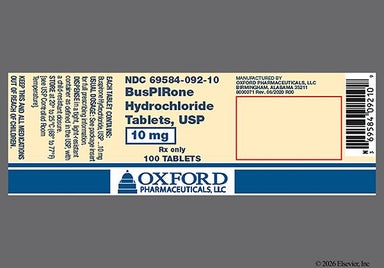
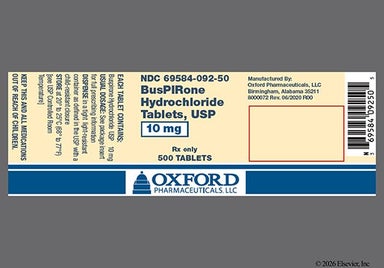
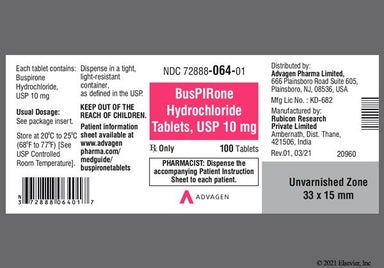
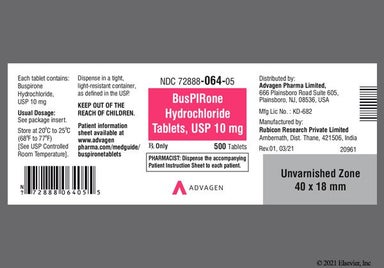
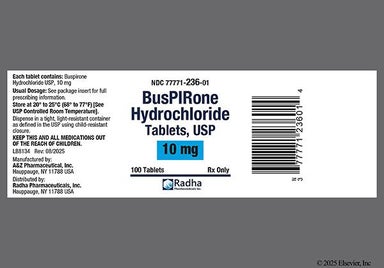
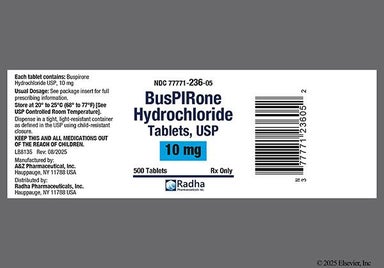
Buspirone is used to relieve anxiety, but it's not a first-choice medication. Your provider might consider adding on buspirone if your anxiety symptoms aren't well-controlled by other medications. It's taken by mouth, typically twice daily. Unlike some other anti-anxiety medications, it's not a controlled substance. Some common side effects of buspirone include dizziness, nausea, headache, and nervousness. The brand name Buspar is no longer available.
The following side effects may get better over time as your body gets used to the medication. Let your healthcare provider know immediately if you continue to experience these symptoms or if they worsen over time.
Common Side Effects
Dizziness (12%)
Drowsiness (10%)
Nausea (8%)
Headache (6%)
Nervousness (5%)
Less Common Side Effects
Feeling tired
Dry mouth
Trouble sleeping
Lightheadedness
Buspirone serious side effects
Contact your healthcare provider immediately if you experience any of the following.
Serotonin syndrome: fast heart rate, fever, dizziness, sweating, shakiness, muscle stiffness, uncoordinated movement, seizures, hallucinations, coma
When do Buspirone possible side effects begin and end?
The following Buspirone side effects have also been reported
Along with its needed effects, a medicine may cause some unwanted effects. Although not all of these side effects may occur, if they do occur they may need medical attention.
Check with your doctor immediately if any of the following side effects occur:
Some side effects may occur that usually do not need medical attention. These side effects may go away during treatment as your body adjusts to the medicine. Also, your health care professional may be able to tell you about ways to prevent or reduce some of these side effects. Check with your health care professional if any of the following side effects continue or are bothersome or if you have any questions about them:
Food affects how your body absorbs buspirone. It's best to be consistent with food when taking your dose. Either always take buspirone with food or always take it without food.
Avoid drinking large amounts of grapefruit juice while taking buspirone. Grapefruit juice causes buspirone to build up in your body to high levels. This makes you more likely to experience side effects, such as dizziness and drowsiness.
Buspirone can make you drowsy or dizzy, especially when you first start it or when your provider raises your dose. Don't drive or operate heavy machinery until you know how this medication affects you.
It's best to avoid alcohol when taking buspirone. This medication can cause drowsiness or dizziness, and alcohol can worsen these side effects.
Buspirone interacts with many medications. Talk with your healthcare provider or pharmacist before starting buspirone, so they can check for interactions. Be sure to tell them about all medications you take, including over-the-counter medications, herbals, and vitamins.
Tell your provider if you're breastfeeding, since buspirone can pass into breast milk and potentially cause harm to your baby.
Buspirone can cause some serious health issues. This risk may be even higher for certain groups. If this worries you, talk to your doctor or pharmacist about other options.
Serotonin syndrome
Risk factors: Taking other medications that can affect the serotonin levels in your brain
Serotonin syndrome is a rare, but potentially life-threatening condition where there's too much serotonin in the brain. Serotonin is one of the chemicals in your brain that's responsible for your mood. Your risk goes up if you take buspirone with other medications that raise serotonin levels, such as certain antidepressants, migraine medications, and pain medications. Tell your pharmacist about all medications and over-the-counter products you take before starting buspirone so they can check for any interactions. Get medical help right away if you experience symptoms of too much serotonin including a fast heart rate, sweating, muscle stiffness or spasms, fever, and confusion.
Effect on driving and concentration
Risk factors: Drinking alcohol | Taking other medications that cause drowsiness
Buspirone can cause some people to feel more sleepy and others to feel more awake. Because its side effects on your ability to concentrate can be unpredictable, avoid activities that require you to be alert (like driving or operating machinery) until you know how buspirone affects you.
Withdrawal symptoms from stopping other anxiety medications
Risk factors: Stopping benzodiazepines or hypnotics suddenly
If you're switching from a benzodiazepine to buspirone, make sure to work closely with your provider to lower your dose of the benzodiazepine slowly over time. Because buspirone works differently than benzodiazepine, it won't help prevent benzodiazepine withdrawal symptoms that you might experience from stopping benzodiazepine too suddenly. Let your provider know if you experience any withdrawal symptoms, such as nausea, vomiting, diarrhea, and headache.
Don't take with monoamine oxidase inhibitors (MAOIs)
Risk factors: Taking buspirone with MAOIs | Taking buspirone within 14 days of stopping MAOIs | Taking MAOIs within 14 days of stopping buspirone
Taking buspirone and a monoamine oxidase inhibitor (MAOI) can lead to dangerously high blood pressures so these medications shouldn't be taken together. Since both buspirone and MAOIs stay in your system for some time, you should wait at least 14 days after stopping one medication to begin the other. Be sure to tell your healthcare provider and pharmacist about all medications you take before starting buspirone.
Buspirone dosage
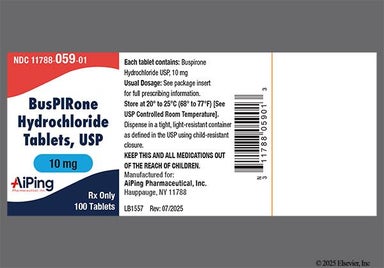
The average cost for 60 tablets of 10mg of Buspirone is $9.00 with a free GoodRx coupon. This is 0.00% off the average retail price of $9.00.
The typical starting dose of buspirone is 7.5 mg by mouth twice daily. Your provider might raise your dose every few days depending on how you respond to the medication. The maximum dose is 60 mg daily.
Buspirone may interact with certain medications or supplements. Always let your doctor and pharmacist know about any other medications or supplements (including prescribed and over-the-counter medications, vitamins, and dietary or herbal supplements) that you are currently taking. The list below does not include all possible drug interactions with Buspirone. Please note that only the generic name of each medication is listed below.
Although certain medicines should not be used together at all, in other cases two different medicines may be used together even if an interaction might occur. In these cases, your doctor may want to change the dose, or other precautions may be necessary. When you are taking this medicine, it is especially important that your healthcare professional know if you are taking any of the medicines listed below. The following interactions have been selected on the basis of their potential significance and are not necessarily all-inclusive.
Using this medicine with any of the following medicines is not recommended. Your doctor may decide not to treat you with this medication or change some of the other medicines you take.
Using this medicine with any of the following medicines is usually not recommended, but may be required in some cases. If both medicines are prescribed together, your doctor may change the dose or how often you use one or both of the medicines.
Using this medicine with any of the following medicines may cause an increased risk of certain side effects, but using both drugs may be the best treatment for you. If both medicines are prescribed together, your doctor may change the dose or how often you use one or both of the medicines.
Contraindications are specific health conditions or situations in which a person should not take a medication due to safety concerns. If you have any of the following conditions or if any of the following apply to you, let your healthcare provider know because Buspirone will not be safe for you to take.
Currently take monoamine oxidase inhibitors (MAOIs) or have taken an MAOI within the past 14 days
What are alternatives to Buspirone?
There are a number of medications that your doctor can prescribe in place of Buspirone. Compare a few possible alternatives below.
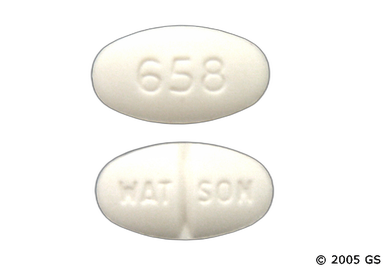
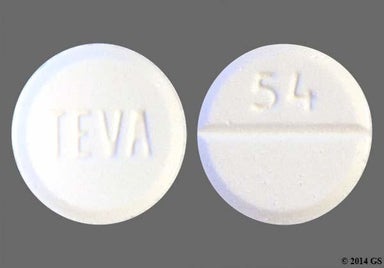
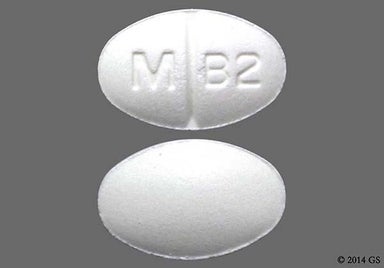
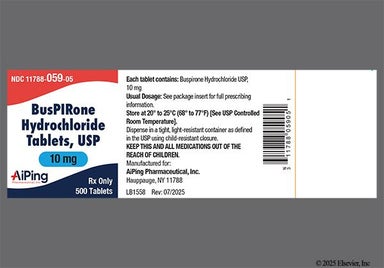
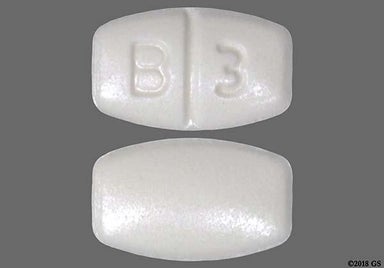
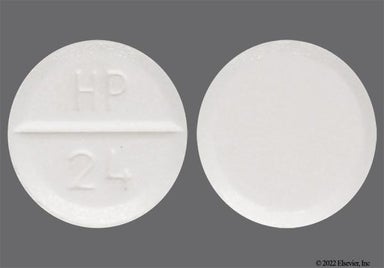
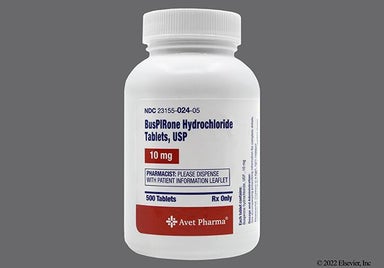
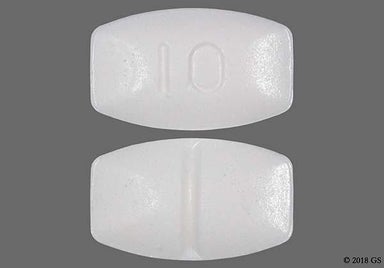
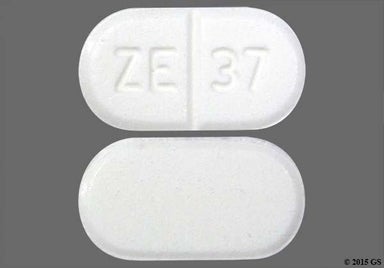
This medicine is White, Round, Scored Tablet Imprinted With "Teva", "93 54", And "54".White Round 54, 93 54, And Teva - Buspirone Hydrochloride 10mg TabletThis medicine is White, Oval, Scored Tablet Imprinted With "M B2".White Oval M B2 - Buspirone Hydrochloride 10mg TabletThis medicine is White, Oval, Scored Tablet Imprinted With "351".White Oval 351 - Buspirone Hydrochloride 10mg TabletThis medicine is White, Oval, Scored Tablet Imprinted With "351".White Oval 351 - Buspirone Hydrochloride 10mg TabletThis medicine is White, Rectangular, Scored Tablet Imprinted With "B 3".White Rectangular B 3 - Buspirone Hydrochloride 10mg TabletThis medicine is White, Round, Scored Tablet Imprinted With "Hp 24".White Round Hp 24 - Buspirone Hydrochloride 10mg TabletThis medicine is White, Round, Scored Tablet Imprinted With "Hp 24".White Round Hp 24 - Buspirone Hydrochloride 10mg TabletThis medicine is White, Oblong, Scored Tablet Imprinted With "099".White Oblong 099 - Buspirone Hydrochloride 10mg TabletThis medicine is White, Modified Rectangle, Scored Tablet Imprinted With "10".White Modified Rectangle 10 - Buspirone Hydrochloride 10mg TabletThis medicine is White, Oblong, Scored Tablet Imprinted With "Ze 37".White Oblong Ze 37 - Buspirone Hydrochloride 10mg TabletThis medicine is White, Round, Scored Tablet Imprinted With "092" And "O".White Round O And 092 - Buspirone Hydrochloride 10mg TabletThis medicine is White, Round, Scored Tablet Imprinted With "092" And "O".White Round O And 092 - Buspirone Hydrochloride 10mg TabletThis medicine is White, Modified Rectangle, Scored Tablet Imprinted With "Logo91".White Modified Rectangle Logo91 - Buspirone Hydrochloride 10mg TabletThis medicine is White, Modified Rectangle, Scored Tablet Imprinted With "Logo91".White Modified Rectangle Logo91 - Buspirone Hydrochloride 10mg TabletThis medicine is White, Oval, Scored Tablet Imprinted With "351".White Oval 351 - Buspirone Hydrochloride 10mg TabletThis medicine is White, Oval, Scored Tablet Imprinted With "351".White Oval 351 - Buspirone Hydrochloride 10mg Tablet
GoodRx Health has strict sourcing policies and relies on primary sources such as medical organizations, governmental agencies, academic institutions, and peer-reviewed scientific journals. Learn more about how we ensure our content is accurate, thorough, and unbiased by reading our editorial guidelines.
Prescription savings
Stop paying too much for your prescriptions. Compare prices, get pharmacy coupons, and save up to 80%.
No. You might need to take Buspirone for about 2 to 4 weeks before you notice any improvements in your anxiety symptoms. This means that just because you don't feel better right away, it doesn't mean that Buspirone isn't working. Keep in mind that if you're starting this medication for the first time, your provider might need to adjust your dose over the course of a few weeks to months before you find the dose that works well for you. Talk with your provider if you're not sure whether Buspirone is working for you.
No. Buspirone isn't a medication that you take as needed. It doesn't work well to relieve symptoms of anxiety immediately after you take it. But you need to take it every day as prescribed by your provider to get the full benefits of this medication.
Weight gain isn't a common side effect of Buspirone. Few people did report weight gain after taking this medication, but it's unclear whether the weight gain can be linked directly to Buspirone. One study found that Buspirone didn't cause any changes in body weight. If you're concerned about weight gain with Buspirone, talk with your healthcare provider.
Buspirone has an extremely low risk for dependence. It isn't classified as a controlled substance. There are other anxiety medication that do have a higher risk for addiction and dependence, so talk with your provider if you're concerned about this issue.
Drowsiness is one of the more common side effects of Buspirone. But some people who take Buspirone can also experience insomnia or sleep problems. Because it can be hard to predict how Buspirone makes your body feel, you're recommended to avoid driving or doing any activities that require you to be alert until you know how this medication affects you. Talk to your provider if you do experience drowsiness that's making it hard for you to go about your day. They might be able to lower your dose of Buspirone or switch you to a different medication.
Both Buspirone and alprazolam (Xanax) are used to treat anxiety, but they work differently in the brain to control symptoms. (1) One difference is how fast they work. Alprazolam (Xanax) works more quickly than Buspirone and it's typically taken as needed or short-term to ease anxiety symptoms. Buspirone takes a few weeks to fully kick in. You should take it every day in order to experience the most benefit from this medication. (2) Another difference is their side effects. Alprazolam (Xanax) is a benzodiazepine and can cause serious side effects such as extreme sleepiness and breathing problems. It also carries a risk for dependence and addiction. Buspirone works differently and doesn't carry the same level of serious risks as alprazolam (Xanax). But it does have some similar side effects, such as dizziness and drowsiness. You can work with your healthcare provider to choose the best medication to treat your anxiety symptoms.
If you want to stop taking Buspirone, let your provider know. Unlike benzodiazepines, research suggest that it's unlikely for you to experience withdrawal symptoms if you suddenly stop taking Buspirone. But depending on the reason why you want to stop Buspirone or how well your anxiety symptoms are controlled, your provider might still want to lower your dose slowly over time. Or they might recommend other medications or lifestyle tips to help manage your anxiety.
There haven't been enough studies done in humans to determine if Buspirone is safe to take during pregnancy. But animal studies suggest that it's unlikely for Buspirone to cause harm in pregnancies. Since animal studies don't always predict what happens in humans, your provider will likely only recommend Buspirone during pregnancy if the benefits for you outweigh the risks of harm to your unborn baby. If you're pregnant or thinking of becoming pregnant, let your provider know before starting this medication.