

How Much Does the RSV Vaccine Cost?
The RSV vaccine for adults can cost about $350 without insurance. But it is covered by many insurance plans, including Medicare. Find out prices and ways to save.
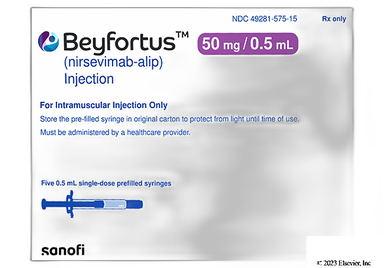
Beyfortus (nirsevimab or nirsevimab-alip) is an injection given to babies and children up to 24 months old. It's used to prevent them from getting very sick from respiratory syncytial virus (RSV). It's not an RSV vaccine. Instead, it's a monoclonal antibody that gives protection against the virus for a short time. Beyfortus (nirsevimab) is now part of the CDC Child Immunization Schedule. The usual dosage is 1 to 2 injections into the muscle during or at the start of the RSV season. It's well-tolerated with only a few side effects.

Beyfortus (nirsevimab) is a type of monoclonal antibody. It attaches to a specific protein found on RSV (called the prefusion F protein).
By attaching to this protein, it prevents RSV from getting into cells and spreading in the body. This helps protect against RSV and lower the risk of serious illness if you do get sick from it.
| Common Brands | Beyfortus |
|---|---|
| Drug Class | Monoclonal antibody |
| Controlled Substance Classification | Not a controlled medication |
| Generic Status | No lower-cost generic available |
| Availability | Prescription only |

The following side effects may get better over time as your body gets used to the medication. Let your healthcare provider know immediately if you continue to experience these symptoms or if they worsen over time.
Contact your healthcare provider immediately if you experience any of the following.
Side effects that you should report to your care team as soon as possible:
Side effects that usually do not require medical attention (report these to your care team if they continue or are bothersome):




Beyfortus (nirsevimab) can cause some serious health issues. This risk may be even higher for certain groups. If this worries you, talk to your doctor or pharmacist about other options.
Some children have had serious allergic reactions after getting Beyfortus (nirsevimab). These reactions can include hives, trouble breathing, or weak muscles. Anaphylaxis has also happened with other monoclonal antibody medications. This can be life-threatening.
If your child has trouble breathing, a severe rash, or swelling in their face, get medical help right away.
Tell your child's healthcare professional about if they have a history of bleeding problems, like low platelets. Also make sure to give them a list of your child's current medications. They can check if your child is taking any blood-thinning medications.
If this is the case, your child might still be able to receive Beyfortus (nirsevimab). But their healthcare team will want to keep an eye on them for any bleeding after the injection.

Beyfortus (nirsevimab) is injected into the front side of the thigh muscle. It's injected by a trained healthcare professional.
Newborns and infants born during or entering their first RSV season
Children up to 24 months old at risk of severe RSV illness in their second RSV season
Note: Children who need heart surgery might need an extra dose of Beyfortus (nirsevimab) afterwards.







Prescription savings
Stop paying too much for your prescriptions. Compare prices, get pharmacy coupons, and save up to 80%. Find expert answers to your health questions so you can make the best decisions for yourself and your family.
Health conditions
Medications & treatment
Access & affordability
 Our monthly healthcare membership can help you save thousands on your prescription costs.
Resources

One dose of Beyfortus protects your child from serious RSV for about 5 months. This should cover the whole RSV season. Beyfortus only provides protection for a relatively short time. So, babies born outside of the RSV season should wait to get the injection when the season starts. Talk to your child's pediatrician about the best time for your child to get Beyfortus.
Beyfortus is usually safe for protecting infants and young children from serious RSV lung infections. Some kids can have side effects like injection site reactions and rash. Although rare, there's a risk of more serious allergic reactions. If you're worried about how safe Beyfortus is, talk to your child's pediatrician. They can help explain the risks and benefits of the medication.
According to the CDC, Beyfortus can be given at the same time as other routine childhood vaccines. They can be given during the same visit. There isn't a lot of information, but Beyfortus isn't expected to cause problems with other vaccines. Talk to your child's pediatrician if you have any questions.
No. Beyfortus isn't an mRNA vaccine. Beyfortus is an injection that provides your body with lab-made antibodies. mRNA vaccines work by teaching your cells to make proteins that then cause your immune system to make antibodies. These antibodies fight off germs and viruses if they get into your body later in the future. Beyfortus works in a different way. It gives you ready-made antibodies to help protect against RSV.
Clinical studies and real-world results show that Beyfortus works very well for babies and young children. It can lower the risk of needing to go to the hospital for RSV by 80% to 90%. It also reduces the chance of getting a serious RSV lung infection that needs medical care by about 80%.
Your child can get Beyfortus at a few places. This includes pediatrician offices, hospitals, and public health clinics. Ask a healthcare professional to find out where your child can get Beyfortus.
Beyfortus starts working within hours after your child gets the injection. In studies, it reached its highest level in the blood in about 6 days. Beyfortus works fast because it's a monoclonal antibody, not a traditional vaccine. It gives your baby read-made antibodies to protect against RSV right away. Vaccines are different – it takes more time for your body to use your immune system to make its own antibodies.
Beyfortus and Synagis (palivizumab) are both injections that help protect babies and infants from getting very sick from RSV. But they're used in different situations. Beyfortus is for all newborns and infants during their first RSV season. It can also be given to children up to 24 months old for their second RSV season if they're at high risk. Synagis is only approved for babies who were born premature (early) and are 6 months or younger when RSV season starts. It's also for children up to 24 months old who have certain health problems. How often the injection is given into the muscle is also different for each medication. Beyfortus is given just once at the start of the RSV season. But Synagis is given every month during the season. Talk to a pediatrician to compare the two medication and see which one is right for your child.
