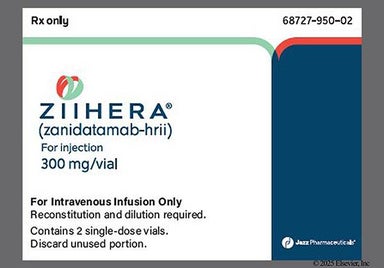
Ziihera
Ziihera (zanidatamab) is a HER2-directed antibody used to treat certain types of bile duct cancer. It's FDA approved for adults with HER2-positive biliary tract cancer that has spread or can't be removed with surgery, and has already been treated. Ziihera (zanidatamab) is given as an intravenous (IV) infusion once every 2 weeks by a healthcare professional. Common side effects include diarrhea, infusion-related reactions, and stomach pain.


What is Ziihera (zanidatamab)?
What is Ziihera (zanidatamab) used for?
- Adults with HER2-positive bile duct cancer that can't be removed with surgery or has spread to other parts of the body, and has already been treated
How Ziihera (zanidatamab) works
Ziihera (zanidatamab) is a bispecific HER2-directed antibody. It works by attaching to HER2, a protein found on some cancer cells that helps them grow and spread.
By blocking HER2 in two different places, Ziihera (zanidatamab) helps stop cancer cells from growing. It also helps your immune system find and destroy cancer cells, which can slow tumor growth.
Drug facts
| Common Brands | Ziihera |
|---|---|
| Drug Class | HER2 receptor antagonist |
| Controlled Substance Classification | Not a controlled medication |
| Generic Status | No lower-cost generic available |
| Availability | Prescription only |

Side effects of Ziihera (zanidatamab)
The following side effects may get better over time as your body gets used to the medication. Let your healthcare provider know immediately if you continue to experience these symptoms or if they worsen over time.
Common Side Effects
- Lower hemoglobin levels (88%)
- Diarrhea (50%)
- Lower white blood cell levels (44%)
- Rise in liver enzymes (up to 47%)
- Infusion-related reaction (35%)
- Changes in electrolytes (up to 35%)
- Stomach pain (29%)
- Tiredness (24%)
Less Common Side Effects
- Rash
- Nausea
- Reduced appetite
- Vomiting
Ziihera (zanidatamab) serious side effects
Contact your healthcare provider immediately if you experience any of the following.
- Heart problems: shortness of breath, swelling in your ankles or feet, sudden weight gain, dizziness, light-headedness, irregular heartbeat, loss of consciousness
- Infusion-related reactions: fever, chills, rash, flushing, nausea, vomiting, shortness of breath, chest discomfort, dizziness
- Severe diarrhea: frequent loose stools, stomach cramping, weakness, dehydration
The following Ziihera (zanidatamab) side effects have also been reported
Side effects that you should report to your care team as soon as possible:
- Allergic reactions—skin rash, itching, hives, swelling of the face, lips, tongue, or throat
- Diarrhea
- Heart failure—shortness of breath, swelling of the ankles, feet, or hands, sudden weight gain, unusual weakness or fatigue
- Infusion reactions—chest pain, shortness of breath or trouble breathing, feeling faint or lightheaded
Side effects that usually do not require medical attention (report these to your care team if they continue or are bothersome):

Pros and cons of Ziihera (zanidatamab)
Pros
- Targeted option for HER2-positive bile duct cancer
- Given once every 2 weeks
- Might work when other medications haven't
Cons
- Requires IV infusions in a healthcare setting
- Can cause severe diarrhea and infusion-related reactions
- Not safe in pregnancy

Pharmacist tips for Ziihera (zanidatamab)

- Ziihera (zanidatamab) is given by IV infusion by a healthcare professional in a clinic or infusion center. Your oncology team will decide how long you stay on treatment based on how well the medication works and how you tolerate it.
- Ziihera (zanidatamab) is given once every 2 weeks. Keep your infusion appointments, and call your care team as soon as possible if you need to reschedule.
- Before each Ziihera (zanidatamab) infusion, your care team will give you medications to help lower the risk of infusion-related reactions. These medications can make your treatment safer and more comfortable.
- Your first two Ziihera (zanidatamab) infusions usually take about 2 to 2.5 hours. Later infusions might be shorter if you don't have infusion-related reactions.
- Tell your care team right away if you have diarrhea while taking Ziihera (zanidatamab). Treating diarrhea early can help prevent dehydration and treatment delays.
- Ziihera (zanidatamab) can affect your heart. Your care team will check your heart before you start treatment and during treatment to watch for heart problems.
- Tell your care team right away if you feel short of breath, dizzy, or unusually tired during or after a Ziihera (zanidatamab) infusion. These can be signs of an infusion reaction or a heart problem.
- Pregnancy: Don't become pregnant while taking Ziihera (zanidatamab). Use effective birth control during treatment and for 4 months after your last dose because this medication can harm an unborn baby.

Risks and warnings for Ziihera (zanidatamab)
Ziihera (zanidatamab) can cause some serious health issues. This risk may be even higher for certain groups. If this worries you, talk to your doctor or pharmacist about other options.
Harm to unborn baby
 Ziihera (zanidatamab) can harm an unborn baby. Although this medication hasn't been studied in pregnancy, this warning is based on how it works and what is known about similar HER2-targeted medications.
Use effective birth control while taking Ziihera (zanidatamab) and for 4 months after your last dose. If you become pregnant or think you might be pregnant during treatment, tell your prescriber right away.
Heart problems
Ziihera (zanidatamab) can weaken your heart and make it harder to pump blood. In some people, this side effect can be serious enough that treatment needs to be paused or stopped.
Your care team will check your heart before you start Ziihera (zanidatamab) and regularly during treatment. Tell your prescriber right away if you have new or worsening shortness of breath, swelling in your feet or ankles, sudden weight gain, dizziness, fainting, or an irregular heartbeat.
Infusion-related reactions
Ziihera (zanidatamab) can cause reactions during or shortly after an infusion. Symptoms can include fever, chills, rash, flushing, trouble breathing, chest discomfort, nausea, vomiting, dizziness, or feeling lightheaded.
Your care team will give you medications (e.g., acetaminophen, diphenhydramine, and corticosteroids) before each Ziihera (zanidatamab) infusion to help lower this risk and will monitor you during treatment. Tell your care team right away if you notice any symptoms, even if they seem mild. They might slow down, pause, or stop the infusion depending on how severe the reaction is.
Diarrhea
Ziihera (zanidatamab) can cause diarrhea, and in some people it can be severe. If it isn't treated early, it can lead to dehydration, weakness, low electrolyte levels, and treatment delays.
Tell your prescriber right away if you start having loose stools, especially if they keep happening or get worse. Your care team can recommend antidiarrheal treatment and check for other possible causes. Depending on how severe it is, they can hold treatment, restart it later, lower the dose, or stop Ziihera (zanidatamab).

Ziihera (zanidatamab) dosage
Typical dosage for Ziihera (zanidatamab)
The typical dose is 20 mg/kg given by intravenous (IV) infusion once every 2 weeks.
Your dose might differ if you have side effects to Ziihera (zanidatamab).

Ziihera (zanidatamab) images