Welireg
Welireg (belzutifan) is a prescription tablet used to treat a rare condition called von Hippel-Lindau (VHL) disease, advanced kidney cancer, and certain adrenal or nerve tumors. You take it once a day by mouth, with or without food. The medication works by blocking HIF-2ɑ, a protein that helps some tumors grow. During treatment, you’ll need regular blood tests. Common side effects include low red blood cell counts, tiredness, and muscle or bone pain.


What is Welireg (belzutifan)?
What is Welireg (belzutifan) used for?
- von Hippel-Lindau (VHL) disease in adults who need treatment for a certain type of kidney cancer, brain or spinal cord tumors, or a certain type of pancreatic tumor when surgery isn’t needed right away
- Advanced kidney cancer in adults after certain medications are no longer working
- Certain adrenal or nerve tumors in adults and children 12 years and older
How Welireg (belzutifan) works
Welireg (belzutifan) is a hypoxia-inducible factor 2 alpha (HIF-2ɑ) inhibitor, meaning it blocks a protein called HIF-2ɑ. This protein helps tumors grow by making new blood vessels that bring nutrients to cancer cells. In some conditions, too much of this protein builds up and fuels tumor growth. By blocking HIF-2a, Welireg (belzutifan) can help stop tumors from growing and spreading.
Drug facts
| Common Brands | Welireg |
|---|---|
| Drug Class | HIF-2ɑ inhibitor |
| Controlled Substance Classification | Not a controlled medication |
| Generic Status | No lower-cost generic available |
| Availability | Prescription only |

Side effects of Welireg (belzutifan)
The following side effects may get better over time as your body gets used to the medication. Let your healthcare provider know immediately if you continue to experience these symptoms or if they worsen over time.
Common Side Effects
VHL disease:
- Low red blood cell count (93%)
- Tiredness (64%)
- Rise in creatinine (64%)
- Headache (39%)
- Dizziness (38%)
- Rise in blood sugar (34%)
- Nausea (31%)
Advanced kidney cancer:
- Low red blood cell count (88%)
- Tiredness (43%)
- Muscle or bone pain (34%)
- Low white blood cell counts (34%)
- Rise in creatinine (up to 34%)
- Lower sodium levels (31%)
- Higher potassium levels (29%)
- Rise in liver enzymes (27%)
Adrenal or nerve tumor:
- Low red blood cell count (96%)
- Tiredness (56%)
- Muscle and bone pain (56%)
- Low white blood cells (up to 54%)
- Rise in liver enzymes (up to 51%)
- Higher calcium levels (34%)
- Shortness of breath (33%)
- Higher potassium levels (31%)
- Headache (29%)
- Dizziness (26%)
- Nausea (25%)
Less Common Side Effects
VHL disease:
- Vision problems
- Infections
- Shortness of breath
- Rise in liver enzymes
- Muscle pain
- Joint pain
- Stomach pain
- Constipation
Advanced kidney cancer:
- Swelling
- Nausea
- Constipation
- Vomiting
- Diarrhea
- Stomach pain
- Shortness of breath
- Reduced appetite
- Headache
- Dizziness
Adrenal or nerve tumor:
- Swelling
- Muscle spasms or weakness
- Cough
- Stuffy nose
- Constipation
- Diarrhea
- Stomach pain
- Vomiting
- Bleeding
- Reduced appetite
- Weight gain
- Lower sodium levels
- Lower platelet count
Welireg (belzutifan) serious side effects
Contact your healthcare provider immediately if you experience any of the following.
- Low red blood cell count (anemia): tiredness, feeling cold, shortness of breath, chest pain, fast heartbeat
- Low oxygen levels: shortness of breath, fast heartbeat
The following Welireg (belzutifan) side effects have also been reported
Side effects that you should report to your care team as soon as possible:
- Allergic reactions—skin rash, itching, hives, swelling of the face, lips, tongue, or throat
- Infection—fever, chills, cough, sore throat, wounds that don't heal, pain or trouble when passing urine, general feeling of discomfort or being unwell
- Low red blood cell level—unusual weakness or fatigue, dizziness, headache, trouble breathing
- Shortness of breath or trouble breathing
Side effects that usually do not require medical attention (report these to your care team if they continue or are bothersome):
- Fatigue
- Joint pain
- Muscle pain

Pros and cons of Welireg (belzutifan)
Pros
- Pill taken by mouth once a day
- Treats many types of tumors in VHL disease
- Helps tumors shrink or stop growing
Cons
- Interacts with many other medications
- Can cause serious anemia or low oxygen
- Not safe in pregnancy or breastfeeding

Pharmacist tips for Welireg (belzutifan)

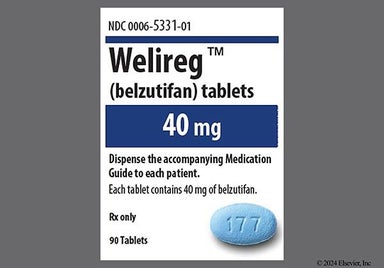
- Welireg (belzutifan) comes as 40 mg tablets. You’ll usually take 3 tablets at once to make the 120 mg dose, around the same time each day, with or without food.
- Swallow Welireg (belzutifan) tablets whole. Don’t chew, cut, or crush them.
- If you miss a dose of Welireg (belzutifan), take it as soon as you remember on the same day. Go back to your regular daily schedule the next day. Do not take extra tablets to make up for the missed dose.
- If you vomit after taking Welireg (belzutifan), don’t take another dose that day. Just take your next scheduled dose the following day.
- Welireg (belzutifan) can interact with many medications. It can make hormonal birth control work less well, so share everything you take with your care team to check if they’re safe.
- It’s common for Welireg (belzutifan) to cause low red blood cell count (anemia). Your care team will monitor your blood tests and might even give you a blood transfusion if needed. Let them know if you feel very tired, cold, short of breath, have chest pain, or a fast heartbeat.
- Welireg (belzutifan) can cause low oxygen levels. Your care team will check your oxygen regularly, and you might need extra oxygen or even hospital care. Contact your oncologist right away if you feel short of breath or a fast heart rate.
- Welireg (belzutifan) can harm an unborn baby. Use non-hormonal birth control (like condoms) to prevent pregnancy while taking the medication and for at least 1 week after the last dose.
- It’s not known if Welireg (belzutifan) passes into breastmilk. So to be safe, you shouldn’t breastfeed during treatment and for at least 1 week after the last dose.
- Based on animal studies, Welireg (belzutifan) can affect your ability to have a baby. Talk with your oncologist before starting if you are planning to become pregnant or father a child.

Risks and warnings for Welireg (belzutifan)
Welireg (belzutifan) can cause some serious health issues. This risk may be even higher for certain groups. If this worries you, talk to your doctor or pharmacist about other options.
Harm to unborn babies
Based on animal studies, Welireg (belzutifan) can harm an unborn baby if taken during pregnancy. If you can get pregnant, your care team will give you a pregnancy test before you start treatment. You and your partner should use effective non-hormonal birth control while taking Welireg (belzutifan) and for at least 1 week after your last dose.
Low red blood cell count (anemia)
Welireg (belzutifan) can cause severe anemia, which means you have very low red blood cell counts. Sometimes this can be serious enough to require a blood transfusion. Your care team will check your blood before you start and throughout treatment to monitor for anemia. If it drops too low, your oncologist might pause treatment, lower your dose, or stop Welireg (belzutifan) completely.
Low oxygen levels
Since Welireg (belzutifan) can lower the red blood cells that carry oxygen, it can also lower your oxygen levels. In some cases, this can be serious enough to require stopping treatment, using oxygen, or even being hospitalized. Your care team will check your oxygen levels before you start and during treatment. If your oxygen drops too low, your oncologist might pause, lower the dose, or permanently stop Welireg (belzutifan). Call your care team right away if you have symptoms like shortness of breath, fast heartbeat, dizziness, or confusion.

Welireg (belzutifan) dosage
Typical dosage for Welireg (belzutifan)
Adults
- The typical dose is 120 mg by mouth once a day.
Children
- Weight less than 40 kg (88 lbs): The typical dose is 80 mg by mouth once a day.
- Weight 40 kg (88 lbs) and more: The typical dose is 120 mg by mouth once a day.
Your dose might be different if you have a side effect to Welireg (belzutifan).

What are alternatives to Welireg (belzutifan)?

Welireg (belzutifan) images