


What’s the Best Osteoporosis Medication?
Learn about the various osteoporosis medications and side effects, plus how to choose the best osteoporosis medication for you.
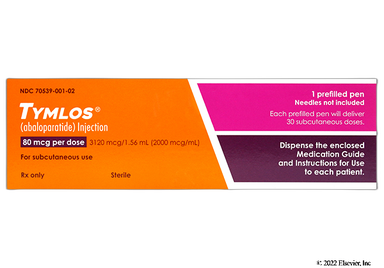
Tymlos (abaloparatide) is a medication used for osteoporosis in men and postmenopausal women at high risk for breaking bones (fractures). It's given once per day as an injection under the skin. This medication can't be used for longer than 2 years because of a theoretical risk of causing bone cancer.

Tymlos (abaloparatide) is a parathyroid hormone (PTH) analog. This means it acts just like the PTH your body normally makes. PTH is a hormone that's important in balancing bone breakdown and formation to keep your bones healthy. When Tymlos (abaloparatide) attaches to the PTH receptors in your body, it promotes bone formation and causes your bones to become stronger. This lowers your risk for bone fractures or breaks.
| Common Brands | Tymlos |
|---|---|
| Drug Class | Parathyroid hormone analog |
| Controlled Substance Classification | Not a controlled medication |
| Generic Status | No lower-cost generic available |
| Availability | Prescription only |

The following side effects may get better over time as your body gets used to the medication. Let your healthcare provider know immediately if you continue to experience these symptoms or if they worsen over time.
*Percentages of people who reported these side effects might differ between men and postmenopausal women taking this medication.
Contact your healthcare provider immediately if you experience any of the following.
Side effects that you should report to your care team as soon as possible:
Side effects that usually do not require medical attention (report these to your care team if they continue or are bothersome):




Tymlos (abaloparatide) can cause some serious health issues. This risk may be even higher for certain groups. If this worries you, talk to your doctor or pharmacist about other options.
Although rare, there have been reports of people taking a medication similar to Tymlos (abaloparatide) who developed bone cancer (osteosarcoma). Additionally, Tymlos (abaloparatide) caused bone cancer in some animals that received much higher doses of the medication than what's typically used in humans. But it's not known if Tymlos (abaloparatide) can cause or raise the risk of bone cancer. The risk of bone cancer when the medication is used any longer than 2 years also hasn't been studied. Because of this risk, Tymlos (abaloparatide) can't be used for longer than 2 years and shouldn't be used in people who are at higher risk of bone cancer.
Tymlos (abaloparatide) can suddenly drop your blood pressure if you get up too fast after sitting or lying down (orthostatic hypotension). This usually happens within 4 hours of injecting the medication and is more common with the first few doses. It should get better as you continue using the medication. For the first few doses, sit down when you're giving yourself Tymlos (abaloparatide) to prevent accidental injuries in case this happens. Get up slowly and hold onto something for support. If you suddenly become dizzy, feel like your heart is pounding or racing, or become nauseous, sit or lie down so you don't fall.
Tymlos (abaloparatide) can cause your blood calcium levels to become too high. You're at risk for high calcium levels if you take Tymlos (abaloparatide) and your intake of calcium and vitamin D is too high or if you have medical conditions that raise your calcium levels. Your provider might regularly check your calcium levels through blood tests during treatment with Tymlos (abaloparatide).
Only take calcium and vitamin D supplements with Tymlos (abaloparatide) if your prescriber told you to do so. Also, make sure your provider knows about all your medical conditions and the medications you take. If you experience symptoms of high calcium levels, such as muscle weakness, nausea, vomiting, loss of appetite, low energy, or confusion, while taking Tymlos (abaloparatide), contact your provider right away.
Along with high blood calcium levels, Tymlos (abaloparatide) can also raise the calcium levels in your urine. In general, having too much calcium in the urine can lead to kidney stones to form. It isn't clear if Tymlos (abaloparatide) raises your risk of getting kidney stones if you've had any before. If you experience symptoms of kidney stones (e.g., low back pain, nausea, vomiting, dark-colored urine), contact your provider. They might measure the amount of calcium in your urine.

 Pen
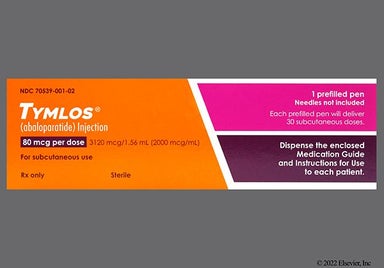
Pen| Dosage | Quantity | Price as low as | Price per unit |
|---|---|---|---|
| 1.56ml of 80mcg/dose | 1 pen | $2,883.03 | $2,883.03 |


Prescription savings
Stop paying too much for your prescriptions. Compare prices, get pharmacy coupons, and save up to 80%.Resources
About GoodRx
 Find expert answers to your health questions so you can make the best decisions for yourself and your family.
Health conditions
Medications & treatment
Access & affordability
Well-being
Medication discounts

In studies, postmenopausal women with a high risk of fracture who took Tymlos for 1.5 years had an 86% lower risk of breaking their spinal bone when compared to those who didn't get treatment (placebo). They also had a 43% lower risk of breaking other bones in the body. In addition, studies showed that the bone density in the spine and hip went up significantly in men with high fracture risk after 1 year of treatment and in postmenopausal women with high fracture risk after 1.5 years of treatment when compared to placebo. Having higher bone density means that your bones are getting stronger and might be less likely to break.
Tymlos will work better to build strong bones if you eat foods rich in calcium and vitamin D. Calcium and vitamin D are both essential nutrients for building strong and healthy bones. If you aren't getting enough of these nutrients from your diet, your provider might recommend taking calcium and vitamin D supplements to raise your levels. Since Tymlos can raise your calcium levels, make sure to only take calcium and vitamin D supplements if your provider said it's safe for you to do so. You can also do regular weight-bearing exercises, like walking, jogging, and dancing, to help prevent bone loss. Speak with your provider about other ways to strengthen your bones.
There isn't a specific amount of time for how long you'll need to take Tymlos. You'll likely continue taking the medication as long as it's helping your osteoporosis and you're not having side effects. But the longest you can take Tymlos is up to 2 years. It's not known if the medication is safe or works well in people who take it longer than 2 years since it hasn't been studied. There's also a theoretical risk for the medication to cause bone cancer. After 2 years, the American Association of Clinical Endocrinology (AACE) guideline for osteoporosis recommends using a bisphosphonate or Prolia (denosumab) to maintain your bone strength and keep fracture risk low. If you're still at high risk for fracture after 2 years of taking Tymlos, talk to your provider about what osteoporosis medication to take next.
Tymlos and Forteo (teriparatide) are PTH analogs that are available as brand-only medications. They come as pre-filled pens that are injected under the skin once per day. The two medications also work well to treat osteoporosis and have similar side effects. But they both can't be used for longer than 2 years because of a theoretical risk of bone cancer. While Tymlos and Forteo (teriparatide) are both approved for men and postmenopausal women with osteoporosis and a high risk of fracture, Forteo (teriparatide) can also be used for people with osteoporosis due to long-term use of corticosteroids. Another difference is that Tymlos can be stored at room temperature for up to 30 days, while Forteo (teriparatide) must be refrigerated at all times when you're not using it. Discuss with your provider which medication is right for you.
Tymlos is given as an injection under the skin in your lower stomach. Don't inject within 2 inches from your belly button. Never inject the medication into your muscle or vein. To lower the risk of bruising and irritation, rotate between different injection sites within your stomach area so that the same site isn't used repeatedly. Avoid injecting into skin that's tender, bruised, red, scaly, or hard or skin with scars or stretch marks to avoid further damage to your skin.
