


Melasma in Women With Darker Skin Tones: Here’s Why It’s Often Worse (With Images)
Melasma is a type of hyperpigmentation that occurs more commonly in people with darker skin tones. Explore the causes and learn how to treat melasma.
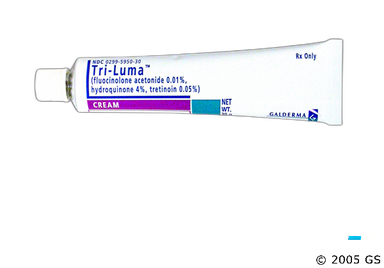
Tri-Luma is a cream that's used to treat adults with melasma, or dark skin patches, on the face. The cream contains three active ingredients: fluocinolone (a steroid to lessen inflammation); hydroquinone (a melanin synthesis inhibitor to lighten skin color); and tretinoin (a retinoid to help with new skin growth). You apply Tri-Luma onto the dark patches on the face once a day, but side effects like skin redness and burning are common. It can take about 1 to 2 months to see results after you start treatment. Tri-Luma isn't approved to treat areas of hyperpigmentation that isn't related to melasma.

Tri-Luma is a combination of three medications that help treat melasma on the face.
| Common Brands | Tri-Luma |
|---|---|
| Drug Class | Corticosteroid / Melanin synthesis inhibitor / Retinoid |
| Controlled Substance Classification | Not a controlled medication |
| Generic Status | No lower-cost generic available |
| Availability | Prescription only |

The following side effects may get better over time as your body gets used to the medication. Let your healthcare provider know immediately if you continue to experience these symptoms or if they worsen over time.
Contact your healthcare provider immediately if you experience any of the following.
Along with its needed effects, a medicine may cause some unwanted effects. Although not all of these side effects may occur, if they do occur they may need medical attention.
Check with your doctor immediately if any of the following side effects occur:
More common
Redness, peeling, drying, itching, or burning of the skin
Less common
Darkening of normal skin color
irritated skin
rash
Incidence not known
Blistering, crusting, or flaking of the skin
burning and itching of the skin with pinhead-sized red blisters
lightening of normal skin color
redness and scaling around the mouth
severe redness, soreness, or scaling of the skin
thinning of the skin with easy bruising
Some side effects may occur that usually do not need medical attention. These side effects may go away during treatment as your body adjusts to the medicine. Also, your health care professional may be able to tell you about ways to prevent or reduce some of these side effects. Check with your health care professional if any of the following side effects continue or are bothersome or if you have any questions about them:
Other side effects not listed may also occur in some patients. If you notice any other effects, check with your healthcare professional.
Call your doctor for medical advice about side effects. You may report side effects to the FDA at 1-800-FDA-1088.




Tri-Luma can cause some serious health issues. This risk may be even higher for certain groups. If this worries you, talk to your doctor or pharmacist about other options.
Tri-Luma contains a sulfite. Although rare, sulfites can cause a serious allergic reaction. Let your healthcare team know before you start treatment if you know you have a sulfite allergy. Keep in mind that sulfite and sulfa aren't the same thing, and many people with sulfa allergies can still use medications containing sulfites.
Call a healthcare professional or get medical help right away if you notice hives, a rash, swelling of the lips or tongue, or difficulty breathing after you apply Tri-Luma onto the skin.
Tri-Luma contains hydroquinone, which is known to cause blue-black patches on the skin. This is more likely to happen if you're Black, but it can also happen to people of any race. For some people, this blue-black color on the skin is permanent. Contact your prescriber as soon as you can if you notice any unusual discoloration of your skin or worsening of your melasma. This side effect might be easier to manage when it's caught early.
Using medications containing corticosteroids, including Tri-Luma, for long periods of time can cause changes in the level of adrenal hormones in your body. These adrenal hormones are important for many bodily functions. Rarely, changes in your adrenal hormone levels can cause your skin to thin or your immune system to weaken. And when you suddenly stop using Tri-Luma after long-term use, your skin might become irritated again. Use Tri-Luma as directed. Don't apply this medication for a longer period of time than instructed.
Skin irritation, including skin redness, skin peeling, dry skin, itching, and a burning sensation, are all common side effects of Tri-Luma. These side effects are usually mild and happen where you applied the medication on the skin. Contact your prescriber if you develop very bothersome skin reactions, such as rash or blisters, on the face, especially if they happen on areas where you didn't apply Tri-Luma.

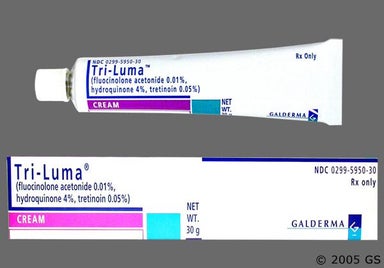
 Tube of cream
| Dosage | Quantity | Price as low as | Price per unit |
|---|---|---|---|
| 30g of 0.05% | 1 tube | $207.30 | $207.30 |
Apply a thin layer of cream to the darker patches of skin on the face once daily, at least 30 minutes before bedtime. Be sure to also cover about one-half inch of the skin surrounding each of the discolored areas with Tri-Luma.

Although certain medicines should not be used together at all, in other cases two different medicines may be used together even if an interaction might occur. In these cases, your doctor may want to change the dose, or other precautions may be necessary. When you are taking this medicine, it is especially important that your healthcare professional know if you are taking any of the medicines listed below. The following interactions have been selected on the basis of their potential significance and are not necessarily all-inclusive.
Using this medicine with any of the following medicines is not recommended. Your doctor may decide not to treat you with this medication or change some of the other medicines you take.
Using this medicine with any of the following medicines is usually not recommended, but may be required in some cases. If both medicines are prescribed together, your doctor may change the dose or how often you use one or both of the medicines.
Using this medicine with any of the following medicines may cause an increased risk of certain side effects, but using both drugs may be the best treatment for you. If both medicines are prescribed together, your doctor may change the dose or how often you use one or both of the medicines.




Prescription savings
Stop paying too much for your prescriptions. Compare prices, get pharmacy coupons, and save up to 80%. Find expert answers to your health questions so you can make the best decisions for yourself and your family.
Health conditions
Medications & treatment
Access & affordability
 Our monthly healthcare membership can help you save thousands on your prescription costs.
Resources

Yes, you'll need to keep the tube of Tri-Luma cream in the refrigerator. Make sure that the medication doesn't freeze though.
Apply Tri-Luma only onto the areas of melasma on your face and about one-half inch of skin surrounding each dark patch. If you have melasma over your entire face, this could possibly mean using the medication all over the face. Avoid getting the medication near your mouth, nose, eyes, and any open wounds because this can cause irritation.
It's best to avoid using Tri-Luma on areas around your eyes. The area around the eyes are more sensitive to irritation. Talk to your dermatologist about safe options to treat darker skin under the eyes.
Yes, Tri-Luma can expire. There should be an expiration date written on the box that the tube of cream came in or on the tube itself. Don't use Tri-Luma after the expiration date because it's not guaranteed to work well for you. It's always best to contact your pharmacy for a refill if it's past the expiration date on your medications.
Although Tri-Luma contains tretinoin, a possible treatment for wrinkles, Tri-Luma isn't FDA approved to help with wrinkles. Speak with your dermatologist or a healthcare professional about your treatment options if you'd like to lessen the appearance of fine lines and wrinkles on your face.
Tri-Luma is meant to be used for a short period of time (about 8 weeks or 2 months). Typically, you'll use Tri-Luma to control your melasma at first and then get switched to a different treatment to keep your melasma at bay. Using Tri-Luma long term can lead to serious issues like a weakened immune system or changes in your adrenal hormone levels. It's possible, though, that your prescriber might have you use Tri-Luma on an as-needed basis after you've used the medication for 2 months. Speak with your prescriber about how long you should use Tri-Luma.
Apply Tri-Luma once a day, at least 30 minutes before bed. Apply the cream as a thin layer onto the areas of melasma on your face. Be sure to evenly rub the medication into your skin. Also cover about one-half inch of skin surrounding each dark patch. Try your best to avoid getting the medication near your mouth, nose, eyes, and any open wounds to prevent irritation.
It can take between 1 and 2 months after you start treatment with Tri-Luma for you to notice some improvement in your skin. Because it can take some time to see results and it's possible to have bothersome skin reactions as a side effect from the medication, it's important that you don't get discouraged early. Contact your prescriber if you're not sure whether Tri-Luma is working for you after you've used it consistently for 2 months. In general, Tri-Luma isn't meant for long-term use and you'll probably need to switch to other treatment to keep your melasma at bay.
