regadenoson
Lexiscan (regadenoson) is used for people who need to take a stress test to detect heart damage, but can't exercise on a treadmill or bike. It mimics blood flow to the heart during exercise. This medication is a part of nuclear stress test procedures that use a small amount of a radioactive substance to help take images of your heart. Lexiscan (regadenoson) is only available as an intravenous injection (IV) that's administered by a healthcare provider. This medication shouldn't be used (or is contraindicated) for people with certain types of heart blocks, so make sure your healthcare team knows your full medical history before undergoing any stress procedures.


What is Lexiscan (regadenoson)?
What is Lexiscan (regadenoson) used for?
- Diagnosis of heart damage in people who can't exercise for a stress test
How Lexiscan (regadenoson) works
Lexiscan (regadenoson) is an adenosine receptor agonist that works as a diagnostic agent. It acts like adenosine, a chemical in your body that works as an energy source during activities. This raises the amount of blood flow to the heart. During a stress test, Lexiscan (regadenoson) mimics what happens during exercise (a rise in blood flow to the heart). This helps providers locate any specific areas of heart damage.
Drug facts
| Common Brands | Lexiscan |
|---|---|
| Drug Class | Diagnostic agent |
| Controlled Substance Classification | Not a controlled medication |
| Generic Status | No lower-cost generic available |
| Availability | Prescription only |

Side effects of Lexiscan (regadenoson)
The following side effects may get better over time as your body gets used to the medication. Let your healthcare provider know immediately if you continue to experience these symptoms or if they worsen over time.
Common Side Effects
Less Common Side Effects
- Abnormal heart rhythm
- Nausea
- Stomach discomfort
- Change in taste
- Feeling hot
Lexiscan (regadenoson) serious side effects
Contact your healthcare provider immediately if you experience any of the following.
- Worsened heart problems: chest pain, racing heartbeat, dizziness, fainting
- Breathing problems: trouble breathing, coughing, wheezing, shortness of breath
- Seizure
- Stroke: sudden numbness or weakness in the face, arm, or leg, especially on one side of the body; sudden confusion; sudden trouble speaking or understanding speech
- Allergic reaction: throat tightness, rash, puffy or swollen face (especially around your eyes and mouth)
The following Lexiscan (regadenoson) side effects have also been reported
Side effects that you should report to your care team as soon as possible:
- Allergic reactions—skin rash, itching, hives, swelling of the face, lips, tongue, or throat
- Heart attack—pain or tightness in the chest, shoulders, arms, or jaw, nausea, shortness of breath, cold or clammy skin, feeling faint or lightheaded
- Heart rhythm changes—fast or irregular heartbeat, dizziness, feeling faint or lightheaded, chest pain, trouble breathing
- Increase in blood pressure
- Low blood pressure—dizziness, feeling faint or lightheaded, blurry vision
- Seizures
- Stroke—sudden numbness or weakness of the face, arm, or leg, trouble speaking, confusion, trouble walking, loss of balance or coordination, dizziness, severe headache, change in vision
- Wheezing or trouble breathing
Side effects that usually do not require medical attention (report these to your care team if they continue or are bothersome):

Pros and cons of Lexiscan (regadenoson)
Pros
- A good alternative for people who can't complete a stress test through exercise
- A one-time dose given by a healthcare provider
- Side effects usually go away within 15 to 30 minutes
- Can usually drive yourself home after receiving this medication
Cons
- Must be given as an injection through the vein (IV)
- Requires close monitoring for serious side effects like heart problems and changes in blood pressure
- Must avoid caffeine for at least 12 hours beforehand
- Only approved for use in adults

Pharmacist tips for Lexiscan (regadenoson)

- Lexiscan (regadenoson) works very quickly, usually within a couple minutes. You might feel effects similar to what you experience during heavy or vigorous exercise, like shortness of breath, headache, chest discomfort, dizziness, or nausea.
- Most of the common side effects of Lexiscan (regadenoson) begin soon after you get the injection, but they should go away within 15 minutes; headaches usually go away within 30 minutes.
- You'll need to avoid caffeine (including coffee, tea, and energy drinks) for at least 12 hours before your stress test procedure with Lexiscan (regadenoson). Caffeine-containing foods, beverages, or products can make the medication work less well.
- Make sure your provider knows about all of the medications you take at home. Your provider might tell you stop taking certain medications for a specific amount of time before your stress test to prevent drug interactions with Lexiscan (regadenoson). These medications can include aminophylline; theophylline; dipyridamole; and Aggrenox (aspirin / dipyridamole), a blood thinner used to prevent stroke.
- Let your provider know if you're pregnant. Your provider will give you this medication only if absolutely necessary and only if the benefits outweigh the potential risk to your baby. There haven't been enough studies about using Lexiscan (regadenoson) in pregnant women to say whether or not it's safe.

Risks and warnings for Lexiscan (regadenoson)
Lexiscan (regadenoson) can cause some serious health issues. This risk may be even higher for certain groups. If this worries you, talk to your doctor or pharmacist about other options.
Heart problems
- Risk factors: Heart disease | History of abnormal heart rhythm
Lexiscan (regadenoson) can cause heart problems, such as heart attack, abnormal heart rhythms, "heart block," and atrial fibrillation (AFib). Some of these heart problems can be life-threatening. Your healthcare team will keep a close eye on you during your stress test with Lexiscan (regadenoson). The team should have equipment and medications ready to treat any heart problems that might happen during or after your stress test.
Changes in blood pressure
- Risk factors: Heart disease | History of high or low blood pressure
Lexiscan (regadenoson) can cause changes in blood pressure, usually within a few minutes to an hour of the IV injection. In some rare cases, changes in blood pressure has caused people to faint, have stroke-like symptoms, or have a seizure. Make sure your providers know your full medical history before you get this medication so they can check your risk for serious complications from changes in blood pressure. Your provider will monitor your blood pressure closely during the stress test, especially after you get the dose of Lexiscan (regadenoson).
Trouble breathing
Lexiscan (regadenoson) can make it hard for you to breathe since it can narrow (constrict) your airways. Before you get Lexiscan (regadenoson), tell your providers if you have any breathing conditions, such as asthma or chronic obstructive pulmonary disease (COPD). They'll have equipment and medications ready to treat any breathing problems that might happen after you receive Lexiscan (regadenoson).
Seizure
- Risk factors: History of seizure | Taking aminophylline
Lexiscan (regadenoson) can make you more likely to have a seizure, especially if you have a history of seizures to begin with. Make sure your provider knows if you have a seizure condition before your heart stress test procedure. Letting your providers know beforehand helps them be prepared to treat a seizure if necessary.
Stroke
People have had strokes after getting Lexiscan (regadenoson). These strokes could be due to changes in blood pressure. Your provider will monitor your blood pressure closely during the stress test, especially after you get your dose of Lexiscan (regadenoson). Alert your provider right away if you develop sudden numbness or weakness, sudden confusion, trouble speaking, or trouble understanding speech. These can be symptoms of a stroke.
Allergic reaction
Allergic reactions to Lexiscan (regadenoson) are rare, but they can be life-threatening if they lead to heart problems, shortness of breath, throat tightness, dangerously low blood pressure, and anaphylaxis. Your healthcare team will have equipment nearby in case you experience any of these symptoms.

Lexiscan (regadenoson) dosage
Typical dosage for Lexiscan (regadenoson)
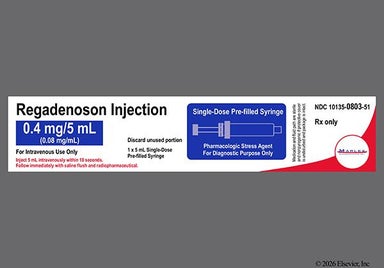
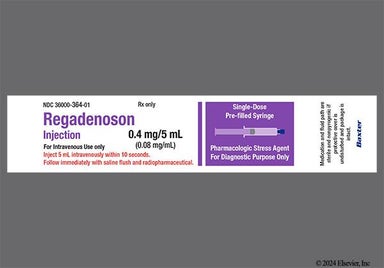
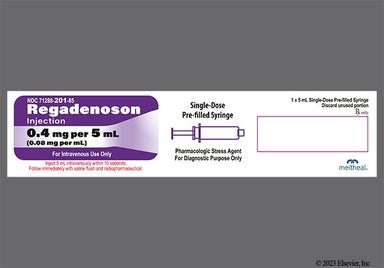
Lexiscan (regadenoson) is only available as an intravenous (IV) injection that's administered by a healthcare provider. The typical dose is 5 mL given as an injection through the vein over a 10-second period. Each 5 mL contains 0.4 mg of regadenoson.

Lexiscan (regadenoson) contraindications
Contraindications are specific health conditions or situations in which a person should not take a medication due to safety concerns. If you have any of the following conditions or if any of the following apply to you, let your healthcare provider know because Lexiscan (regadenoson) will not be safe for you to take.
- Second- or third-degree heart block
- Heart problems called sinus node dysfunction

What are alternatives to Lexiscan (regadenoson)?

Lexiscan (regadenoson) images