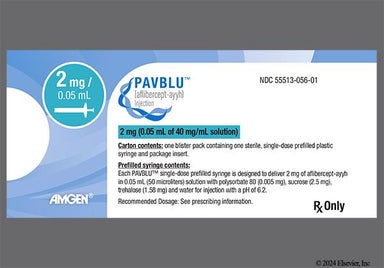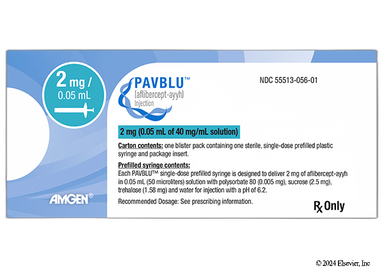
Pavblu
Pavblu (aflibercept or aflibercept-ayyh) is a biosimilar to Eylea. It's a VEGF inhibitor that treats eye conditions related to the retina that can cause vision loss. It’s FDA approved for adults with wet age‑related macular degeneration (AMD) as well as macular edema after retinal vein occlusion (RVO). It's also for diabetic macular edema (DME) and diabetic retinopathy (DR). Pavblu (aflibercept) is injected into the eye by a trained eye specialist at regular intervals. Side effects include bleeding on the surface of the eye, eye pain, and higher eye pressure.


What is Pavblu (aflibercept)?
What is Pavblu (aflibercept) used for?
- Wet age‑related macular degeneration (wet AMD)
- Macular edema following retinal vein occlusion (MEfRVO)
- Diabetic macular edema (DME)
- Diabetic retinopathy (DR)
How Pavblu (aflibercept) works
Pavblu (aflibercept) is a VEGF inhibitor. It acts like a “decoy” that attaches to VEGF‑A and placental growth factor (PlGF). These proteins are part of the VEGF family and play a role in making new blood vessels in the body.
Once Pavblu (aflibercept) attaches to these proteins, it blocks signals to make new blood vessels. When injected into the eye, the medication helps slow the growth of new, leaky blood vessels there. This reduces fluid and swelling in the retina. This can help keep your vision stable or improve it over time.
Drug facts
| Common Brands | Pavblu |
|---|---|
| Drug Class | VEGF inhibitor |
| Controlled Substance Classification | Not a controlled medication |
| Generic Status | No lower-cost generic available |
| Availability | Prescription only |

Side effects of Pavblu (aflibercept)
The following side effects may get better over time as your body gets used to the medication. Let your healthcare provider know immediately if you continue to experience these symptoms or if they worsen over time.
Common Side Effects
Wet AMD:
- Blood spot on the whites of eye (25%–27%)
- Cataract (7%–13%)
- Eye pain (9%–10%)
- Floaters (6%–8%)
- Vitreous detachment (6%–8%)
- Higher eye pressure (5%–7%)
Macular edema after RVO:
- Eye pain (13%)
- Blood spot on the whites of eye (12%)
- Higher eye pressure (8%)
- Floaters (5%)
- Corneal surface defect (5%)
Diabetic macular edema (DME):
- Blood spot on the whites of eye (28%–31%)
- Cataract (8%-19%)
- Eye pain (9%–11%)
- Higher eye pressure (5%–9%)
- Floaters (6%-8%)
- Vitreous detachment (3%–8%)
- Corneal surface defect (5%–7%)
Less Common Side Effects
- Eye redness
- Blurry vision
- Watery eye
- Eye inflammation
- Eyelid swelling
- Feeling like there's something in the eye
- Injection site pain
Pavblu (aflibercept) serious side effects
Contact your healthcare provider immediately if you experience any of the following.
- Eye infection (endophthalmitis): eye pain, sensitivity to light, loss of vision, eye redness
- Retinal detachment: flashing lights, feeling like something is covering your vision, changes in your vision, vision loss, seeing floaters
- Very high eye pressure: intense eye pain, red eye, blurry vision, headache
- Blood clot: weakness on one side, trouble speaking, chest pain, shortness of breath
- Severe allergic reaction: rash, itching, hives, swelling, trouble breathing, severe eye inflammation
The following Pavblu (aflibercept) side effects have also been reported
Side effects that you should report to your care team as soon as possible:
- Allergic reactions—skin rash, itching, hives, swelling of the face, lips, tongue, or throat
- Eye pain, redness, irritation, or discharge with blurry or decreased vision
- Heart attack—pain or tightness in the chest, shoulders, arms, or jaw, nausea, shortness of breath, cold or clammy skin, feeling faint or lightheaded
- Stroke—sudden numbness or weakness of the face, arm, or leg, trouble speaking, confusion, trouble walking, loss of balance or coordination, dizziness, severe headache, change in vision
- Sudden eye pain or change in vision such as blurry vision, seeing halos around lights, vision loss
Side effects that usually do not require medical attention (report these to your care team if they continue or are bothersome):
- Blurry vision
- Eye pain
- Increased tears
- Small spots floating in vision

Pros and cons of Pavblu (aflibercept)
Pros
- FDA approved for 4 major retinal conditions
- Less frequent dosing after the first few injections for many people
- Given by an eye specialist in clinic, so you don’t self‑inject
Cons
- Need ongoing eye injections and clinic visits
- Can raise your eye pressure or cause bleeding on the surface of your eye
- Small risk of serious eye infection, retinal problems, and blood clots

Pharmacist tips for Pavblu (aflibercept)

- You'll typically receive Pavblu (aflibercept) at your eye specialist's office. It needs to be given by a healthcare professional with the right tools and technique. This helps lower the risk of eye infection and injury.
- Put your appointments in your calendar to help you remember when to get your Pavblu (aflibercept) injection. It's given about once a month. For some retinal conditions, it can be given once every 2 months later on. Your eye specialist will set a treatment plan for you. Staying on schedule helps manage your eye condition and protect your vision.
- Pavblu (aflibercept) is given as an injection into the eye. Before the procedure, you'll get eye drops to numb your eye so you don't feel any pain. Your eye specialist will also put antibiotic drops in your eye to help lower the risk of eye infection. Ask your care team to learn more about what to expect with your eye injection.
- After your Pavblu (aflibercept) injection, your eye specialist will check your eye pressure before you go home. This medication can raise your eye pressure for a short time.
- Arrange a ride home after your Pavblu (aflibercept) injection, and take it easy the rest of the day. You might want to wear sunglasses since your eyes might be more sensitive to light. You also might have blurry vision for a short time. Avoid driving or using machines until your vision clears. This prevents accidents.
- Don’t rub your eye after the Pavblu (aflibercept) injection. Rubbing can raise the chance of eye irritation. And touching around your eye with your hands can put you at risk of an eye infection. If your eye feels scratchy, tell your prescriber. They might recommend lubricating drops to help.
- Watch for signs of an eye infection or eye problems after Pavblu (aflibercept). Call your care team right away for eye pain, discharge, redness, light sensitivity, new floaters, or a sudden vision change. Quick treatment helps protects your vision.
- If you miss a Pavblu (aflibercept) injection, reschedule as soon as you can. Skipping an injection can let fluid build up in your eye again and threaten your vision. Your clinic can get you back on track.
- If you're pregnant, planning pregnancy, or nursing: Talk with your care team. It isn't known if Pavblu (aflibercept) is safe during pregnancy or while breastfeeding. Your care team can go over risks and benefits and help you decide what's safest for you.

Risks and warnings for Pavblu (aflibercept)
Pavblu (aflibercept) can cause some serious health issues. This risk may be even higher for certain groups. If this worries you, talk to your doctor or pharmacist about other options.
Eye infection, retinal detachment, and other eye damage
Eye injections, such as with Pavblu (aflibercept), have been linked to endophthalmitis. This infection affects the tissues or fluids inside the eye. It can sometimes happen when the eye gets infected during the injection.
Eye injections have also been linked to retinal detachment. This happens when the retina pulls away from the back of the eye. More rarely, eye injections have been linked to inflammation of the eye blood vessels.
To lower the risk of eye infection, your eye specialist might give you a topical antibiotic beforehand. During the procedure, they'll use the proper techniques and tools to inject Pavblu (aflibercept) into your eye. This helps lower the risk of contamination and other eye damage.
Make sure to monitor for any visual changes. If your eye becomes red, sensitive to light, or painful, get medical care right away. Also call your eye specialist right away if you notice unusual changes in vision.
Higher eye pressure
- Risk factors: Regular injections of Pavblu (aflibercept)
Your eye pressure can go up within an hour after receiving Pavblu (aflibercept). This can happen because the injection introduces more fluid in the eye. This rise in eye pressure is usually temporary. But it can be longer-lasting after repeated eye injections.
Your eye specialist will check your eye pressure after each Pavblu (aflibercept) injection. This is important because repeated injections can raise your risk of long-lasting high eye pressure. And, high eye pressure often doesn't cause symptoms. But if you have intense eye pain, red eye, or blurry vision after receiving Pavblu (aflibercept), call your eye specialist right away. These can be symptoms of very high eye pressure.
Potential risk of blood clots
Although not common in studies, Pavblu (aflibercept) injections might cause blood clots. These blood clots can sometimes be serious and lead to a heart attack or stroke.
Watch for signs of a heart attack, like chest pain that travels to your arm or jaw, sweating, or shortness of breath. Also look out for sudden confusion, severe headache, a droopy face, weakness on one side of the body, slurred speech, or trouble walking. These can be signs of a stroke. If you have symptoms of a heart attack or stroke, call 911 right away.

Pavblu (aflibercept) dosage
Typical dosage for Pavblu (aflibercept)
A trained eye specialist will inject the medication into your eye. This is done at their office.
-
Wet AMD: The typical starting dose is 2 mg injected into the eye(s) once a month for 3 months. Afterwards, the typical dose is 2 mg injected into the eye(s) once every 2 months.
-
Macular edema after RVO: The typical dose is 2 mg injected into the eye(s) once a month (about every 25 days).
-
Diabetic retinopathy or diabetic macular edema: The typical starting dose is 2 mg injected into the eye(s) once a month for the first 5 months. Afterwards, the typical dose is 2 mg once into the eye(s) every 2 months.

Pavblu (aflibercept) contraindications
Contraindications are specific health conditions or situations in which a person should not take a medication due to safety concerns. If you have any of the following conditions or if any of the following apply to you, let your healthcare provider know because Pavblu (aflibercept) will not be safe for you to take.
- Infection in or around the eye
- Active eye inflammation (e.g., swelling, pain, redness)
- Allergy to aflibercept

What are alternatives to Pavblu (aflibercept)?
Conditions related to swelling or damage to the macula or retina (parts of the eye that are important for vision):
Lucentis and all its biosimilars
Lucentis and Cimerli biosimilar only

Pavblu (aflibercept) images