Onivyde
Onivyde (liposomal irinotecan) is a chemotherapy medication used for treating pancreatic cancer in adults. It works as a topoisomerase inhibitor to damage cancer cells and stop the cancer from growing. Onivyde (liposomal irinotecan) is given as an infusion through the vein once every 2 weeks. The medication is given by a nurse at a medical center. It’s usually used together with other cancer treatments. Common side effects of Onivyde (liposomal irinotecan) together with other treatments include fatigue and diarrhea.


What is Onivyde (liposomal irinotecan)?
What is Onivyde (liposomal irinotecan) used for?
- Metastatic pancreatic cancer
- As first-choice treatment, with oxaliplatin, 5-fluorouracil, and leucovorin injection
- As next-choice treatment, with 5-fluorouracil and leucovorin, after trying gemcitabine-based treatment
How Onivyde (liposomal irinotecan) works
Onivyde (liposomal irinotecan) is a type of chemotherapy called a topoisomerase I inhibitor. It works by interfering with and damaging the DNA in your cells. This causes fast-growing cells like cancer cells to get destroyed. It helps prevent the cancer from growing and spreading.
Drug facts
| Common Brands | Onivyde |
|---|---|
| Drug Class | Topoisomerase I inhibitor |
| Controlled Substance Classification | Not a controlled medication |
| Generic Status | No lower-cost generic available |
| Availability | Prescription only |

Side effects of Onivyde (liposomal irinotecan)
The following side effects may get better over time as your body gets used to the medication. Let your healthcare provider know immediately if you continue to experience these symptoms or if they worsen over time.
Common Side Effects
- Lower hemoglobin levels (91%)
- Diarrhea (72%)
- Lower white blood cell count (up to 64%)
- Lower potassium levels (62%)
- Feeling very tired (62%)
- Nausea (59%)
- Lower platelet count (55%)
- Higher liver enzyme levels (up to 45%)
- Vomiting (40%)
- Not feeling as hungry (37%)
- Stomach pain (35%)
- Mouth sores (28%)
- Constipation (25%)
Less Common Side Effects
- Swelling in the arm, legs, or feet
- Lower body weight
- Fever
- Shortness of breath
- Dehydration
- Hair loss
- Rash
- Bleeding
- Blockage of a blood vessel
- Higher sodium levels
- Higher potassium levels
Note: Side effects were reported from people taking Onivyde (liposomal irinotecan) with oxaliplatin, 5-fluorouracil, and leucovorin (the NALIRIFOX regimen).
Onivyde (liposomal irinotecan) serious side effects
Contact your healthcare provider immediately if you experience any of the following.
- Infection: fever, chills, body aches, headache, new cough, sore throat, feeling tired
- Any diarrhea, but especially severe diarrhea: diarrhea that doesn’t go away, black or bloody stools, dehydration (dizziness, lightheadedness, faintness)
- Lung problems: having trouble catching your breath, fever, new cough, worsening cough, wheezing
- Serious allergic reaction: swelling of the face, lips, or tongue; trouble breathing; rash; itching
The following Onivyde (liposomal irinotecan) side effects have also been reported
Side effects that you should report to your care team as soon as possible:
- Allergic reactions or angioedema—skin rash, itching or hives, swelling of the face, eyes, lips, tongue, arms, or legs, trouble swallowing or breathing
- Dry cough, shortness of breath or trouble breathing
- Diarrhea
- Infection—fever, chills, cough, or sore throat
Side effects that usually do not require medical attention (report to your care team if they continue or are bothersome):

Pros and cons of Onivyde (liposomal irinotecan)
Pros
- Recommended treatment option for pancreatic cancer
- Usually given once every 2 weeks
Cons
- Can cause diarrhea, fatigue, and low blood cell counts
- Must be given with other chemotherapy medications

Pharmacist tips for Onivyde (liposomal irinotecan)

- Before each infusion, your care team will give you medications to help prevent nausea and vomiting. Most times, it’s a steroid like dexamethasone and an anti-nausea medication like ondansetron (Zofran). Onivyde (liposomal irinotecan) often causes nausea, which can feel uncomfortable.
- During your Onivyde (liposomal irinotecan) infusion, tell your nurse if you feel anything out of the ordinary. This could be stomach cramps, sweating, itching, or feeling flushed. Your care team can give you medications to help you feel better.
- Diarrhea is a common side effect while taking Onivyde (liposomal irinotecan). Drink plenty of fluids during treatment. Let your care team know right away if you have any diarrhea at any time while taking this medication. They can give you recommendations to help manage diarrhea.
- To lower your risk of severe diarrhea from Onivyde (liposomal irinotecan), remember to stay hydrated. Also follow a low-fat diet and eat small meals. Avoid eating or drinking anything with lactose in it.
- Tell your oncology care team about all the medications and supplements you take. Certain drug interactions with Onivyde (liposomal irinotecan) can raise your risk of side effects. Others can make some of your medications work less well. It’s important for your care team to check to keep you safe. You might need to stop or switch some of your medications a couple weeks before you start Onivyde (liposomal irinotecan).
- If you can become pregnant, make sure to use reliable birth control while taking Onivyde (liposomal irinotecan). Keep using birth control for 7 months after your last dose. This medication has a risk of harming an unborn baby. So, it’s important to avoid becoming pregnant. Tell your oncologist right away if you get pregnant.
- If you can father a child, make sure to at least use condoms as birth control with your partners while you’re taking Onivyde (liposomal irinotecan). Continue to do this for 4 months after your last dose of the medication. This is important because Onivyde (liposomal irinotecan) might harm an unborn baby. Tell your oncologist right away if your partner becomes pregnant during this time.

Risks and warnings for Onivyde (liposomal irinotecan)
Onivyde (liposomal irinotecan) can cause some serious health issues. This risk may be even higher for certain groups. If this worries you, talk to your doctor or pharmacist about other options.
Severely low white blood cell count (neutropenia)
- Risk factors: Asian descent
Onivyde (liposomal irinotecan) can make you have dangerously low white blood cell counts. This is called neutropenia and can lead to life-threatening problems. When you don’t have enough white blood cells, it puts you at high risk of infection. Although rare, it also could put you at risk of serious fever or a serious condition called sepsis.
On day 1 and 8 of each treatment cycle with Onivyde (liposomal irinotecan), your oncology team will draw your blood to check your blood cell count. If needed, they might check more often. If your white blood cell count is too low or if you also have a fever, your oncologist will delay your infusion until you get better. They might also lower your dose for your next infusions if your blood counts get too low or if you get an infection.
Let your healthcare team know if you think you have an infection, especially if you have a fever. Sometimes, fever might be the only sign of an infection.
Severe diarrhea
Diarrhea is a common side effect of Onivyde (liposomal irinotecan). But it can sometimes be very serious and even life-threatening. Because of this risk, people with a blockage in their gut shouldn’t take Onivyde (liposomal irinotecan).
This severe diarrhea can happen soon after your infusion (within 24 hours) or later (a day or more after). Early diarrhea can also come with stomach cramps, runny nose, drooling, watery eyes, or sweating. Severe diarrhea can lead to problems, like dehydration and low electrolytes.
Be sure to stay hydrated. Tell your oncology team right away if you have any diarrhea at any time while taking Onivyde (liposomal irinotecan). Especially call them if you have vomiting or diarrhea that doesn’t go away or black or bloody stools. Also tell them if you have signs of dehydration like feeling dizzy, lightheaded, or faint. These can be signs of severe diarrhea and serious problems from it.
Your care team can recommend treatment depending on when the diarrhea happens. For example, they can give you a medication called atropine for early diarrhea. And they’ll have you take loperamide (Imodium A-D) for late diarrhea. Your oncologist will also decide to pause or stop taking Onivyde (liposomal irinotecan).
Lung damage
- Risk factors: History of lung problems | Previous radiation therapy | Taking medications that can cause lung damage | Taking medications that help the body make more white blood cells (colony stimulating factors)
It’s rare, but Onivyde (liposomal irinotecan) can cause lung damage. This can sometimes be severe and even life-threatening.
Tell your oncologist about all your health problems, the treatments you’ve had, and the medications you take. Some things can make you more likely to have lung damage. If you’re at risk, your care team will check on you more often while you’re taking Onivyde (liposomal irinotecan).
Tell your care team right away if you have a new cough, a cough that gets worse, shortness of breath, or fevers. Your oncologist will probably have you stop taking Onivyde (liposomal irinotecan) while they check your lungs.
Severe allergic reaction
Onivyde (liposomal irinotecan) can cause severe allergic reactions, including anaphylaxis. This can look like dizziness, trouble breathing, swelling in your lips or tongue, itching, or hives.
If you think you’re having an allergic reaction, get medical help right away. If the reaction is very severe, your care team will change your treatment plan.
Harm to an unborn baby
Onivyde (liposomal irinotecan) has the potential to harm an unborn baby if it’s given during pregnancy. Before starting treatment, let your oncologist know if you’re pregnant. They can help explain the risks.
If you’re able to become pregnant, use effective birth control while taking Onivyde (liposomal irinotecan). Keep using birth control for at least 7 months after your last dose. If you’re male and can father a child, use condoms while taking this medication and for 4 months after your last dose.
If you’re thinking about becoming pregnant, talk to your oncologist. They can speak with you about options for family planning. Tell your oncologist right away if you get pregnant while taking Onivyde (liposomal irinotecan).

Onivyde (liposomal irinotecan) dosage
Typical dosage for Onivyde (liposomal irinotecan)
Your oncology team will determine your dose based on your body surface area (BSA). It’s measured in units of m² and uses your height and weight.
-
First-choice treatment of metastatic pancreatic cancer: The typical dose is 50 mg/m² given as an infusion through the vein (IV) once every 2 weeks. Onivyde (liposomal irinotecan) is given together with oxaliplatin, 5-fluorouracil, and leucovorin injection. This treatment regimen is called NALIRIFOX.
-
Next-choice treatment of metastatic pancreatic cancer after gemcitabine-based therapy: The typical dose is 70 mg/m² given as an IV infusion once every 2 weeks. Your dose might be lower if you have certain genetics. Onivyde (liposomal irinotecan) is given together with 5-fluorouracil and leucovorin injection.

Onivyde (liposomal irinotecan) contraindications
Contraindications are specific health conditions or situations in which a person should not take a medication due to safety concerns. If you have any of the following conditions or if any of the following apply to you, let your healthcare provider know because Onivyde (liposomal irinotecan) will not be safe for you to take.
- Severe allergic reaction to conventional irinotecan (Camptosar)

What are alternatives to Onivyde (liposomal irinotecan)?

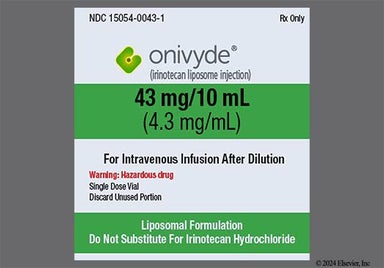
Onivyde (liposomal irinotecan) images