Key takeaways:
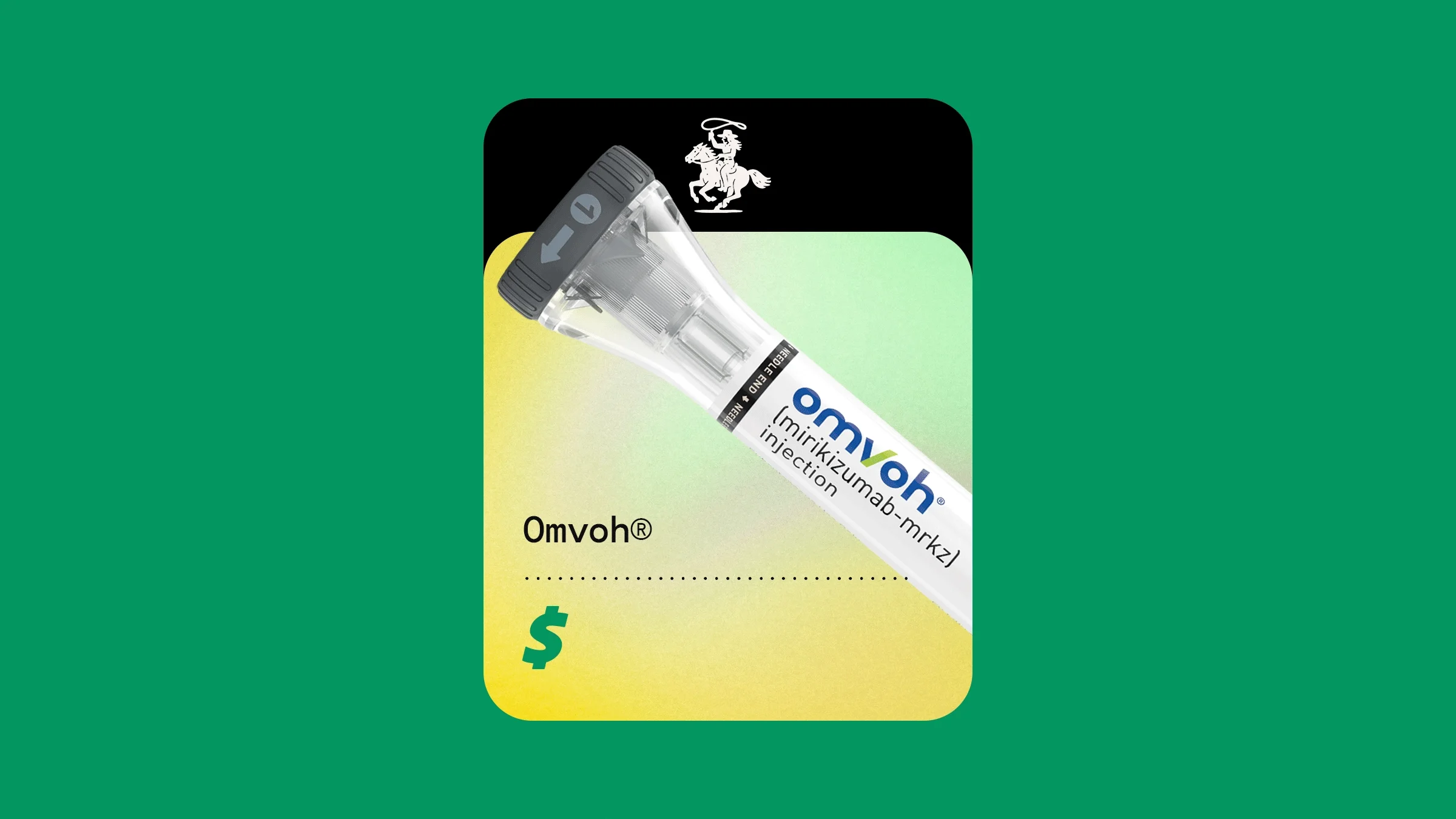
Omvoh (mirikizumab) is an injectable biologic medication that treats inflammatory bowel disease. Without insurance, Omvoh can cost over $11,000 per month for at-home injections.
Almost all Medicaid plans cover Omvoh, as do most Affordable Care Act (ACA) marketplace and commercial insurance plans. But prior authorization and step therapy are often required. Medicare typically covers Omvoh under enrollees’ Plan B benefits. Check with your plan to learn more.
A manufacturer copay savings card or patient assistance program could help make your Omvoh prescription more affordable. Don’t hesitate to reach out to your specialty pharmacy team for help.
Save on related medications
Omvoh (mirikizumab) is an injectable biologic that treats Crohn’s disease and ulcerative colitis in adults. Biologics are among some of the most expensive prescription medications available. So it’s common to wonder: How much is Omvoh without insurance coverage?
Let’s review how much Omvoh costs without insurance, how likely insurance is to cover it, and ways you can save on this medication.
How much does Omvoh cost?
Omvoh’s manufacturer list price is around $11,400 per month for the most common doses injected at home. But the average retail cash price is typically higher because of wholesaler and pharmacy markups.
Omvoh comes in injection pens and prefilled syringes for at-home use. Both forms come in 100 mg and 200 mg doses. The usual Omvoh maintenance dosage is 200 mg or 300 mg injected once a month (every 4 weeks).
Omvoh also comes in a 300 mg vial that’s used for the first 3 doses of the medication. But it’s given as an IV infusion in a healthcare setting. Since infusion clinics and medical offices typically supply IV Omvoh for infusions, it’s usually covered by medical insurance, not pharmacy insurance. For this reason, we are not covering this form of Omvoh in this savings guide. Your prescriber and insurance company (if applicable) can provide more information on the cost of Omvoh infusions.
What factors affect the cost of Omvoh?
Several factors can affect the cost of Omvoh. These factors can vary depending on whether or not you have prescription medication coverage:
Insurance formulary tier: Most insurance plans have tiers, or levels, within their formulary (list of covered medications). Lower-tier medications typically have a lower copay, while higher-tier medications typically have a higher copay. If you have insurance, how much you pay for Omvoh will depend on where it’s placed within your plan’s formulary.
Dosage and dosage form: What you pay for Omvoh can depend on what dosage and form you’re prescribed.
Quantity: The more doses of Omvoh you purchase at one time, the higher your total cost will be.
Location: Where you live plays a role in the cash price of your medications. For instance, prices for prescription medications are generally lower in Tampa, Florida, than in New York City.
Pharmacy: Omvoh is typically filled at a specialty pharmacy. But which pharmacy you choose can play a role in the cash price.
Does insurance cover Omvoh?
Almost all Medicaid plans and about 75% of commercial and Affordable Care Act (ACA) marketplace insurance plans cover Omvoh. Medicare typically covers Omvoh through original Medicare (Part B), instead of through Part D prescription medication coverage.
Most plans that cover Omvoh require prior authorization, and step therapy is required about 50% of the time. Getting prior authorization requires your prescriber to submit medical information that your plan reviews to ensure Omvoh is an appropriate treatment for you. Step therapy involves you trying one or more lower-cost treatments before Omvoh — or explaining why they aren’t an option.
Keep in mind that Omvoh is typically filled at a specialty pharmacy. The staff at your specialty pharmacy will have extra training on how to help you get coverage approved for your medication. They can also be a helpful resource for finding additional savings opportunities. So don’t hesitate to reach out to them for assistance if needed.
How different insurance plans cover Omvoh
The following chart shows the percentage of enrollees who have coverage for the most common monthly, at-home Omvoh dosage — one 100 mg/mL pen and one 200 mg/2 mL pen — by insurance type. It also shows how often prior authorization or step therapy is required.
Insurance type | Enrollees covered for Omvoh | Enrollees required to get prior authorization | Enrollees required to do step therapy |
|---|---|---|---|
72.1% | 69.2% | 49.7% | |
Commercial plans (excluding ACA plans) | 76.3% | 68.7% | 47.6% |
Medicare (Medicare Advantage and Part D plans)* | 5.8% | 5.8% | 2.8% |
Medicaid, including state-run and managed care plans | 99.6% | 98.2% | 50.4% |
*Data does not reflect coverage under original Medicare (Part B).
Source: Managed Markets Insight & Technology, LLC™, as of January 10, 2026. (See methodology below.)
If your insurance doesn’t cover Omvoh, try these options:
Request a formulary exception from your insurance company. You can also file an appeal if your claim is denied.
Use a free discount program, such as GoodRx coupons, to save on the cost of your prescription.
Talk to your prescriber about an Omvoh alternative, such as Entyvio (vedolizumab), to see if there’s an option that’s covered by your insurance plan.
When your next open enrollment window comes, look for a health insurance plan that includes Omvoh as a covered medication.
Ways to save on Omvoh
There are ways to save on the cost of Omvoh. Some options require having insurance coverage, while others can help reduce the cash price. Here are four to consider.
1. See if you qualify for a copay savings card
If you have commercial insurance, Omvoh’s manufacturer offers two different savings programs:
If you have insurance that covers Omvoh: You may pay as little as $5 per month for your prescription.
If you have insurance that denies coverage for Omvoh: You may pay as little as $0 per month.
To be eligible for either savings program:
You must have commercial insurance.
You must have a valid Omvoh prescription for an FDA-approved use.
You must be a resident of the U.S. or Puerto Rico.
You must be 18 or older.
You must not be enrolled in a government-funded health insurance program, such as Medicare, Medicaid, or Tricare.
You can apply for the Omvoh savings program online or call 1-800-545-5979 for assistance.
2. Check if you’re eligible for a patient assistance program
If you’re uninsured or underinsured, you may qualify to receive Omvoh at no cost through the Lilly Cares Foundation. To qualify:
You must be a permanent resident of the U.S., Puerto Rico, or the U.S. Virgin Islands.
You cannot not have insurance coverage, including through low-income subsidies or U.S. Department of Veterans Affairs (VA) benefits.
You must meet household income guidelines.
You can apply for assistance through the Lilly Cares program website or call 1-800-545-6962 for assistance.
3. Ask about a 90-day supply
Filling a 90-day supply (instead of a 30-day supply) may reduce your overall prescription costs. If you have insurance, your plan may offer Omvoh at a lower cost per month when you fill 3 months at a time.
4. Tap into your HSA, FSA, or HRA
If you have a health savings account (HSA), a flexible spending account (FSA), or a health reimbursement arrangement (HRA), you can use it to help cover your out-of-pocket costs for Omvoh. These tax-advantaged healthcare accounts let you pay for eligible expenses with tax-free dollars.
Pay directly with your HSA or FSA card at the pharmacy, or cover the cost yourself and submit a request for reimbursement. The funds in HSAs and HRAs typically roll over annually, but you have to use your FSA dollars before the deadline or they’ll expire.
The bottom line
Omvoh (mirikizumab) is an injectable biologic medication that treats Crohn’s disease and ulcerative colitis in adults. Without insurance, Omvoh can cost over $11,000 per month. It’s typically filled by a specialty pharmacy for at-home use.
Almost all Medicaid plans cover Omvoh, as do most Affordable Care Act (ACA) marketplace and commercial insurance plans. But prior authorization is often required, and about 50% of plans also have step therapy requirements. Medicare typically covers Omvoh under Plan B benefits. Check with your plan to learn more about your individual coverage.
A manufacturer copay savings card or patient assistance program could also help make your Omvoh prescription more affordable. Don’t hesitate to reach out to your specialty pharmacy team for more information about savings opportunities and enrollment.

Why trust our experts?



Methodology
We obtained national prescription coverage data for each medication from Managed Markets Insight & Technology (MMIT). The data reflects health insurance coverage as of January 2026.
We calculated the percentage of enrollees in plans that cover each medication by dividing the number of enrollees covered for the medication within a specific insurance channel (e.g., ACA, Medicare, Medicaid) by the total number of enrollees in all plans within that channel.
We determined the percentage of enrollees in plans with a prior authorization requirement by calculating the proportion of enrollees in plans that required prior authorization for the medication within each channel.
Finally, we measured the percentage of enrollees in plans with a step therapy requirement by calculating the proportion of enrollees in plans that imposed step therapy requirements for the medication in each channel.
These estimates, derived from national MMIT coverage data, provide insight into health insurance coverage for each medication. They take into account restrictions such as prior authorization, step therapy, and quantity limits. The percentages are expressed relative to the total number of enrollees covered by various insurance channels, including ACA plans, commercial (excluding ACA) plans, Medicare, and Medicaid (both state-run and managed care plans).
References
Eli Lilly and Company. (n.d.). How much should I expect to pay for Omvoh® (mirikizumab-mrkz)?
Eli Lilly and Company. (2025). Omvoh - mirikizumab-mrkz injection, solution, Omvoh - mirikizumab-mrkz [package insert].
Lilly Cares Foundation. (n.d.). Lilly Cares application.
Medicaid.gov. (n.d.). Managed care.
Omvoh. (n.d.). Savings & support. Eli Lilly and Company.
Omvoh. (n.d.). Savings card forms. Eli Lilly and Company.