nitroglycerin
Nitroglycerin (Nitrolingual) spray is a nitrate medication used to prevent and treat angina (chest pain). It works by widening the blood vessels in your heart to ease blood flow. Typically, you spray 1 to 2 sprays under the tongue at the first sign of chest pain. Your provider might also instruct you to use it 5 to 10 minutes before an activity that might cause chest pain. Some common side effects of nitroglycerin (Nitrolingual) spray include headache and low blood pressure. Avoid using nitroglycerin (Nitrolingual) spray if you're taking sildenafil (Viagra) (or other similar medications) to prevent your blood pressure from dropping too low.


What is Nitroglycerin (Nitrolingual) spray?
What is Nitroglycerin (Nitrolingual) spray used for?
- Prevention and treatment of angina (chest pain due to tight blood vessels in the heart)
How Nitroglycerin (Nitrolingual) spray works
Nitroglycerin (Nitrolingual) spray is a nitrate that opens the blood vessels in your heart. This helps blood reach the heart better, which puts less stress on the heart and relieves heart-related chest pain.
Drug facts

Side effects of Nitroglycerin (Nitrolingual) spray
The following side effects may get better over time as your body gets used to the medication. Let your healthcare provider know immediately if you continue to experience these symptoms or if they worsen over time.
Common Side Effects
- Headache
- Dizziness
- Tingling or prickling sensation
Less Common Side Effects
- Weakness or drowsiness
- Warm skin or skin redness (flushing)
- Chest pounding
- Rash
Nitroglycerin (Nitrolingual) spray serious side effects
Contact your healthcare provider immediately if you experience any of the following.
- Dangerously low blood pressure: dizziness, lightheadedness, pale skin, feeling faint
The following Nitroglycerin (Nitrolingual) spray side effects have also been reported
Along with its needed effects, a medicine may cause some unwanted effects. Although not all of these side effects may occur, if they do occur they may need medical attention.
Check with your doctor immediately if any of the following side effects occur:
Less common
Bloating or swelling of the face, arms, hands, lower legs, or feet
burning, crawling, itching, numbness, prickling, "pins and needles", or tingling feelings
difficult or labored breathing
feeling faint, dizzy, or lightheadedness
feeling of warmth or heat
flushing or redness of the skin, especially on the face and neck
headache
rapid weight gain
sweating
tightness in the chest
tingling of the hands or feet
unusual weight gain or loss
Rare
Bluish-colored lips, fingernails, or palms
dark urine
pale skin
rapid heart rate
unusual bleeding or bruising
unusual tiredness or weakness
Incidence not known
Arm, back, or jaw pain
blurred vision
chest pain or discomfort
chest tightness or heaviness
confusion
cracks in the skin
difficulty with swallowing
dizziness, faintness, or lightheadedness when getting up suddenly from a lying or sitting position
fainting
fast, irregular, pounding, or racing heartbeat or pulse
feeling of constant movement of self or surroundings
feeling of warmth
increased sweating
loss of heat from the body
nausea or vomiting
puffiness or swelling of the eyelids or around the eyes, face, lips, or tongue
red, swollen skin
redness of the face, neck, arms, and occasionally, upper chest
sensation of spinning
weakness
Get emergency help immediately if any of the following symptoms of overdose occur:
Symptoms of overdose
Bluish-colored lips, fingernails, or palms
blurred or loss of vision
bulging soft spot on the head of an infant
change in consciousness
change in the ability to see colors, especially blue or yellow
cold, clammy skin
dark urine
difficulty breathing
disturbed color perception
dizziness or lightheadedness
double vision
flushed skin
halos around lights
headache, severe and throbbing
increased sweating
loss of appetite
loss of consciousness
night blindness
overbright appearance of lights
pale skin
paralysis
slow or irregular heartbeat
tunnel vision
unusual bleeding or bruising
unusual tiredness or weakness
Some side effects may occur that usually do not need medical attention. These side effects may go away during treatment as your body adjusts to the medicine. Also, your health care professional may be able to tell you about ways to prevent or reduce some of these side effects. Check with your health care professional if any of the following side effects continue or are bothersome or if you have any questions about them:
Other side effects not listed may also occur in some patients. If you notice any other effects, check with your healthcare professional.
Call your doctor for medical advice about side effects. You may report side effects to the FDA at 1-800-FDA-1088.

Get your GoodRx coupon

Pros and cons of Nitroglycerin (Nitrolingual) spray
Pros
- A first-choice treatment option for angina
- Can ease chest pain in 2 minutes
- Can prevent chest pain due to activities like exercise
- Available as a generic
Cons
- Need to prime the spray bottle if it hasn't been used for a while
- Can cause dizziness, lightheadedness, or fainting
- Can become tolerant to the medication (won't work as well over time)

Pharmacist tips for Nitroglycerin (Nitrolingual) spray

- Keep nitroglycerin (Nitrolingual) spray with you at all times so you're ready to treat chest pain at any time.
- To prime Nitrolingual, spray away from your face 5 times if it's a new bottle or if you haven't used it for 3 months. If you haven't used it for 6 weeks, spray just 1 time.
- To prime NitroMist, spray the medication away from your face 10 times to keep it primed for 6 weeks. If you don't use NitroMist within 6 weeks, re-prime with 2 sprays.
- Nitroglycerin (Nitrolingual) spray should only be sprayed onto or under the tongue only. Close your mouth after spraying the medication and try not to swallow right after taking a spray. Don't inhale the spray either. To make sure the medication fully absorbs, wait at least 5 to 10 minutes before you spit or rinse your mouth.
- Your chest pain should get better within 3 minutes after you take nitroglycerin (Nitrolingual) spray. But if it doesn't, you can take another dose 5 minutes later. You can take a total of up to 3 doses within 15 minutes. Get emergency help if you're still having chest pain after 3 doses or if the pain is different than usual.
- Nitroglycerin (Nitrolingual) spray can cause low blood pressure, which can lead to dizziness, lightheadedness, or fainting. Sit down before and after taking this medication to lower your risk of fainting or falling.
- Avoid alcohol after you take a nitroglycerin (Nitrolingual) spray dose because this combination can cause dangerously low blood pressure and dizziness.
- Don't use nitroglycerin (Nitrolingual) spray if you’re also taking medications like sildenafil (Viagra) or tadalafil (Cialis). Doing so can cause your blood pressure to drop dangerously low. If you've recently taken one of these medications, call 911 right away when you experience chest pain. Let the emergency care team know your complete medication list.
- Using nitroglycerin (Nitrolingual) spray too often can lead to tolerance or tachyphylaxis. This means the medication might not work as well to ease chest pain over time. To prevent tolerance, use nitroglycerin (Nitrolingual) spray only when you need it.

Common questions about Nitroglycerin (Nitrolingual) spray
You can expect chest pain to ease a couple of minutes after you use nitroglycerin (Nitrolingual) spray. The effects of each spray should last for about 15 minutes.
Yes, nitroglycerin (Nitrolingual) spray can cause low blood pressure as a side effect. Your risk is higher if you're an older adult, dehydrated, or are taking other medications that can lower blood pressure. Having low blood pressure can lead to symptoms such as dizziness and lightheadedness, which can make you feel off-balance. To prevent falls, hold on to something stable when you're going from a sitting to standing position. Also, consider removing or securing any rugs you have around the home that might be a tripping hazard. If the dizziness is very bothersome and you're having trouble going through the day, talk with your provider about other medication options besides nitroglycerin (Nitrolingual) spray.
Sometimes, people experience chest pain (angina) because there isn't enough blood flowing to the heart. Nitroglycerin (Nitrolingual) spray prevents chest pain by opening up the blood vessels so that the blood flows better. Keep in mind that nitroglycerin (Nitrolingual) spray is applied to the skin once daily to prevent chest pain. But this medication doesn't work quickly enough to relieve chest pain if you're already experiencing symptoms.
You should take nitroglycerin (Nitrolingual) spray right away at the first sign of chest pain. If the chest pain doesn't go away within 5 minutes after you use nitroglycerin (Nitrolingual) spray, take another dose and wait another 5 minutes. If you still have chest pain, take a third dose and call 911 or go to an emergency department right away. You can also take a dose of nitroglycerin (Nitrolingual) spray about 5 to 10 minutes before an activity that might cause chest pain. This helps prevent chest pain from happening in the first place.
If you're having chest pain that doesn't go away after 3 sprays of nitroglycerin (Nitrolingual) within 15 minutes or if your chest pain returns within the same day, get emergency medical help right away. This might be a sign that you're experiencing a serious heart problem that needs more medical attention.
Before using nitroglycerin (Nitrolingual) spray, make sure the medication is already primed if you haven't used it in a while or if it's a new bottle. While sitting down, remove the plastic cap on the medication container and hold it upright (the grooved, actuator button to give the dose should be on top). Open your mouth and bring the medication as close to your mouth as possible. Press down on the top of the grooved button to spray onto or under your tongue. Repeat if a second dose is needed. Avoid swallowing right after using the spray and don't spit out the medication or rinse your mouth for 5 to 10 minutes after taking a dose.
Yes, nitroglycerin (Nitrolingual) spray can expire. There should be an expiration date that's written on the medication spray. Ask your pharmacist or provider about getting a refill if your inhaler has expired. Don't use nitroglycerin (Nitrolingual) spray past the written expiration date because it might not work well to help with your chest pain.

How to save using GoodRx


Risks and warnings for Nitroglycerin (Nitrolingual) spray
Nitroglycerin (Nitrolingual) spray can cause some serious health issues. This risk may be even higher for certain groups. If this worries you, talk to your doctor or pharmacist about other options.
Tolerance
- Risk factors: Use of long-acting nitrates | Taking too many doses of nitroglycerin (Nitrolingual) spray
Your body can get used to nitroglycerin (Nitrolingual) spray over time. When this happens, the same amount of medication might no longer work as well as it used to. This is called tolerance or tachyphylaxis. Tolerance to nitroglycerin (Nitrolingual) spray is more likely to happen if you’ve taken longer-acting forms of nitrates (e.g., isosorbide mononitrate (Monoket) or isosorbide dinitrate (Isordil)). You can also develop tolerance to nitroglycerin (Nitrolingual) spray if you use the medication too many times. When you develop tolerance, taking a higher dose of medication might not always help it to work better. Because of this risk, make sure to use nitroglycerin (Nitrolingual) spray only when you need it at the prescribed dose and talk to your provider if you notice worsening chest pain.
Low blood pressure
- Risk factors: Taking nitroglycerin (Nitrolingual) spray while standing | Certain heart problems | Dehydration | Use of erectile dysfunction medications | Use of blood pressure-lowering medications | Alcohol use
Nitroglycerin (Nitrolingual) spray can cause your blood pressure to drop too much, which can make you feel dizzy, tired, or lightheaded. When you use nitroglycerin (Nitrolingual) spray, make sure to sit down for the first few minutes to avoid dizziness or fainting. Change positions slowly until your body is used to the medication. Get emergency help if you feel like you're going to pass out in addition to having an irregular heartbeat, nausea, vomiting, weakness, changes in vision, sweating, cold and clammy skin, or worse chest pain.
Worsening chest pain
- Risk factors: Hypertrophic cardiomyopathy
Although rare, taking nitroglycerin (Nitrolingual) spray can worsen chest pain that's caused by a heart problem called hypertrophic cardiomyopathy. This is a condition where your heart muscles are too thick and can't pump blood as well. If you’ve been diagnosed with hypertrophic cardiomyopathy, check with your provider to make sure that nitroglycerin (Nitrolingual) spray is right for you. If you take nitroglycerin (Nitrolingual) spray dose and it worsens your chest pain, get emergency help right away.
Headache
- Risk factors: First starting nitroglycerin (Nitrolingual) spray | Higher doses of nitroglycerin (Nitrolingual) spray
Nitroglycerin (Nitrolingual) spray can cause headaches, which can sometimes be severe. These headaches can last for up to an hour, but they can also be long-lasting. In particular, headaches can happen when you first start using nitroglycerin (Nitrolingual) spray or if you take higher doses of the medication. But they can become less bothersome or happen less often after you've used nitroglycerin (Nitrolingual) spray a few times and your body gets used to the medication. If the headaches are causing you too many problems, talk to your healthcare provider about other options.

Nitroglycerin (Nitrolingual) spray dosage
 Bottle of spray
| Dosage | Quantity | Price as low as | Price per unit |
|---|---|---|---|
| 4.9g of 400mcg/spray | 1 bottle | $54.53 | $54.53 |
| 12g of 400mcg/spray | 1 bottle | $93.97 | $93.97 |
Typical dosage for Nitroglycerin (Nitrolingual) spray
Nitroglycerin (Nitrolingual) spray is given as a spray onto or under the tongue. Close your mouth after spraying the medication; don't inhale it.
- Treatment of chest pain: The typical dose is 1 or 2 sprays at the first sign of chest pain. You can repeat a dose after 5 minutes if the pain continues. But don't use more than 3 sprays within 15 minutes.
- Prevention of chest pain: The typical dose is 1 or 2 sprays 5 to 10 minutes before doing any activity that could cause chest pain.

Interactions between Nitroglycerin (Nitrolingual) spray and other drugs
Although certain medicines should not be used together at all, in other cases two different medicines may be used together even if an interaction might occur. In these cases, your doctor may want to change the dose, or other precautions may be necessary. When you are taking this medicine, it is especially important that your healthcare professional know if you are taking any of the medicines listed below. The following interactions have been selected on the basis of their potential significance and are not necessarily all-inclusive.
Using this medicine with any of the following medicines is not recommended. Your doctor may decide not to treat you with this medication or change some of the other medicines you take.
- Avanafil
- Riociguat
- Sildenafil
- Tadalafil
- Vardenafil
Using this medicine with any of the following medicines is usually not recommended, but may be required in some cases. If both medicines are prescribed together, your doctor may change the dose or how often you use one or both of the medicines.
- Alteplase, Recombinant
Using this medicine with any of the following medicines may cause an increased risk of certain side effects, but using both drugs may be the best treatment for you. If both medicines are prescribed together, your doctor may change the dose or how often you use one or both of the medicines.
- Acetylcysteine
- Apomorphine
- Aspirin
- Dihydroergotamine
- Pancuronium

How much does Nitroglycerin (Nitrolingual) spray cost?

Nitroglycerin (Nitrolingual) spray contraindications
Contraindications are specific health conditions or situations in which a person should not take a medication due to safety concerns. If you have any of the following conditions or if any of the following apply to you, let your healthcare provider know because Nitroglycerin (Nitrolingual) spray will not be safe for you to take.
- Taking PDE-5 inhibitors like sildenafil (Viagra, Revatio)
- Taking sGC stimulators like Adempas (riociguat)
- Severe anemia (low red blood cell count)
- People with raised blood pressure in the brain (e.g., brain bleed, traumatic brain injury)
- Allergy to other nitrates, such as isosorbide mononitrate (Monoket) or isosorbide dinitrate (Isordil)
- Circulatory failure or shock

What are alternatives to Nitroglycerin (Nitrolingual) spray?

News about Nitroglycerin (Nitrolingual) spray


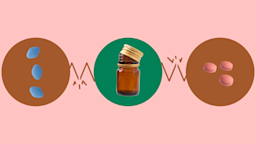







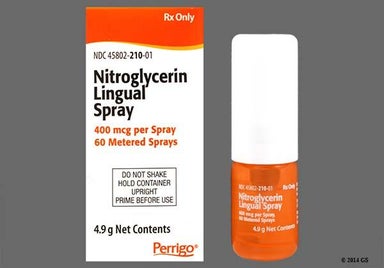
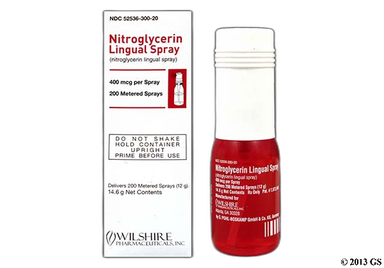
Nitroglycerin (Nitrolingual) spray images