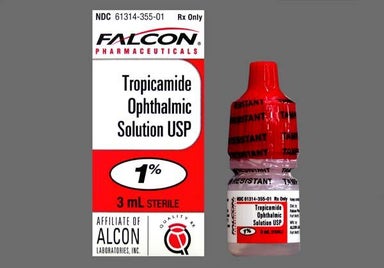
tropicamide
Tropicamide (Mydriacyl) dilates the pupil and blocks the eye's ability to focus. This allows for your provider to complete eye procedures and diagnose eye conditions.


What is Tropicamide (Mydriacyl)?
What is Tropicamide (Mydriacyl) used for?
- Dilate pupils for diagnostic procedures
How Tropicamide (Mydriacyl) works
Tropicamide (Mydriacyl) is an anticholinergic medication. It dilates (widens) the pupil and paralyzes the muscle needed to focus on an object so your provider can check your eyes.
Drug facts
| Common Brands | Mydriacyl |
|---|---|
| Drug Class | Anticholinergic |
| Controlled Substance Classification | Not a controlled medication |
| Generic Status | Lower-cost generic available |
| Availability | Prescription only |

Side effects of Tropicamide (Mydriacyl)
The following side effects may get better over time as your body gets used to the medication. Let your healthcare provider know immediately if you continue to experience these symptoms or if they worsen over time.
Common Side Effects
- Blurry vision
- Stinging
- Light sensitivity
Less Common Side Effects
- High pressure in the eye
- Dry mouth
- Fast heart rate
- Headache
- Nausea
- Vomiting
- Muscle stiffness
Tropicamide (Mydriacyl) serious side effects
Contact your healthcare provider immediately if you experience any of the following.
- Brain and nervous system disturbances: hallucinations (seeing things that aren't real), confusion, abnormal behavior
The following Tropicamide (Mydriacyl) side effects have also been reported
Along with its needed effects, a medicine may cause some unwanted effects. Although not all of these side effects may occur, if they do occur they may need medical attention.
Check with your doctor as soon as possible if any of the following side effects occur:
Symptoms of too much medicine being absorbed into the body
Clumsiness or unsteadiness
confusion
fast heartbeat
flushing or redness of face
hallucinations (seeing, hearing, or feeling things that are not there)
increased thirst or dryness of mouth
skin rash
slurred speech
swollen stomach in infants
unusual behavior, especially in children
unusual drowsiness, tiredness, or weakness
Some side effects may occur that usually do not need medical attention. These side effects may go away during treatment as your body adjusts to the medicine. Also, your health care professional may be able to tell you about ways to prevent or reduce some of these side effects. Check with your health care professional if any of the following side effects continue or are bothersome or if you have any questions about them:
More common
Blurred vision
headache
sensitivity of eyes to light
stinging of the eye when the medicine is applied
Other side effects not listed may also occur in some patients. If you notice any other effects, check with your healthcare professional.
Call your doctor for medical advice about side effects. You may report side effects to the FDA at 1-800-FDA-1088.

Get your GoodRx coupon

Pros and cons of Tropicamide (Mydriacyl)
Pros
- Available as a lower-cost generic medication
- Only need to take 1 to 2 drops before your eye exam
- Tropicamide (Mydriacyl) can be used in people 65 years of age and older.
Cons
- Might be difficult for some people to administer
- Shouldn't be used in children under 18 years old
- Might take up to 24 hours for your eye to recover from the effects of tropicamide (Mydriacyl)

Pharmacist tips for Tropicamide (Mydriacyl)

- If you wear contact lenses, you'll need to remove them before placing tropicamide (Mydriacyl) drops in your eye(s). Check with your provider on when you can reinsert the contact lenses.
- How to use the eye drops: Wash and dry your hands before and after using the eye drops. Shake the bottle well. Tilt your head backward and look up. Then, gently pull your lower eyelid down to form a small pocket and squeeze one drop of medication into this pocket. Don't blink or wipe your eyes. Close your eyes while pressing a finger against the inside corner of your eye for about 1 minute to help keep the medication in your eye. If you need to take more than one drop, wait a few minutes in between each drop.
- Don't touch the dropper tip to any surface to avoid getting it dirty.
- Tropicamide (Mydriacyl) can cause blurry vision. Don't drive or do anything that requires you to focus while your pupils are dilated.
- Your eyes might be more sensitive to light while your pupils are dilated. It's important that you protect your eyes from light as much as possible until the medication's effects wear off.
- Store tropicamide (Mydriacyl) in a cool and dry place at room temperature and keep away from children.

Risks and warnings for Tropicamide (Mydriacyl)
Tropicamide (Mydriacyl) can cause some serious health issues. This risk may be even higher for certain groups. If this worries you, talk to your doctor or pharmacist about other options.
Not for use in children
Anticholinergic medications, like tropicamide (Mydriacyl), can cause severe psychotic reactions, behavorial changes, and sudden stopping of the heart in children under 18 years old. Although this risk is lower with tropicamide (Mydriacyl) since it's applied in the eye rather than swallowed, this risk cannot be ruled out. Keep tropicamide (Mydriacyl) away from children.
High eye pressure
Tropicamide (Mydriacyl) can temporarily raise the pressure in your eye, which can interfere with medications, such as carbachol, that are used to lower eye pressure. Make sure to tell your provider about all the medications you're taking before using Tropicamide (Mydriacyl), especially if you're taking medications for your eye(s).

Tropicamide (Mydriacyl) dosage


Interactions between Tropicamide (Mydriacyl) and other drugs
Although certain medicines should not be used together at all, in other cases two different medicines may be used together even if an interaction might occur. In these cases, your doctor may want to change the dose, or other precautions may be necessary. When you are taking this medicine, it is especially important that your healthcare professional know if you are taking any of the medicines listed below. The following interactions have been selected on the basis of their potential significance and are not necessarily all-inclusive.
Using this medicine with any of the following medicines is usually not recommended, but may be required in some cases. If both medicines are prescribed together, your doctor may change the dose or how often you use one or both of the medicines.
- Amifampridine
- Bupropion
- Clozapine
- Donepezil
- Glucagon
- Glycopyrrolate
- Glycopyrronium Tosylate
- Methacholine
- Quetiapine
- Revefenacin
- Scopolamine
- Secretin Human
- Tiotropium

How much does Tropicamide (Mydriacyl) cost?

What are alternatives to Tropicamide (Mydriacyl)?

Tropicamide (Mydriacyl) images