


Key takeaways:
Imaavy (nipocalimab) is a prescription-only medication administered by an IV infusion. This treatment is used for myasthenia gravis, an autoimmune condition that causes muscles to weaken.
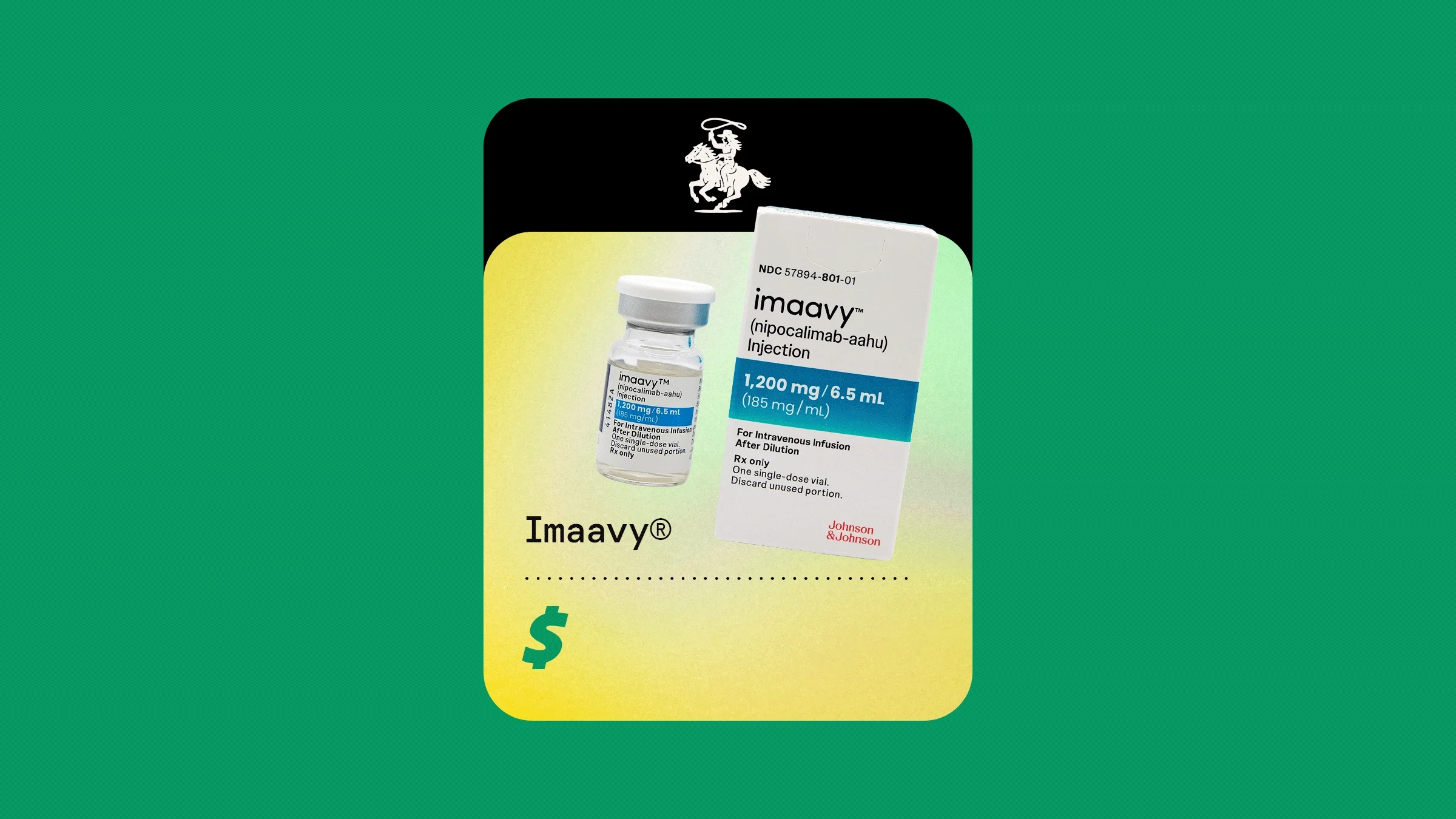
Without insurance or discounts, one 6.5 mL vial of Imaavy (1,200 mg/6.5 mL) may cost at least $12,480. This is the manufacturer’s list price as of April 2025.
Coverage for Imaavy varies widely across insurance types. Your costs may be reduced to as little as $0 per infusion if you qualify for the manufacturer’s savings program.
Save on related medications
Imaavy (nipocalimab) is a prescription-only biologic medication used to treat myasthenia gravis in people ages 12 and older. As part of a class of treatments known as FcRn blockers, it helps decrease levels of antibodies responsible for attacking the neuromuscular junction.
Imaavy is typically given as an IV infusion in a healthcare setting — though, it can be given at home, in some cases — and comes in two vial sizes. The treatment course generally starts with a higher initial dose, followed by lower maintenance doses given every 2 weeks.
Due to the need for special handling and storage, Imaavy is dispensed through specialty pharmacies and received by healthcare professionals or clinics administering the medication. The medication can cost thousands of dollars per vial without health insurance or discounts, and there is no biosimilar (“generic” version) currently available. But you may be able to lower your costs with a GoodRx discount or receive Imaavy for as little as $0 per infusion with the manufacturer’s savings program, if you qualify.
How much does Imaavy cost?
As of April 2025, the manufacturer list price for one 6.5 mL vial of Imaavy (1,200 mg/6.5 mL) is about $12,480.
Your actual costs for Imaavy will depend on several factors, including:
Where you receive your infusions: Because Imaavy is typically administered by a healthcare professional in a medical setting, there is usually an infusion administration fee in addition to the cost of the medication. This amount can differ based on the setting. A hospital outpatient infusion center may charge more than a freestanding infusion clinic or medical office for many reasons, including facility fees. Your costs may also be different if you receive infusions at home.
Pharmacy: If you have insurance, your plan will likely designate which specialty pharmacy you must use, which can affect costs. Your specialty pharmacy will send Imaavy to the healthcare professional or clinic administering the medication.
Insurance coverage: Insurance coverage for Imaavy varies by plan. With insurance, your costs depend on which tier your plan assigns to the medication, plus any deductible, copay, or coinsurance amounts you’re responsible for.
Dosage: Recommended Imaavy dosages are largely based on body weight and whether an initial dose or a maintenance dose is being administered. These factors determine the vial size and number of vials used for each infusion, which affect your total costs.
Discounts: You may pay significantly less for Imaavy if you qualify for the manufacturer’s savings program.
Does insurance cover Imaavy?
Coverage for Imaavy varies by insurance type. About 1 in 3 people enrolled in Affordable Care Act (ACA) marketplace plans have coverage for Imaavy. Prior authorization is common, and some ACA enrollees are required to try other treatments first, a process known as step therapy.
About 4 in 10 people with commercial insurance plans have coverage for Imaavy. Prior authorization is required for about 1 in 3 enrollees, while step therapy is required for about 1 in 5.
Medicare Part D prescription plans rarely cover Imaavy, and prior authorization is generally required when they do. Most Medicare enrollees will have this medication covered by Part B medical insurance.
Most people enrolled in Medicaid have access to coverage for Imaavy, though the majority will need to obtain prior authorization. Some Medicaid plans also require step therapy.
For information on your specific coverage and requirements, check your plan’s list of covered medications, known as your formulary, or contact your insurer directly.
How different insurance plans cover Imaavy
The table below details how various insurance types cover Imaavy, plus whether prior authorization or step therapy may be required.
Insurance type | Enrollees covered for Imaavy (6.5 mL vial of 1,200 mg/6.5 mL intravenous solution) | Enrollees required to get prior authorization | Enrollees required to do step therapy |
33.9% | 31% | 11.6% | |
Commercial plans (excluding ACA plans) | 41.2% | 34.6% | 21.8% |
Medicare (Medicare Advantage and Part D plans)* | 3.5% | 3.5% | 1.7% |
Medicaid, including state-run and managed care plans | 79.6% | 70.1% | 12% |
*Data does not reflect coverage under original Medicare (Part B).
Source: Managed Markets Insight & Technology, LLC™, as of January 10, 2026. (See methodology below.)
Here are some steps to try if your insurance doesn’t cover Imaavy or your out-of-pocket costs are too high:
Check if you’re eligible for the manufacturer’s savings program or patient assistance program. (More details are provided below.)
Talk to your prescriber about alternative medications, such as another FcRn blocker that works similarly to Imaavy to treat your condition. Your plan may cover a different medication in the same class or another option that may lower your out-of-pocket costs.
Ask your health plan to cover Imaavy by submitting a formulary exception. Your prescriber will likely need to provide a letter of medical necessity and other supportive documentation to explain why this medication is needed.
File an appeal with your insurer if your formulary exception request is denied.
Review other health insurance options during open enrollment. You may find a plan that offers better coverage for your medications at a lower cost.
Ways to save on Imaavy
Imaavy can cost thousands of dollars per vial without insurance or discounts. But there are ways to reduce your out-of-pocket expenses whether or not you have insurance. You may even be able to get the medication at no cost. Here are four possible ways to save.
1. See if you qualify for the manufacturer’s savings program
If you qualify for the Imaavy withMe Savings Program, you may pay as little as $0 per infusion of Imaavy.
To be eligible, you must:
Be 12 or older
Have commercial insurance, which includes plans purchased through an ACA health insurance marketplace
Have out-of-pocket costs for Imaavy
Not be enrolled in a federal or state program like Medicare, Medicaid, Tricare, or U.S. Department of Veterans Affairs (VA) healthcare benefits
This program can help with both the cost of Imaavy and certain expenses related to your infusion administration and monitoring. But there are limitations, so it’s important to read and understand every aspect of eligibility. For administration and monitoring expenses, the program provides up to $7,000 per calendar year, though this support is not available for residents of Massachusetts, Minnesota, or Rhode Island.
Some insurance plans use rules known as accumulators or maximizers that limit where and how manufacturer savings are applied with your benefits. If your plan applies these rules or works with a company called SaveOnSP, the assistance you receive through the Imaavy withMe Savings Program may be reduced or you may not be eligible.
To learn more or enroll, visit the program’s website or call 1-844-494-8463.
2. Ask your insurance plan’s preferred specialty pharmacy for assistance
It’s important to note that Imaavy is typically dispensed by specialty pharmacies directly to healthcare professionals and infusion clinics that administer the medication.
If you have insurance that covers Imaavy, your plan’s preferred specialty pharmacy can also help you find financial assistance for the medication. Check with your insurer for a list of preferred specialty pharmacies to find one to handle your medication needs.
3. See if you qualify for a patient assistance program
Imaavy is one of the medications provided by the Johnson & Johnson Patient Assistance Program at no cost for 1 year to people facing affordability challenges. This manufacturer-sponsored program is available to both uninsured and insured consumers. You may be eligible if you:
Live in the U.S., Puerto Rico, or the U.S. Virgin Islands
Are receiving outpatient care from a healthcare professional licensed in the U.S.
Have an income equal to or less than 400% of the federal poverty level
If you have Medicare Part D, you are not eligible for this program if you qualify for the low-income subsidy known as Extra Help.
You may also be able to get help paying for Imaavy through an independent patient assistance program. For instance, the Patient Advocate Foundation’s Co-Pay Relief program has a myasthenia gravis fund that can assist with insurance premiums, as well as deductibles, copays, and coinsurance, for people who qualify based on income and other requirements. The maximum award is $10,000 a year. At publication time, the fund was closed for applications.
4. Tap into your tax-advantaged healthcare account
A health savings account (HSA), a flexible spending account (FSA), or a health reimbursement arrangement (HRA) can help you save on many qualified healthcare expenses, including prescription medications like Imaavy.
Keep in mind that you must use the money in your FSA by the end of the plan year or you’ll lose it, unless your employer offers a grace period or allows you to carry over a portion. HSA funds roll over each year and never expire. HRA carryover rules vary by employer, so check with your benefits administrator to understand how your plan works.
The bottom line
Imaavy (nipocalimab) is a biologic medication used to treat myasthenia gravis. Without insurance or discounts, one 6.5 mL vial of Imaavy (1,200 mg/6.5 mL) may cost at least $12,480. This is the manufacturer’s list price as of April 2025. But what you actually pay for Imaavy will depend on factors like your insurance coverage, your dosage, and where you receive your infusions.
If you have commercial insurance, you may qualify for the manufacturer’s savings program, which could reduce your costs to as little as $0 per infusion. Or you may be eligible to receive Imaavy at no cost for 1 year through the manufacturer’s patient assistance program. You could also reduce your out-of-pocket costs for Imaavy through an independent patient assistance program or by paying for your medication with a tax-advantaged healthcare account.

Why trust our experts?




Methodology
We obtained national prescription coverage data for each medication from Managed Markets Insight & Technology (MMIT). The data reflects health insurance coverage as of January 2026.
We calculated the percentage of enrollees in plans that cover each medication by dividing the number of enrollees covered for the medication within a specific insurance channel (e.g., ACA, Medicare, Medicaid) by the total number of enrollees in all plans within that channel.
We determined the percentage of enrollees in plans with a prior authorization requirement by calculating the proportion of enrollees in plans that required prior authorization for the medication within each channel.
Finally, we measured the percentage of enrollees in plans with a step therapy requirement by calculating the proportion of enrollees in plans that imposed step therapy requirements for the medication in each channel.
These estimates, derived from national MMIT coverage data, provide insight into health insurance coverage for each medication. They take into account restrictions such as prior authorization, step therapy, and quantity limits. The percentages are expressed relative to the total number of enrollees covered by various insurance channels, including ACA plans, commercial (excluding ACA) plans, Medicare, and Medicaid (both state-run and managed care plans).
References
Healthcare.gov. (n.d.). Appealing a health plan decision: Internal appeals.
Healthcare.gov. (n.d.). Federal poverty level (FPL).
Imaavy. (2025). Find an infusion center. Johnson & Johnson.
Imaavy. (2025). Imaavy brochure. Johnson & Johnson.
Imaavy withMe. (2025). Imaavy billing & coding guide. Johnson & Johnson.
Imaavy withMe. (2025). Savings program overview. Johnson & Johnson.
Imaavy withMe. (2026). Commercial or private insurance. Johnson & Johnson.
Imaavy withMe. (2026). Cost support for Imaavy. Johnson & Johnson.
Janssen Biotech. (2025). Imaavy - nipocalimab injection, solution, concentrate [package insert]. DailyMed.
Johnson & Johnson. (2025). Johnson & Johnson Patient Assistance Program: Quick reference guide.
Medicaid.gov. (n.d.). Managed care.
Patient Advocate Foundation Co-Pay Relief. (n.d.). Myasthenia gravis.
Santhosh, C. (2025). US FDA approves J&J's immune disorder drug. Reuters.

