Key takeaways:
Sunscreens can contain mineral ingredients (like zinc oxide), chemical ingredients (like avobenzone), or both to protect your skin from harmful UVA and UVB rays.
Bemotrizinol is the first new sunscreen ingredient approved in the U.S. in over 20 years. It’s a popular and effective sunscreen ingredient that has been used safely in other countries for decades.
Most sunscreen ingredients are generally safe when used as directed. The benefits of daily sunscreen use outweigh the possible risks. Choose an SPF 30+ sunscreen that offers broad-spectrum protection (UVA and UVB).
If sensitive skin is a concern, a mineral sunscreen is your best bet. If you have hyperpigmentation, then choose a tinted sunscreen. Beyond that, the best sunscreen is one that you’ll wear consistently.
You know sunscreen is a must for lowering your risk of skin cancer and photoaging. But when it comes to choosing a sunscreen, what do the many ingredients listed on the packaging mean? Are some sunscreen ingredients better than others? And, how can you know which sunscreen is best for you?
The good news is sunscreen ingredients are safe and effective. Most have been around for decades. But one — bemotrizinol — is brand new to the U.S.
Sunscreen ingredients differ in how they work to protect your skin. But all of them work, and most sunscreens contain more than one ingredient.
Search and compare options
So the best sunscreen for you is the one that you’ll use. Here’s what to know about different sunscreen ingredients, and what to consider when choosing a product.
What are the different types of sunscreen?
Sunscreen ingredients fall into two main types: mineral and chemical. And some products contain a mixture of both. Here’s how each type works:
Mineral sunscreens work by absorbing and reflecting ultraviolet (UV) rays. They’re less likely to irritate skin, but some formulas leave a white cast.
Chemical sunscreens absorb UV rays and convert them to heat. They blend in easily and are lightweight, but can irritate sensitive skin.
Tinted sunscreens aren’t a separate type of sunscreen. Both mineral and chemical sunscreens can come as tinted formulations. Tinted sunscreens contain pigments called iron oxides, which give the sunscreen a tint. In mineral sunscreens, tinted formulations can leave less white cast. Iron oxides also protect against visible light, which can worsen melasma (skin discoloration) and other types of hyperpigmentation.
What are the main ingredients in sunscreen?
All sunscreens have active and inactive ingredients:
Active ingredients are what protect your skin from harmful, cancer-causing UV rays. This includes both UVA (which also causes photoaging) and UVB (which also causes sunburn). Many sunscreens contain more than one active ingredient.
Inactive ingredients are what help stabilize the formula and improve how the sunscreen feels on your skin.
Here’s a closer look at common sunscreen ingredients in the U.S.:
Ingredient | Type | Protects against | Good to know |
|---|---|---|---|
Zinc oxide | Mineral | UVA and UVB | Good for sensitive skin Can leave white cast |
Titanium dioxide | Mineral | UVA and UVB | Good for sensitive skin Can leave white cast |
Avobenzone | Chemical | UVA | Breaks down in sunlight Often paired with other ingredients |
Bemotrizinol | Chemical | UVA and UVB | New to the U.S. Doesn’t break down in sunlight Used abroad for decades |
Ensulizole | Chemical | UVB | Water soluble Used in lightweight and gel formulas |
Homosalate | Chemical | UVB | Usually paired with other filters |
Octinoxate | Chemical | UVB | May be linked to hormone disruption Banned in some reef-protected areas |
Octisalate | Chemical | UVB | Helps stabilize avobenzone |
Octocrylene | Chemical | UVB | Helps stabilize avobenzone |
Oxybenzone | Chemical | UVA and UVB | May be linked to hormone disruption Banned in some reef-protected areas |
What is bemotrizinol?
Bemotrizinol is a chemical sunscreen ingredient that blocks both UVA and UVB rays. It can be combined with other ingredients and, unlike other sunscreens, it doesn’t break down in sunlight. The FDA approved it in 2026, making it the first new sunscreen ingredient approved in the U.S. in more than 20 years.
People in Europe, Australia, and parts of Asia have used bemotrizinol for decades, and it has a lot of safety data behind it. The U.S. took longer to approve it because sunscreens are regulated as over-the-counter (OTC) medications rather than cosmetic products. This makes the approval process slower than in many other countries.
Are there any harmful ingredients in sunscreen?
Several well-designed studies have shown sunscreen to be safe and effective when used as directed. Because of this, major health organizations like the American Academy of Dermatology, the Skin Cancer Foundation, and the FDA recommend sunscreen to protect against UV rays. Sunscreen significantly protects against skin cancer, and this health benefit outweighs any theoretical risks.
Having said that, some sunscreen ingredients have generated some debate, and research on them is ongoing. Here’s what to know:
Possible effects on hormone levels: Some ingredients, like oxybenzone and octinoxate, act like a mild hormone in lab animals and other lab studies. So far, studies haven’t definitively linked them to health problems in humans. However, the European Union has lowered the allowable amounts of some of these ingredients. The American Academy of Pediatrics also recommends that children avoid oxybenzone if possible.
Environmental impact: Oxybenzone and octinoxate have been linked to coral reef damage. For this reason, Hawaii has banned the sale of sunscreens containing these ingredients.
Absorption into the bloodstream: Studies show that some chemical sunscreens can be absorbed into the bloodstream. It’s not clear what effect (if any) this has on your health, but more research is being done.
Inactive ingredients: Some fragrance blends, preservatives, or other inactive ingredients may irritate sensitive skin.
Are there any side effects from using sunscreen?
Most people have no issues using sunscreen. But, side effects can occasionally happen, including:
Skin irritation or itching
Skin redness or discoloration
Some people with sensitive skin find chemical sunscreens more irritating than mineral formulas.
What is the safest sunscreen?
The safest sunscreen is the one that you’ll actually wear. For the best protection, look for one that is:
Broad spectrum (covers both UVA and UVB)
SPF 30 or higher
Water resistant
If you have sensitive skin or are concerned about certain sunscreen ingredients, opt for sunscreens that contain zinc oxide or titanium dioxide. And if you have melasma or dark spots, consider a tinted sunscreen containing iron oxides for added protection from visible light.
Frequently asked questions
For sunscreen to be effective, you have to apply it correctly. Here are some tips to follow:
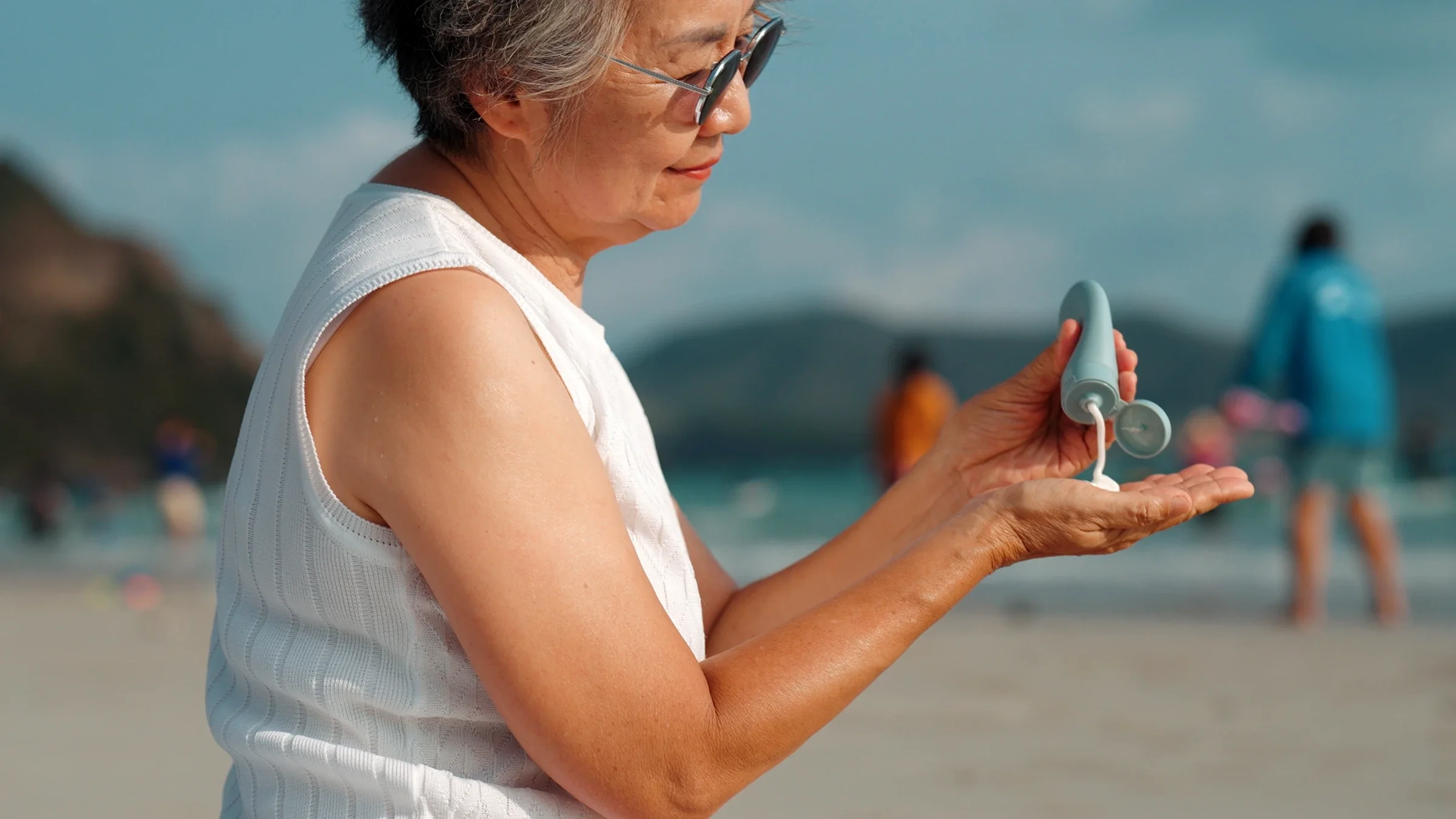
Use about 1 oz (a shot-glass full) of sunscreen lotion to cover your entire body. For spray formulations, keep the bottle close to the skin and spray multiple passes until the skin is covered and moist and then rub it in.
Apply it 15 minutes before going outside.
When outside, reapply sunscreen every 2 hours and after swimming or sweating.
It depends on the age. Babies younger than 6 months should be kept out of direct sunlight. The best sun protection for them is to stick to shade and use protective clothing.
Children older than 6 months can use a broad-spectrum sunscreen. Mineral sunscreens are often preferred because they may be less likely to irritate sensitive skin.
Yes, sunscreen does expire. You shouldn’t use a sunscreen that has passed its expiration date. If there isn’t an expiration date listed, it’s considered expired 3 years after the manufacture date.
SPF (sun protection factor) measures protection against UVB rays, which cause sunburns.The higher the SPF, the higher the protection — but not by much. For example, an SPF 30 blocks about 98% of rays while SPF 100 blocks about 99% of rays. No sunscreen blocks all the sun’s rays.
Broad spectrum means that the product also blocks UVA rays. These rays go deeper into the skin and contribute to skin cancer and photoaging. You want a sunscreen that protects against both UVA and UVB.
For sunscreen to be effective, you have to apply it correctly. Here are some tips to follow:
Use about 1 oz (a shot-glass full) of sunscreen lotion to cover your entire body. For spray formulations, keep the bottle close to the skin and spray multiple passes until the skin is covered and moist and then rub it in.
Apply it 15 minutes before going outside.
When outside, reapply sunscreen every 2 hours and after swimming or sweating.
It depends on the age. Babies younger than 6 months should be kept out of direct sunlight. The best sun protection for them is to stick to shade and use protective clothing.
Children older than 6 months can use a broad-spectrum sunscreen. Mineral sunscreens are often preferred because they may be less likely to irritate sensitive skin.
Yes, sunscreen does expire. You shouldn’t use a sunscreen that has passed its expiration date. If there isn’t an expiration date listed, it’s considered expired 3 years after the manufacture date.
SPF (sun protection factor) measures protection against UVB rays, which cause sunburns.The higher the SPF, the higher the protection — but not by much. For example, an SPF 30 blocks about 98% of rays while SPF 100 blocks about 99% of rays. No sunscreen blocks all the sun’s rays.
Broad spectrum means that the product also blocks UVA rays. These rays go deeper into the skin and contribute to skin cancer and photoaging. You want a sunscreen that protects against both UVA and UVB.
The bottom line
Sunscreen ingredients may have complicated names, but they all serve the same purpose: To protect your skin from harmful UV rays. Mineral and chemical sunscreens are both effective, and newer ingredients like bemotrizinol give people even more comfortable options. Ultimately, the best sunscreen is a broad-spectrum SPF 30 or higher that protects against both UVA and UVB, feels good on your skin, and that you’ll use consistently every day.

Why trust our experts?



References
Abdel Azim, S., et al. (2025). Sunscreens part 1: Mechanisms and efficacy. Journal of the American Academy of Dermatology.
American Academy of Dermatology. (2025). Sunscreen FAQs.
Bain, J. (2025). Sunscreen safety: The facts. Skin Cancer Foundation.
Druml, L., et al. (2023). Sunscreen label marketing towards pediatric populations: Guidance for navigating sunscreen choice. Cureus.
Environmental Working Group. (n.d.). EWG’s 20th annual guide to sunscreens.
Environmental Working Group. (2026). EWG’s 20th annual guide to sunscreens finds market progress, a promising new ingredient but a stubborn UVA protection gap.
Environmental Working Group. (n.d.). The trouble with ingredients in sunscreen.
Godoy, M. (2026). 4 things to know about the new sunscreen ingredient the FDA approved. National Public Radio.
Hawaii’s State Legislature. (2018). SB2571 SD2 HD2 CD1.
Matta, M. K., et al. (2020). Effect of sunscreen application on plasma concentration of sunscreen active ingredients: A randomized clinical trial. JAMA.
National Academies of Sciences, Engineering, Medicine. (n.d.). Environmental impact of currently marketed sunscreens and potential human impacts of changes in sunscreen usage.
Sander, M., et al. (2020). The efficacy and safety of sunscreen use for the prevention of skin cancer. Canadian Medical Association Journal.
Suh, S., et al. (2020). The banned sunscreen ingredients and their impact on human health: A systematic review. International Journal of Dermatology.
Turner, C. W., et al. (2025). Modernizing U.S. sunscreen regulations: How newer filters can improve public health. Photodermatology, Photoimmunology & Photomedicine.
U.S. Food and Drug Administration. (2026). FDA expands sunscreen options for the first time in 20 years.
U.S. Food and Drug Administration. (2024). Should you put sunscreen on infants? Not usually.
U.S. Food and Drug Administration. (2026). Sunscreen: How to help protect your skin from the sun.
Wadyka, S. (2019). What you need to know about sunscreen ingredients. Consumer Reports.
Wang, S. Q. (2026). Ask the expert: Does a high SPF protect my skin better? Skin Cancer Foundation.