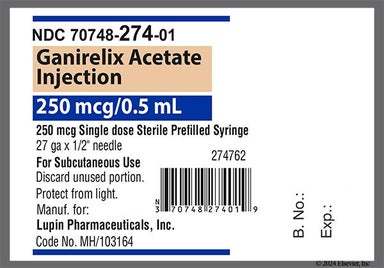
Ganirelix (Fyremadel) is an injection that's given on certain days during the in vitro fertilization (IVF) process for people who have a hard time becoming pregnant. This medication is a gonadotropin-releasing hormone (GnRH) antagonist. It prevents your eggs from being released too soon before the egg retrieval step. Ganirelix (Fyremadel) is injected under the skin once daily during a certain number of days of the IVF cycle. Potential side effects include stomach pain, headache, and redness and swelling at the injection site.
Ganirelix (Fyremadel) is a gonadotropin-releasing hormone (GnRH) antagonist. It blocks GnRH, a hormone in the body that typically plays a role in preparing your body for ovulation (the release of an egg from your ovary). By blocking GnRH, ganirelix (Fyremadel) temporarily delays ovulation. This prevents the ovary from releasing eggs too soon before the egg retrieval procedure.
The following side effects may get better over time as your body gets used to the medication. Let your healthcare provider know immediately if you continue to experience these symptoms or if they worsen over time.
Contact your healthcare provider immediately if you experience any of the following.
Along with its needed effects, a medicine may cause some unwanted effects. Although not all of these side effects may occur, if they do occur they may need medical attention.
Check with your doctor immediately if any of the following side effects occur:
Some side effects may occur that usually do not need medical attention. These side effects may go away during treatment as your body adjusts to the medicine. Also, your health care professional may be able to tell you about ways to prevent or reduce some of these side effects. Check with your health care professional if any of the following side effects continue or are bothersome or if you have any questions about them:
Other side effects not listed may also occur in some patients. If you notice any other effects, check with your healthcare professional.
Call your doctor for medical advice about side effects. You may report side effects to the FDA at 1-800-FDA-1088.
No. Keep ganirelix (Fyremadel) at room temperature (between 68 and 77 degrees Fahrenheit). It's okay if the medication is kept at a temperature slightly above or below this range. But tell your pharmacist or prescriber if it's exposed to temperatures below 59 degrees Fahrenheit or above 86 degrees Fahrenheit. You'll probably need to get a new set of medication to make sure it's safe for you to use.
One small study showed that ganirelix (Fyremadel) delayed ovulation by at least 1 week during a cycle of IVF. Keep in mind that this can be different for everyone. So speak to your fertility specialist about what to expect with your treatment.
No. Ganirelix (Fyremadel) and cetrorelix (Cetrotide) are both GnRH antagonists that can be used during the IVF process to prevent ovulation before the egg retrieval procedure. They're both injections that are given under the skin at home after proper training. But you store ganirelix (Fyremadel) at room temperature and you must keep cetrorelix (Cetrotide) in the refrigerator. Talk to your fertility specialist to learn more about comparisons between the two medications.
A small study found that ganirelix (Fyremadel) starts to work within hours of injecting the medication to lower the levels of the hormones that play a role in ovulation.
How long the effects of ganirelix (Fyremadel) last will depend on each individual person. But a small study showed that the levels of the hormones that play a role in ovulation returned to pretreatment levels within 2 days of the last injection.
Ganirelix (Fyremadel) lasts for about 3 days in your system after you stop taking it. This is based on the medication's half-life, or how long it takes for half the amount of medication to leave the body. Follow up with your prescriber if you have concerns about how long the medication stays in your system.
Because ganirelix (Fyremadel) is injected under the skin, you might experience injection site reactions. These can include redness, swelling, and pain at and near the area where you inject the medication. Additionally, people reported stomach pain as a side effect during clinical studies. Tell your prescriber if you're having any bothersome side effects from ganirelix (Fyremadel).
Your fertility specialist will give you instructions on where to inject ganirelix (Fyremadel). It's generally recommended to inject the medication under the skin on your stomach (at least 2 inches away from your belly button) or on your upper thigh. Make sure to choose a different injection site each time to let your skin heal.
Ganirelix (Fyremadel) can cause some serious health issues. This risk may be even higher for certain groups. If this worries you, talk to your doctor or pharmacist about other options.
Severe allergic reactions to ganirelix (Fyremadel) are possible, including life-threatening problems like anaphylaxis (closing of the throat). Get medical help right away if you notice hives, rash, swelling of the lips or tongue, or difficulty breathing after you take ganirelix (Fyremadel).
Some ganirelix (Fyremadel) products have a needle shield that contains natural rubber latex. If you have a latex allergy, you might have a higher risk of having an allergic reaction when you use ganirelix (Fyremadel). Let your prescriber know if you're allergic to latex before you start your injections. They might want you to inject the medication for the first time at their office in case you have a reaction to it.
You shouldn't take ganirelix (Fyremadel) if you're pregnant because the medication can cause harm to unborn babies if it's given during pregnancy. Because of this risk, your prescriber might ask you to take a pregnancy test before you start any fertility medications to make sure you're not pregnant. Tell your fertility specialist right away if you become pregnant during treatment with ganirelix (Fyremadel).
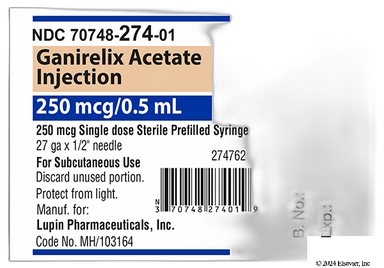
| Dosage | Quantity | Price as low as | Price per unit |
|---|---|---|---|
| 250mcg/0.5ml | 5 syringes | $155.03 | $31.01 |
The typical dose is 250 mcg (the amount of medication in 1 prefilled syringe) injected under the skin once a day during a certain period of time in your IVF cycle. Your fertility specialist will tell you when to start and stop taking this medication.
Although certain medicines should not be used together at all, in other cases two different medicines may be used together even if an interaction might occur. In these cases, your doctor may want to change the dose, or other precautions may be necessary. Tell your healthcare professional if you are taking any other prescription or nonprescription (over-the-counter [OTC]) medicine.
Contraindications are specific health conditions or situations in which a person should not take a medication due to safety concerns. If you have any of the following conditions or if any of the following apply to you, let your healthcare provider know because Ganirelix (Fyremadel) will not be safe for you to take.