Key takeaways:
If you’re dealing with menopause symptoms, estrogen patches can help. Some are applied once weekly, while others are applied twice a week. Climara, Menostar, and Vivelle-Dot are three popular examples.
You may notice an improvement in your menopause symptoms in as little as 2 weeks after starting an estrogen patch.
Estrogen patches provide better estrogen absorption and steadier estrogen levels in the body compared to estrogen tablets. The patches also have a lower risk of blood clots. Estrogen patches can still cause side effects, though, such as nausea, back pain, and mood changes.
There are ways to save on estrogen patches. Many are available as lower-cost generics. GoodRx can help make your prescription more affordable.
Save on related medications
Menopause is a natural part of getting older, but the changes it brings can be uncomfortable. As hormone levels change, it’s common to experience symptoms such as hot flashes, sleeping troubles, and mood swings. Some women may also experience low sex drive (libido) and other vaginal-related symptoms, such as painful sex from vaginal dryness.
These menopause symptoms may go away over time without any medication. But if you’re experiencing discomfort, there are several treatments to help relieve your symptoms, including an estrogen patch.
If you’ve had a hysterectomy (surgical removal of the uterus), an estrogen patch is a potential option for you. Women with uteruses can also use them if they take a progesterone product at the same time. Here, we’ll discuss estrogen patches — their benefits, how the patches work, and possible side effects.
Search and compare options
7 top benefits of estrogen patches
Estrogen patches can make life a little easier for women who need relief from various menopause symptoms. These are some of the top benefits of estrogen patches compared to other estrogen products, namely estrogen tablets:
Systemic benefits: Estrogen patches can help with symptoms that affect your whole body, while vaginal estrogen works on symptoms in one area.
Better estrogen absorption: When you take an estrogen tablet by mouth, your liver and intestines break down some of the medication before the body can absorb any estrogen into the bloodstream. An estrogen patch skips this step, resulting in your body being able to absorb more estrogen directly through the skin.
Steady estrogen levels in the body: The patches generally keep estradiol levels steadier than tablets. Estradiol is the main natural estrogen used in all patches.
Fewer side effects: Some data shows that vaginal estrogen tablets may cause more side effects than estrogen patches, such as breast pain and fatigue.
Less estradiol to estrone conversion: Compared to oral tablets, estrogen patches have a lower risk of converting estradiol to estrone. Higher amounts of estrone are linked to cancer growth of the breast and endometrium (uterus lining).
Less negative impact on triglycerides: Triglycerides are a type of fat in the blood, and having high levels can raise your risk of heart disease. Oral estrogen can increase triglycerides by making the liver produce more VLDL, a particle that carries fat in the blood. Estrogen patches bypass the intestines and liver, so they don’t raise triglycerides as much.
Lower clotting risk: Compared to oral estrogen tablets, estrogen patches might have a lower risk of venous thromboembolism (VTE), which occurs when there is a blood clot in the veins.
How does an estrogen patch work?
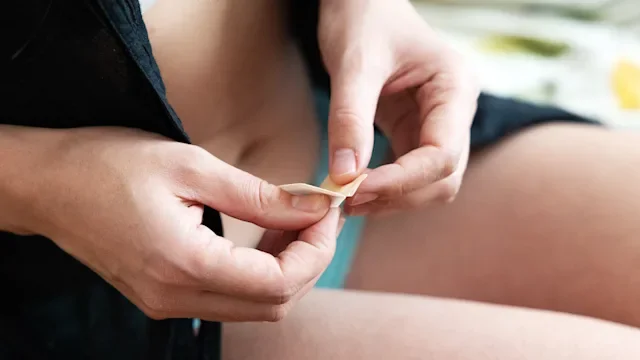
Estrogen patches are typically made up of three layers:
Backing: This is the outer layer you see when the patch is on the skin.
Adhesive: This layer contains the active ingredient, estradiol, as well as inactive ingredients that help the patch operate and stick to your skin.
Protective liner: You’ll need to remove this layer from the adhesive in order to use the patch.


When you remove the protective liner and place the patch on your skin, it continuously releases estradiol, which your skin absorbs and then passes into your bloodstream.
Some patches are designed to slowly release medicine over 7 days; they’re considered once-weekly patches. Other patches release estradiol over a period of 3 to 4 days and need to be changed more often. These are called twice-weekly patches. Depending on its type — once-weekly or twice-weekly — an individual estrogen patch will last anywhere from 3 to 7 days.
How long does it take for an estrogen patch to start working?
You might notice some improvement in your menopause symptoms after 2 weeks of treatment with an estrogen patch. But this can vary from person to person, and the specific patch and dosage you use may also make a difference.
What are some common estrogen patch brands?
The following are some common estrogen patch brands:
All of these estrogen patches — except Menostar — are FDA approved to treat menopause symptoms and prevent osteoporosis after menopause. Menostar is only approved to prevent postmenopausal osteoporosis. Osteoporosis is a medical condition that causes weak bones.

Could it be menopause? Learn about the signs and symptoms that women tend to experience when they enter menopause.
Prioritizing self-care: Discover tips and tricks that can help you feel your best during menopause.
Have old patches? Pharmacists instruct how to safely dispose of them.
Saddle up for savings: Read our GoodRx guide on how to save on various menopause treatments.
Climara, Dotti, and Vivelle-Dot are also approved to treat low estrogen due to ovary impairment or ovary removal.
Types of estrogen patches
There are two main types of estrogen patches: once-weekly or twice-weekly patches.
Once-weekly estrogen patches
There are a couple of patches available that you can apply and remove every 7 days.
Climara: Climara and its generic equivalent come in six different doses. They range from 0.025 mg/24hr to 0.1 mg/24 hr. You can apply Climara on the lower part of the stomach below the belly button or the upper part of the buttocks.
Menostar: Menostar only has one dose, which is 14 mcg/24 hr. You can place the Menostar patch on the lower part of the stomach, below the belly button.
Twice-weekly estrogen patches
There are a few twice-weekly patches available:
Lyllana
Minivelle
Vivelle-Dot
Dotti
In general, you can place a twice-weekly patch on your lower stomach area (below the level of your belly button) or on your upper buttocks. All twice-weekly patches are available as the five same doses. The lowest dose is 0.025 mg/24hr, and the highest dose is 0.1 mg/24 hr.
Combination estrogen patches
Estrogen patches can raise the risk of uterine (endometrial) cancer when they’re used by themselves. So, if you have a uterus, you’ll likely need to take a progestogen (a compound that’s similar to progesterone) along with your estrogen to lower the risk of uterine cancer.
If you don’t want to use two separate products, you can use a topical patch that contains both an estrogen and a progestogen. The main differences between these products are the type of progestogen they use and how often you need to apply a new patch:
Climara Pro (estradiol / levonorgestrel), a once-weekly patch
CombiPatch (estradiol / norethindrone), a twice-weekly patch
How long can a woman stay on an estrogen patch?
In general, it’s recommended to use the lowest dose of estrogen for the shortest amount of time possible. This timeframe will be different for everyone. Some women only need to use an estrogen patch for a few months to alleviate symptoms, while others may need to use them for years to manage their symptoms.
You can keep receiving the patch as long as the benefits of using the patch outweigh the risks. For this reason, frequent check-ins with a healthcare professional are recommended while using an estrogen patch.
Estrogen patch side effects
Relatively common side effects of estrogen patches include:
Back pain
Breast pain and tenderness
Changes in vaginal discharge or fluids
Headache
Indigestion
Mood changes
Nausea
Rare but serious estrogen patch side effects that warrant immediate medical care include:
Abnormal vaginal bleeding
Chest pain
New breast lumps
Severe leg pain
Increased blood pressure
Shortness of breath
Sudden and new severe headaches that won’t go away
Vision or speech changes
Intense stomach pain
Estrogen patches may also have other possible side effects. For additional information about a specific estrogen patch’s side effects, talk with a healthcare professional.
Keep in mind: Weight gain is a common concern people have with estrogen patches. Although some people might experience weight gain while using estrogen patches, it isn’t a typical side effect.
How to save on estrogen patches
There are many ways to save on estrogen patches. GoodRx can help you navigate your options, which may include GoodRx discounts, copay savings cards, and patient assistance programs. You can find estrogen patches for as low as $28 with a free GoodRx discount.
Frequently asked questions
The choice between a vaginal cream and a patch depends on your symptoms. If you’re mostly experiencing symptoms specific to the vagina, such as vaginal dryness — the vaginal cream is a good option. But if you’re having symptoms that aren’t specific to one area (such as hot flashes or mood swings), you may want to consider using a patch. The patch can provide medication to multiple parts of your body.
The estrogen patch dose you’ll need depends on the patch you’re prescribed, what you’re using it for, and how severe your symptoms are. But it’s recommended to use the lowest effective dose to treat your symptoms. A healthcare professional can help you choose the right patch and dose for your needs.
It depends. Once you start using an estrogen patch, your prescriber will likely want to see you regularly, typically every 3 to 6 months. During each of your office visits, you and your prescriber will decide how to proceed with your estrogen treatment. If the choice is to stop the estrogen patch, stopping the medication cold turkey is OK. For some people, however, it's better to slowly lower the dose over time. A healthcare professional can help you choose the safest approach for you.
The choice between a vaginal cream and a patch depends on your symptoms. If you’re mostly experiencing symptoms specific to the vagina, such as vaginal dryness — the vaginal cream is a good option. But if you’re having symptoms that aren’t specific to one area (such as hot flashes or mood swings), you may want to consider using a patch. The patch can provide medication to multiple parts of your body.
The estrogen patch dose you’ll need depends on the patch you’re prescribed, what you’re using it for, and how severe your symptoms are. But it’s recommended to use the lowest effective dose to treat your symptoms. A healthcare professional can help you choose the right patch and dose for your needs.
It depends. Once you start using an estrogen patch, your prescriber will likely want to see you regularly, typically every 3 to 6 months. During each of your office visits, you and your prescriber will decide how to proceed with your estrogen treatment. If the choice is to stop the estrogen patch, stopping the medication cold turkey is OK. For some people, however, it's better to slowly lower the dose over time. A healthcare professional can help you choose the safest approach for you.
The bottom line
If menopause symptoms are affecting your daily life, estrogen patches can help provide some relief. Some popular twice-weekly patches are Vivelle-Dot and Lyllana. Climara and Menostar patches only need to be changed once a week. Estrogen patches are effective but may cause side effects. Talk with a healthcare professional to decide if an estrogen patch is a good option for you.

Why trust our experts?




References
Amneal Pharmaceuticals. (2024). Dotti- estradiol patch, extended release [package insert].
Baracat, E., et al. (1996). Comparative bioavailability study of an once-a-week matrix versus a twice-a-week reservoir transdermal estradiol delivery systems in postmenopausal women. Maturitas.
Bayer HealthCare Pharmaceuticals. (2023). Climara- estradiol patch [package insert].
Bayer HealthCare Pharmaceuticals. (2023). Menostar- estradiol patch [package insert].
Castelo-Branco, C., et al. (2014). Clinical efficacy of estradiol transdermal system in the treatment of hot flashes in postmenopausal women. Research and Reports in Transdermal Drug Delivery.
Centers for Disease Control and Prevention. (2025). About venous thromboembolism (blood clots).
Hill, D. A., et al. (2016). Hormone therapy and other treatments for symptoms of menopause. American Family Physician.
Kopper, N. W., et al. (2009). Transdermal hormone therapy in postmenopausal women: A review of metabolic effects and drug delivery technologies. Drug Design, Development and Therapy.
MedlinePlus. (2025). Uterus.
Office on Women’s Health. (2025). Menopause treatment. U.S. Department of Health and Human Services.
Rodrigues, A. C., et al. (2019). Estrogen signaling in endometrial cancer: A key oncogenic pathway with several open questions. Hormones & Cancer.
ScienceDirect. (n.d.). Ovary.
The American College of Obstetricians and Gynecologists. (2024). Postmenopausal estrogen therapy route of administration and risk of venous thromboembolism.
van Seumeran, I. (2000). Weight gain and hormone replacement therapy: Are women's fears justified? Maturitas.